Structured Manufacturing Data (2026)

Insulated Tunnel Casing

Based on aggregated insights from structured factory profiles within the CNFX directory, the standard Insulated Tunnel Casing used in the Machinery and Equipment Manufacturing sector typically supports operational capacities ranging from standard industrial configurations to heavy-duty production requirements.

Technical Definition & Core Assembly

A canonical Insulated Tunnel Casing is characterized by the integration of Outer Shell and Insulation Layer. In industrial production environments, manufacturers listed on CNFX commonly emphasize Stainless steel construction to support stable, high-cycle operation across diverse manufacturing scenarios.

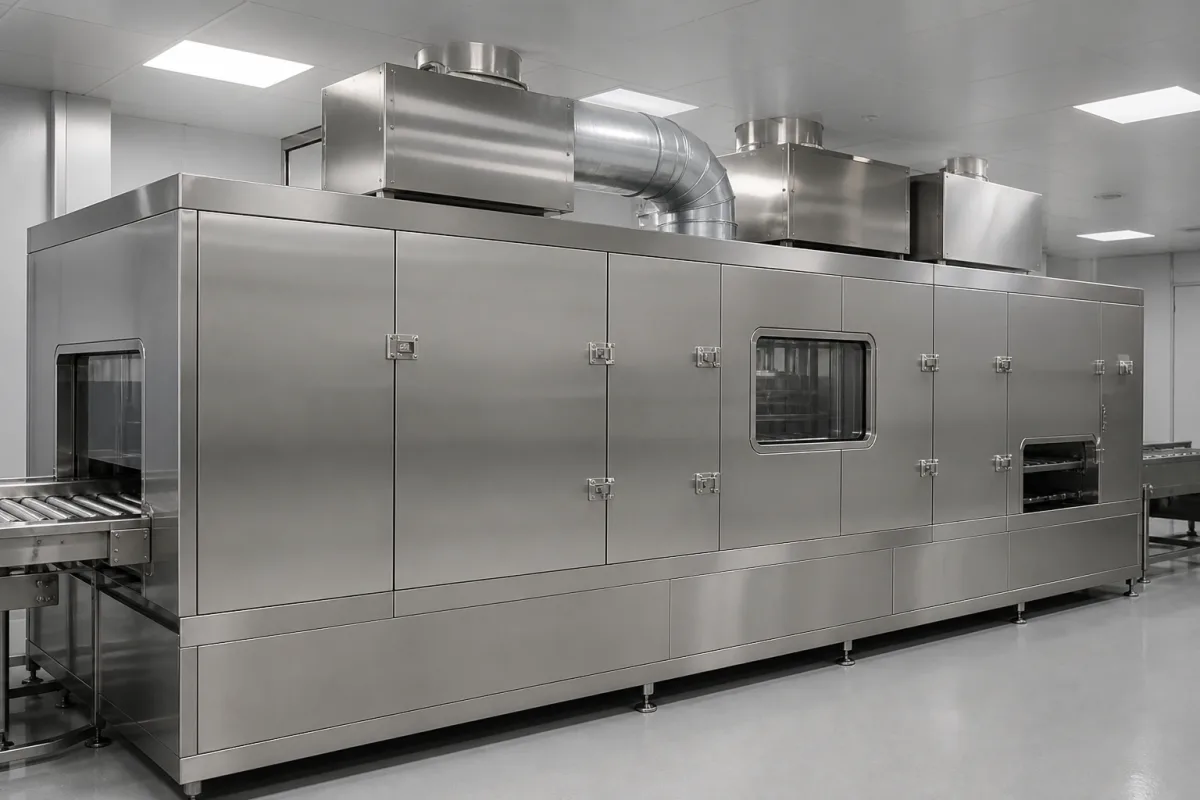
The insulated enclosure that forms the main structure of a sterile air drying tunnel, providing thermal insulation and containment.
Product Specifications

Technical details and manufacturing context for Insulated Tunnel Casing

Definition
The insulated tunnel casing is the structural component of a sterile air drying tunnel that houses the drying process. It creates a sealed, thermally insulated environment where controlled air flow and temperature conditions can be maintained to efficiently dry products while preventing contamination and heat loss.
Working Principle
The casing provides a sealed, insulated chamber where heated, sterile air circulates to remove moisture from products. Its insulation minimizes heat transfer to the external environment, maintaining consistent internal temperatures for efficient drying while reducing energy consumption.
Common Materials
Stainless steel, Insulation material (mineral wool or ceramic fiber), Sealing gaskets
Technical Parameters
  • Wall thickness including insulation layer (mm) Customizable
Components / BOM
  • Outer Shell Part
    Provides structural integrity and external protection
    Material: Stainless steel
  • Insulation Layer Part
    Minimizes heat transfer to maintain internal temperature
    Material: Mineral wool or ceramic fiber
  • Inner Liner Part
    Creats smooth internal surface for air flow and easy cleaning
    Material: Stainless steel
  • Sealing System Part
    Ensures airtight connection between casing sections
    Material: Silicone or high-temperature gaskets
  • Access Doors
    Allow maintenance access while maintaining seal integrity
    Material: Stainless steel with insulation

Industry Taxonomies & Aliases

Commonly used trade names and technical identifiers for Insulated Tunnel Casing.

Applied To / Applications

This component is essential for the following industrial systems and equipment:

Industrial Ecosystem & Supply Chain Structure

Complementary Systems
Downstream Applications
Specialized Tooling

Application Fit & Sizing Matrix

Operational Limits
pressure: Atmospheric to 0.5 bar gauge (positive pressure), -0.2 bar gauge (negative pressure)
other spec: Air flow rate: 0.5-5 m/s, Slurry concentration: ≤15% solids by weight, Humidity: 0-100% RH (non-condensing)
temperature: -40°C to 200°C (continuous), up to 250°C (intermittent)
Media Compatibility
✓ Sterile air streams ✓ Pharmaceutical powder drying processes ✓ Food-grade drying applications
Unsuitable: Corrosive chemical vapor environments (e.g., chlorine, strong acids)
Sizing Data Required
  • Required tunnel length for residence time
  • Maximum product throughput (kg/hr)
  • Required air velocity and temperature profile

Reliability & Engineering Risk Analysis

Failure Mode & Root Cause
Thermal degradation of insulation
Cause: Excessive operating temperatures exceeding insulation material limits, leading to loss of thermal efficiency and potential casing distortion
Moisture ingress and corrosion
Cause: Breaches in casing seals or insulation cladding allowing environmental moisture penetration, causing corrosion of internal components and insulation breakdown
Maintenance Indicators
  • Visible hot spots or thermal imaging anomalies on casing surface indicating insulation failure
  • Audible hissing or whistling sounds suggesting air leaks through compromised seals or casing joints
Engineering Tips
  • Implement regular infrared thermography surveys to detect early-stage insulation degradation before complete failure
  • Establish proactive seal integrity testing and replacement schedule based on operating cycles rather than calendar time

Compliance & Manufacturing Standards

Reference Standards
ISO 1461:2009 - Hot dip galvanized coatings on fabricated iron and steel articles ASTM A36/A36M - Standard Specification for Carbon Structural Steel CE Marking - EU Construction Products Regulation (CPR) 305/2011
Manufacturing Precision
  • Wall Thickness: +/-0.5mm
  • Length: +/-2mm per meter
Quality Inspection
  • Ultrasonic Thickness Testing
  • Thermal Conductivity Verification Test

Factories Producing Insulated Tunnel Casing

Manufacturer profiles with relevant production capability in China

Manufacturer listings support early research and capability understanding. They are not certification, ranking, or transaction guarantees.

Technical documentation
4/5
Manufacturing capability
4/5
Inspection readiness
5/5
Supplier transparency
3/5

These scores are example evaluation dimensions, not real customer ratings, country-specific buyer feedback, or live inquiry activity.

Supply Chain Compatible Machinery & Devices

Hydraulic Press

Industrial machine using hydraulic pressure to compress, form, or assemble materials

Explore Specs →
Heavy-Duty CNC Plasma Cutting Machine

Industrial machine for precision metal cutting using plasma arc technology

Explore Specs →
Automated Assembly Line System

Integrated production system for sequential component assembly operations

Explore Specs →
Automated Powder Coating System

Integrated industrial system for applying dry powder coatings to metal substrates.

Explore Specs →

Frequently Asked Questions

What materials are used in insulated tunnel casings for sterile air drying applications?

Our insulated tunnel casings feature stainless steel construction with mineral wool or ceramic fiber insulation layers, plus durable sealing gaskets for optimal thermal containment and hygiene.

How does the insulation in tunnel casings improve drying tunnel efficiency?

The insulation layer (mineral wool or ceramic fiber) minimizes heat loss, maintains consistent temperatures within the sterile drying tunnel, reduces energy consumption, and ensures uniform product drying.

What components are included in a complete insulated tunnel casing system?

A complete system includes the outer shell, inner liner, insulation layer, sealing system, and access doors - all designed for easy maintenance and long-term durability in industrial environments.

Can I contact factories directly on CNFX?

CNFX is an open directory, not a transaction platform. Each factory profile provides direct contact information and production details to help you initiate direct inquiries with Chinese suppliers.

Data Basis

CNFX manufacturer profiles, technical classification, publicly available product information, and ongoing plausibility checks.

Preliminary Technical Classification
This page supports structured research, RFQ preparation, and supplier evaluation. It does not replace buyer-led supplier qualification, standards review, or technical approval.

Request Manufacturing Insight for Insulated Tunnel Casing

Ask for use case, specification boundaries, supplier type, and RFQ preparation information for Insulated Tunnel Casing.

Your business information is used only to process this request.

Thank you! Your message has been sent. We'll respond within 1–3 business days.

Need to Manufacture Insulated Tunnel Casing?

Compare manufacturer profiles with relevant product and process capability.

Create Manufacturer Profile Contact Us
Previous Product
Insulated Enclosure
Next Product
Insulated Tunnel Housing