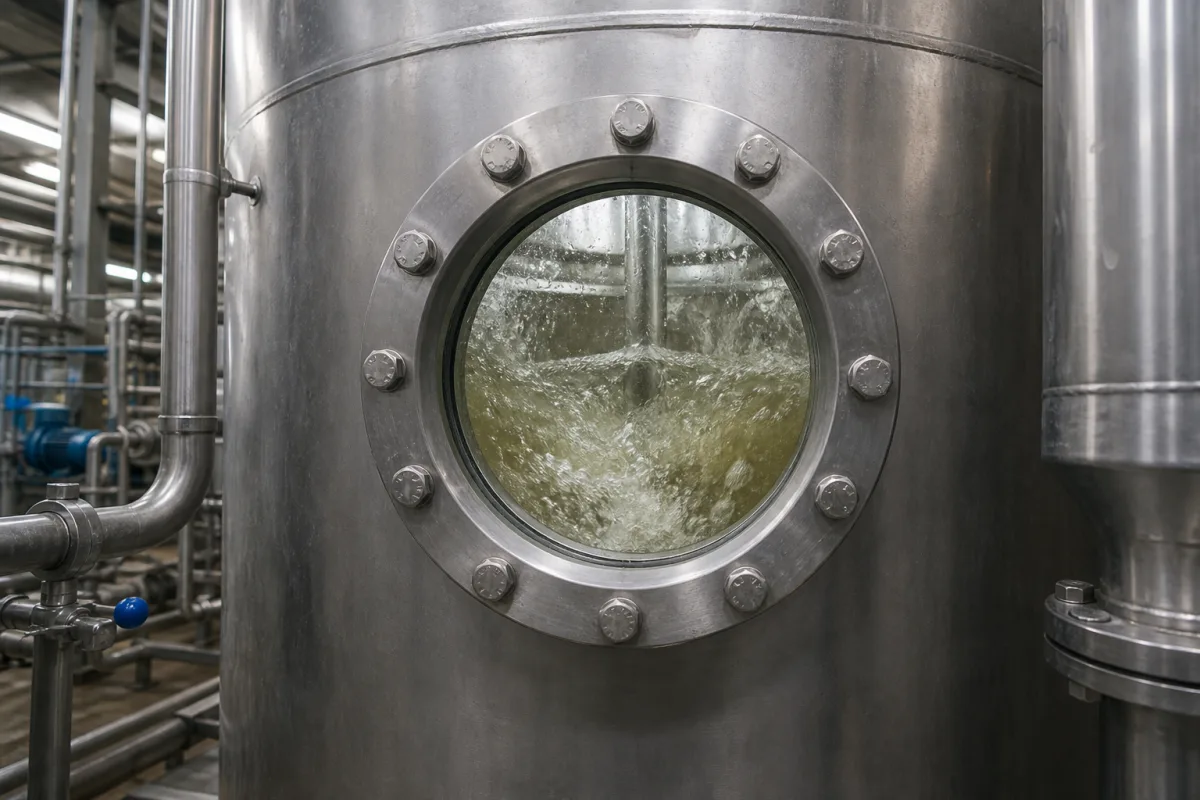
Observation window for hot alkaline and steam service: how fast the glass erodes, and when to fit a mica disc or FEP screen on the media side
Vessel sight glasses in hot alkaline liquor, hot water and steam · glass loss per month, mica discs, FEP screens and oxide coatings, replacement intervals
In acid or neutral process liquids a borosilicate observation window can stay clear for years. Put the same window on a vessel holding hot caustic liquor, alkaline boiler water or saturated steam and the medium dissolves the inner face of the glass, so the disc gets thinner, hazier and weaker while it is in service. This page is about that service: how much glass is lost and how fast, which protective layer goes between the glass and the medium, the temperature each arrangement is rated for, and how to tell when the window has to come out.
Bolted round and oval observation windows (sight-glass fittings with a glass disc between gaskets) on vessels, boilers and tanks containing hot alkaline solutions, hot water or steam, where the medium erodes the glass: published glass-loss rates, mica discs, FEP screens and oxide coatings on the media side, temperature and pressure limits with and without protection, and replacement. Feed frames, paddle wheels and seals for rotary tablet presses are covered on the Pharmaceutical tablet press feed frame page. Choosing glass type, fitting standard, shape, lighting and fused versus gasketed construction for general process duty is covered on the Sight glass assembly and Viewing port pages; magnetic, tubular and glass level gauges on the Level gauge page.
CNFX editorial research · Sources checked October 13, 2026 · 5 sources
Millimetres of borosilicate lost per month at pH 10 and 170–225 °C
Ebora Process Automation, which supplies sight glass fittings, writes that hardened borosilicate glass in a medium at 170 °C and pH 10 erodes by 0.2 mm a month, about 2.4 mm in a year, and gives 8.4 mm for the same glass at 200 °C. It says glass erodes faster above pH 7, because it resists acids well but alkalis less. [1]
A Schott patent on corrosion-resistant boiler sight glasses reports a harsher autoclave test: at 225 °C, 25 bar and pH 10, unprotected high-resistance borosilicate glass became 0.6 mm thinner in 70 hours, while a tin oxide (SnO₂) layer on the inner face prevented glass corrosion for at least those 70 hours. [5] Editorial calculation: 0.6 mm in 70 hours is about 0.0086 mm per hour, or roughly 6 mm over a 720-hour month if the rate held, some 30 times Ebora's 0.2 mm per month at 170 °C. The two figures come from different temperatures, pressures and test methods, so treat them as a range that shows how steeply loss rises with temperature, not as one curve.
Continental Trade, which sells mica shields and gauge glasses, describes the mechanism in steam boilers: mineral deposits crystallise on the glass and attack it, more so at higher temperature and pressure and depending on the pH of the water; the glass becomes tarnished and thinner, which reduces its strength and can lead to dangerous failure. It says losses for unprotected glass, depending on the pH and temperature of the boiler water, can reach millimetres per month. [3]
Give the window supplier the medium, its pH, the maximum temperature and pressure at the window, whether it is liquid, steam or both, and how long the window must stay in service between shutdowns.
02
Mica disc, FEP screen or tin oxide layer between the glass and the medium
ACI's PN 25 oval sight glass fitting, Type 337, shows how protection changes the rating of the same fitting. With borosilicate glass to DIN 7081 it is rated to 243 °C in saturated steam or hot water, to 280 °C where no technically significant glass attack occurs, and to 320 °C for transparent glass with mica protection, all at up to 25 bar(g). ACI offers an FEP protective screen or FEP coating for higher pH values and says mica lenses should be used with aggressive media or steam. [2]
Continental Trade says a mica shield should be mandatory where steam pressure exceeds 40 bar and temperature exceeds 200 °C. It supplies shields cut from natural muscovite mica in standard thickness bands from 0.10–0.15 mm up to 0.30–0.40 mm, grades mica by the visual categories of ASTM D351 (V-1 clear being the best), and warns that the layers must never be split, because the naturally bonded layers are what keep the shield tight. [3]
The Schott patent notes the limits of each protective route as they stood when it was filed: mica protects only within limits that depend on the quality of the deposit it came from, optical-grade mica had become scarce and expensive, and plastic layers on the glass were limited to about 200 °C and could peel off under vapour diffusion and strong flow at the window. [5]
Layer on the media side
What the source says about it
Limit stated
None (borosilicate only)
Rated for saturated steam or hot water at a lower temperature than with mica. [2]
243 °C steam/hot water; 280 °C without significant attack [2]
Mica disc
Placed between media-side gasket and glass; cannot be used with reflex glass, as it stops the prisms reflecting. [2]
State on the order which side of the glass faces the medium, whether a mica disc or FEP screen is to be fitted there, and whether the glass is transparent or reflex, since reflex glass cannot take a mica disc.
03
Borosilicate or aluminosilicate behind mica: 313 °C at 100 bar against 400 °C at 220 bar
For the modular viewing ports of high-pressure level indicators, in which each port holds a glass, a mica shield and a set of seals and springs in a heavy housing, Continental Trade lists borosilicate glass for saturated steam or alkaline media at up to 313 °C and 100 bar, and aluminosilicate glass at up to 400 °C and 220 bar, with a mica shield required in both cases. In non-aggressive media up to 36 °C it gives a permissible pressure of 340 bar for either glass. [4]
The same supplier states that the mica shield is not a permanent protection: continuous exposure to hot, high-pressure water also corrodes the mica, at a rate much lower than that of glass and higher at higher temperature. [4] Editorial note: these ratings belong to compact high-pressure ports, not to a large observation window on a vessel shell; a bigger glass in the same conditions is rated lower, so use them to see the gap between glass types, and take the actual rating from the window maker for the size you are buying.
04
White or opaque glass, six-month changes and keeping a spare disc
Continental Trade's instruction for steam-service viewing ports is to replace the mica, gasket and glass assembly immediately when the glass turns white or opaque, warning that failure to do so can end in the glass breaking and a violent discharge of high-velocity steam; it recommends a preventive schedule that replaces the assembly before the mica shield is dissolved. [4]
Ebora's rough guide, to be agreed with the window maker, is to replace a sight glass used under extreme conditions every six months and one in normal conditions every two years, and to order a spare glass with the fitting so that it is on the shelf when needed. [1] ACI adds that after the base frame is welded into the vessel the sealing face must be checked for warping and reworked if needed, that the specified bolt torques must be followed, and that the fitting's pressure rating does not cover the base flange, which has to be verified with the vessel under AD 2000 leaflet B9 or an equivalent code. [2]
Editorial calculation: at Ebora's 0.2 mm a month, a six-month change removes the disc after about 1.2 mm of loss; at the 2.4 mm a year it gives for the same conditions, a two-year interval would allow about 4.8 mm, which is why the shorter interval is attached to extreme service.
05
Medium and service data for a protected observation window
Paste it into your enquiry below or into an email to a maker, then replace every bracket.
Medium: [liquor, boiler water or steam; pH; solids or deposits]
Conditions at the window: [maximum temperature; pressure; vacuum]
Window: [round or oval; glass size; transparent or reflex]
Glass: [borosilicate to DIN 7080/7081; aluminosilicate]
Protection: [mica disc; FEP screen or coating; none]
Fitting: [weld-in or weld-on base frame; frame material; gaskets]
Service: [planned replacement interval; spare glass and mica kits]
Explore company information and manufacturing capabilities, then discuss the scope of your project with a relevant supplier.
Share this page
Compiled and source-reviewed by the CNFX editorial team.
Each manufacturer above links to the page on that company's own website where the product is listed, with the date we checked it. How we source and review
· Page last updated 13 October 2026
Buyer questions
How fast does a borosilicate sight glass erode in hot alkaline liquid?
Ebora gives 0.2 mm a month at 170 °C and pH 10; a Schott patent test measured 0.6 mm in 70 hours at 225 °C, 25 bar and pH 10. [1][5]
What temperature can a sight glass take with a mica disc?
ACI rates its Type 337 fitting with transparent borosilicate glass to 320 °C with mica, against 243 °C in saturated steam or hot water without it, at up to 25 bar(g). [2]
When is a mica shield mandatory?
Continental Trade says where steam pressure exceeds 40 bar and temperature exceeds 200 °C. [3]
Can a reflex glass have a mica disc?
No. ACI says mica would stop the reflex glass from reflecting, so mica is used only with transparent glass. [2]
When should the glass be replaced?
Immediately if it looks white or opaque, according to Continental Trade; Ebora suggests about every six months in extreme service and two years in normal service. [4][1]
Sources and what still needs a direct check
Sources checked 2026-10-13. ACI Industriearmaturen's Type 337 datasheet, an Ebora article on sight glass wear in Fluids Processing, Continental Trade's pages on mica shields and high-pressure gauge kits, and Schott patent EP0231749B1 on coated boiler sight glasses.