Workstation power strips · Total load against the strip rating, no daisy-chaining, cord routing, listing and socket standard
A power strip (relocatable power tap) is a multi-outlet extension of a branch circuit on a flexible cord, which may include a switch, indicator, circuit breaker or surge protection; at assembly workstations it is fixed under the bench to feed hand tools, soldering stations and test equipment. Ask three things first: what the total current of everything plugged in will be against the strip's rating, how the strip is connected and its cord routed, and which listing, socket standard and protection it carries for the destination market.
Relocatable multi-outlet power strips and rack or bench power distribution strips fed by a plug from a fixed receptacle. Fixed wall sockets, permanently wired busbar or trunking systems, industrial plug-and-socket distribution boards and extension cable reels are outside this page.
CNFX editorial research · Sources checked October 12, 2026 · 4 sources
OSHA's 2002 interpretation letter on relocatable power taps quotes 29 CFR 1910.304(b)(2): outlet devices shall have an ampere rating not less than the load to be served. It says power strips "are not designed for high power loads such as space heaters, refrigerators and microwave ovens." [1]
Electrical Safety First, a UK electrical safety charity, says some older extension leads may be rated only 10A or less. It adds that the rating should be marked on the lead, and that the total of appliances plugged in must not exceed it. [3]
Editorial calculation: a 13 A strip on a 230 V supply carries about 13 × 230 = 2,990 W, and a 15 A strip on 120 V about 1,800 W. A bench with two 1,500 W heat guns and three 80 W soldering stations draws about 3,240 W, which exceeds a 13 A strip even though only five of its outlets are used. The tool wattages are assumed examples; add up the nameplate ratings of your own equipment.
Give the supplier the supply voltage and socket standard, the total and largest single load, number and spacing of outlets, mounting position, cord length and plug type, required protection (switch, breaker, surge, residual current), enclosure and ingress rating, and the listing or certification the destination market needs.
02
Connect the strip directly and route the cord properly
OSHA explains that 29 CFR 1910.303(b)(2) requires listed equipment to be used in line with its listing, and that the UL Directory instructions require listed power strips to be plugged directly into a permanently installed branch-circuit receptacle; they are not to be series-connected to other power strips or connected to extension cords, and are not intended for construction sites and similar locations. [1]
The strip's cord must also meet 29 CFR 1910.305(g)(1): flexible cords may not substitute for the fixed wiring of a structure, run through holes in walls, ceilings or floors, through doorways or windows, be attached to building surfaces, concealed behind walls or installed in raceways, and must be connected so strain relief prevents pull on joints or terminal screws. [2][1]
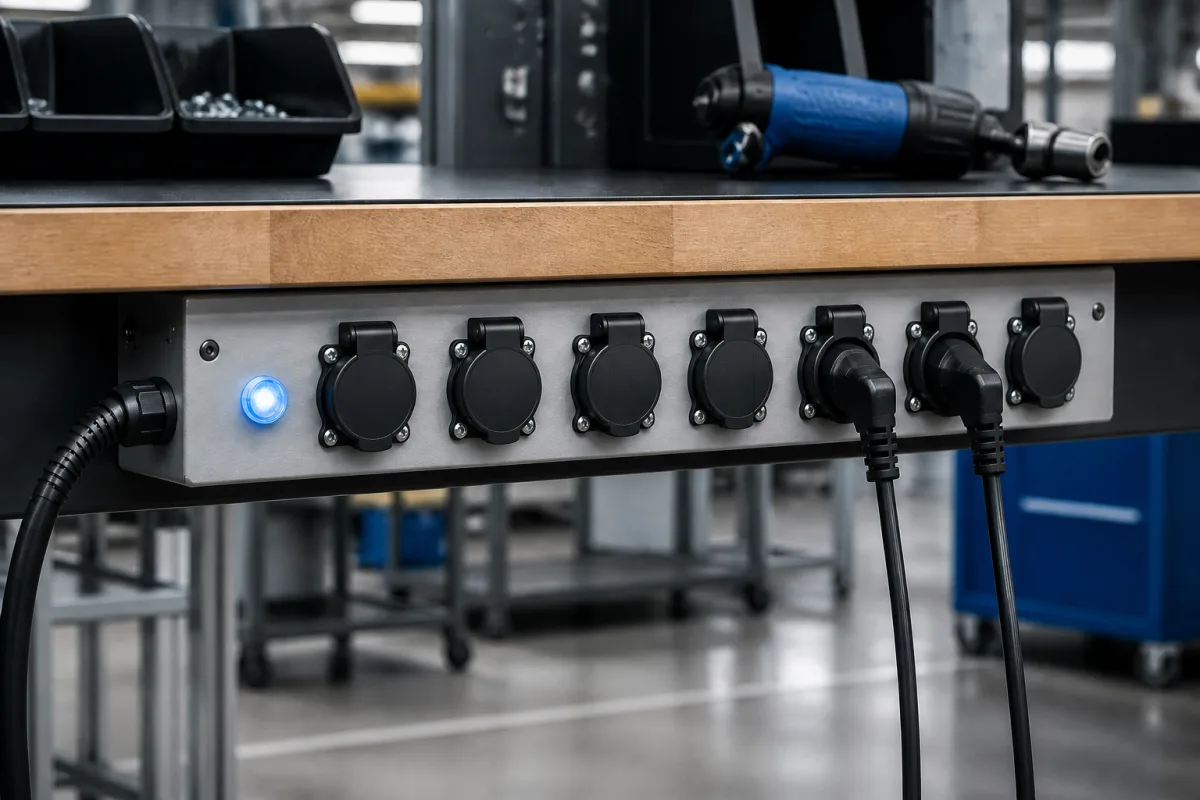
Electrical Safety First likewise warns against plugging one extension lead into another, which can overheat the plug in the wall socket, and says cable reels should be fully unwound and fitted with a thermal cut-out. [3] Editorial note: a bench strip fixed under the worktop, as pictured, should still be fed by its own plug from a fixed outlet, with the cord kept off the floor and away from openings.
03
Check the IEC scope for cord extension sets
IEC 60884-2-7, Plugs and socket-outlets for household and similar purposes - Part 2-7: Particular requirements for cord extension sets, "applies to cord extension sets, rewirable and non-rewirable, with or without earthing contact, with a rated voltage greater than 50 V but not exceeding 440 V and a rated current not exceeding 16 A, intended for household and similar purposes, either indoors or outdoors". The second edition, published on 21 February 2025, replaced the 2011 first edition and its 2013 amendment, aligning with the fourth edition of IEC 60884-1. [4]
The 16 A ceiling and the ambient limits give two values to put on a workstation order alongside the rating rules the page already cites. OSHA's interpretation requires outlet devices with an ampere rating not less than the load [1], and Electrical Safety First says some older extension leads may be rated 10A or less [3]. Ask the supplier for the standard the strip is certified to (IEC 60884-2-7 or a national equivalent, or a UL listing in the US), its rated voltage and current, and whether it is intended for furniture mounting, which the IEC scope routes to IEC 60884-2-8.
For benches near ovens, reflow equipment or test chambers, the temperature figures matter: the 2025 edition sets a 24-hour average ambient not above +35 °C and a lower limit of −5 °C [4]. Ask for the ambient rating if the strip will sit in a warm enclosure or under equipment exhaust.
Editorial calculation: at 230 V, a 16 A rating corresponds to 3,680 W and a 13 A rating to 2,990 W; at 120 V, 15 A corresponds to 1,800 W (P = V × I, resistive load). [4][3]
Item
IEC 60884-2-7:2011 (edition 1)
IEC 60884-2-7:2025 (edition 2)
Rated voltage
Greater than 50 V, not exceeding 440 V
Greater than 50 V, not exceeding 440 V
Rated current
Not exceeding 16 A
Not exceeding 16 A
Ambient temperature
—
24 h average not above +35 °C; lower limit −5 °C
Excluded or added
Read with IEC 60884-1:2002
Excludes sets with means for reeling; covers sets used in a cable reel (with IEC 61242); furniture socket-outlets also covered by IEC 60884-2-8
Status
Withdrawn 21 February 2025
Current
Values are from the Standard Norge catalogue pages for IEC 60884-2-7 editions 1 and 2; the full standard was not reviewed.
04
Plug standards, custom cords and rack PDUs in the listings
Listings include power strips and extension sockets for EU, French, US, UK, German and Australian plug standards, custom power strips with cords, and rack-mount power distribution units with metering or switching. Ask each supplier for the rated current, the certification for your market, the socket standard and whether the strip has a breaker, surge protection or residual current protection.
05
Outlets, breaker, surge module and cord
The breaker rating and the cord's routing tie this table back to the OSHA and eCFR rules above.
Who lists bench strips, extension sockets and PDUs
Changfeng and Yosun list rack PDUs alongside power strips; Hongzhou makes custom strips with cords for different plug standards; Deli sells strips within an office range.
Cixi Changfeng Electrical Appliance Co., Ltd.
Manufacturing site to be confirmed for the order
Lists power strips, extension sockets, adapters and PDUs.
Explore company information and manufacturing capabilities, then discuss the scope of your project with a relevant supplier.
Share this page
Compiled and source-reviewed by the CNFX editorial team.
Each manufacturer above links to the page on that company's own website where the product is listed, with the date we checked it. How we source and review
· Page last updated 13 October 2026
Buyer questions
Can power strips be plugged into each other?
No. OSHA's 2002 interpretation says listed power strips must plug directly into a permanent receptacle and not be series-connected to other strips or extension cords. [1]
How much can a 13 A power strip supply?
About 2,990 W at 230 V (editorial calculation); Electrical Safety First says the total of everything plugged in must not exceed the lead's rating. [3]
Can a power strip be fixed to a wall or run through it?
US rules bar flexible cords from running through walls, ceilings, floors, doorways or windows, or substituting for fixed wiring. [2]
Which IEC standard covers power strips and extension leads?
IEC 60884-2-7 covers cord extension sets rated above 50 V up to 440 V and up to 16 A, for indoor or outdoor household and similar use; its second edition was published in February 2025. [4]
Sources and what still needs a direct check
Sources checked 2026-10-12. OSHA's interpretation letter explains US workplace rules and the UL listing conditions for power strips; the eCFR gives the regulation text. Electrical Safety First is a UK charity giving consumer guidance.