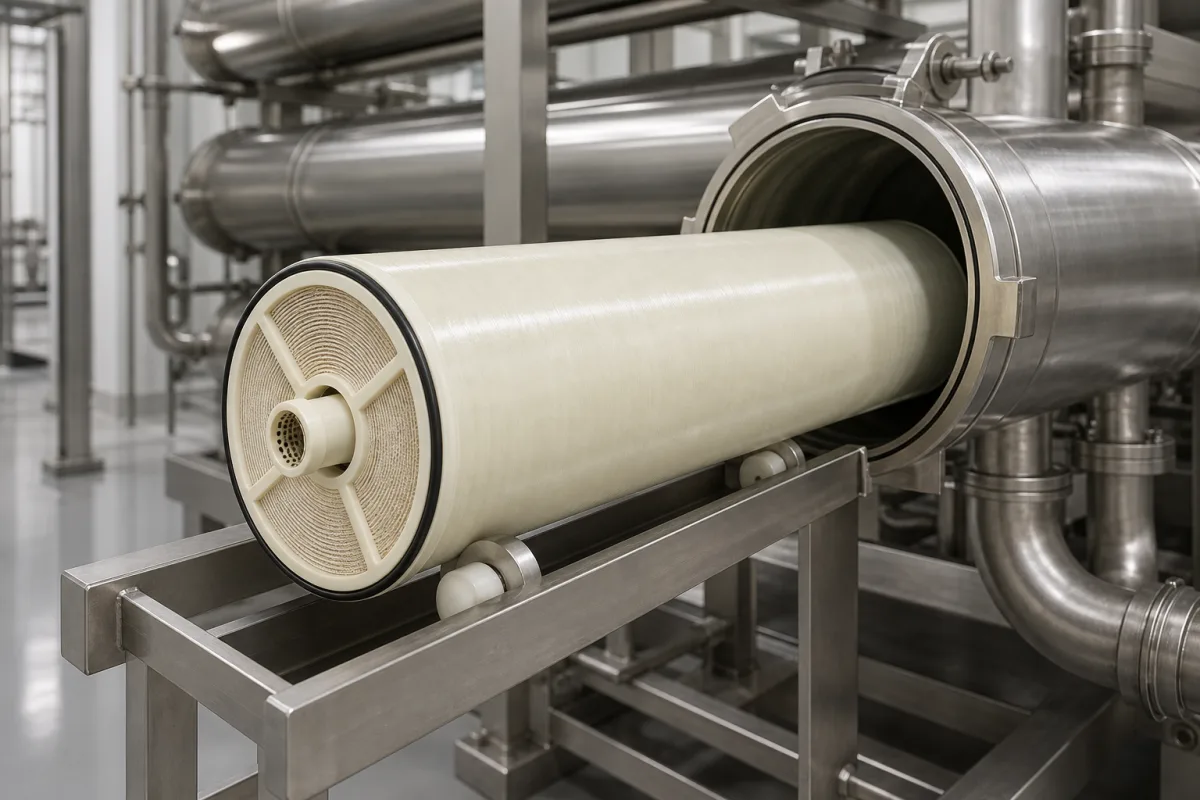
Water treatment · Element rating conditions, rejection, flux, feed limits and handling
A reverse osmosis membrane element is a spiral-wound sheet of thin-film composite membrane that lets water through under pressure while holding back dissolved salts. Ask three things first: what feed water it will see and how it is pretreated, what permeate flow and quality you need, and what element size fits your pressure vessels.
Spiral-wound reverse osmosis membrane elements for brackish water, tap water and industrial use, such as 8-inch elements. Complete RO systems, food membrane filtration plants and ultrafiltration are outside this page.
CNFX editorial research · Sources checked October 12, 2026 · 4 sources
The data sheet for Dow FilmTec's BW30-400/34i brackish-water element, for example, lists 37 m² (400 ft²) active area, a 34 mil feed spacer, 40 m³/d (10,500 gpd) permeate flow, 99.5% stabilized and 99.0% minimum salt rejection, all at standard conditions of 2,000 ppm NaCl, 15.5 bar (225 psi), 25 °C, pH 8 and 15% recovery. Individual element flow may be up to 15% below the stated value, and the maker notes that its active area is not comparable with nominal area quoted by some manufacturers. [1]
Editorial calculation: 40 m³/d over 37 m² is 40,000 L ÷ 24 h ÷ 37 m² ≈ 45 L/m²/h of flux at test conditions. At 99.5% rejection, salt passage is 0.5%, so 2,000 ppm feed gives roughly 2,000 × 0.005 = 10 ppm in the permeate at those conditions. [1] Real systems differ with feed salinity, temperature and recovery; ask for a projection at your conditions.
Hydranautics' 8-inch polyamide elements show how test conditions shape the headline numbers: the CPA3 lists 41.6 m³/d (11,000 gpd) with 99.7% salt rejection (99.6% minimum) at 1,500 ppm NaCl and 1.55 MPa, while the low-energy ESPA2-LD lists 37.9 m³/d (10,000 gpd) with 99.6% (99.5% minimum) at the same salinity but only 1.03 MPa; both are tested at 25 °C, 15% recovery and pH 6.5–7.0, have 37.2 m² active area and a 34 mil (0.86 mm) feed spacer, measure 1,016 × 200 mm, and allow individual element flow to vary ±15%. [2][3]
Editorial calculation: the ESPA2-LD delivers about 91% of the CPA3's flow (37.9 ÷ 41.6) at two-thirds of the test pressure (1.03 ÷ 1.55 ≈ 0.66), and both Hydranautics ratings use 1,500 ppm NaCl rather than the 2,000 ppm used for the FilmTec element, so convert to the same conditions before comparing. [2][3][1]
The element is 1,016 mm long when connected, 201 mm in diameter with a 29 mm product tube, and fits a nominal 8-inch (203 mm) pressure vessel. [1]
Give the supplier a full feed water analysis, temperature range, pretreatment, required permeate flow and quality, recovery, element size and number of vessels, and ask for a design projection and the test conditions behind every flow and rejection figure.
02
Respect feed limits and start-up rules
The same data sheet gives operating limits for the polyamide thin-film composite element: 45 °C maximum (35 °C above pH 10), 41 bar maximum pressure, 1.0 bar maximum pressure drop, pH 2–11 in continuous operation and 1–13 for 30-minute cleaning, 19 m³/h maximum feed flow, feed SDI no more than 5 and free chlorine below 0.1 ppm, because chlorine and other oxidants can cause premature failure not covered by warranty. [1]
It also tells operators to raise feed pressure gradually over 30–60 seconds, reach cross-flow over 15–20 seconds, discard the first hour's permeate and keep elements moist. [1] Editorial calculation: 41 bar is 4.1 MPa and 15.5 bar is 1.55 MPa, for comparison with specifications given in MPa.
Hydranautics lists for both elements a maximum applied pressure of 4.14 MPa (600 psig), free chlorine below 0.1 ppm, 45 °C maximum temperature, feed turbidity up to 1.0 NTU and SDI (15 min) up to 5.0, maximum feed flow of 19.3 m³/h, minimum brine flow of 2.7 m³/h and a maximum pressure drop of 0.10 MPa per element; continuous pH is 2–10.8 for the CPA3 and 2–10.6 for the ESPA2-LD, with cleaning ranges of 1–12.5 and 1–12. [2][3]
Toray's TM800M seawater element data sheet shows how the ratings change for seawater: the TM820M-400 (37 m²) lists 26.5 m³/d (7,000 gpd) permeate with 99.80% nominal and 99.50% minimum salt rejection, tested at 5.52 MPa (800 psi), 32,000 mg/L NaCl, 25 °C, 8% recovery and pH 7, and gives boron rejection of 95% at pH 8 (typ.) [4]. Its limits are 8.3 MPa (1,200 psi) maximum operating pressure, 45 °C, SDI₁₅ of 5, free chlorine "Not detectable", pH 2–11 continuous and 1–12 for cleaning, and 0.10 MPa pressure drop per element or 0.34 MPa per vessel. Editorial calculation: 26.5 m³/d over 37 m² is 26,500 L ÷ 24 h ÷ 37 m² ≈ 30 L/m²/h, against about 45 L/m²/h for the BW30-400/34i at its brackish-water test conditions. [4]
03
Industrial membranes, NSF-stated elements and mixed membrane catalogues
Huaqiang lists industrial reverse osmosis membranes; Hidrotek lists RO membranes and states NSF certification; Watech, Yubo, Delta and Reclea list RO membranes alongside other membrane elements, cartridges and water-treatment equipment.
04
Membrane leaf, feed spacer, permeate tube and brine seal
The feed spacer is the part to specify on purpose: its thickness sets channel height, and a thicker spacer eases fouling. [1]
Data-sheet lines to request, each with its test condition
A flow or rejection value in this table only means something next to its test salinity and pressure: the Toray seawater row sits at 32,000 mg/L, the brackish-water rows at 1,500 or 2,000 ppm. [4][1]
Industrial RO membrane elements, some listed beside cartridges, UF membranes and other water-treatment equipment; one supplier states NSF certification.
Explore company information and manufacturing capabilities, then discuss the scope of your project with a relevant supplier.
Share this page
Compiled and source-reviewed by the CNFX editorial team.
Each manufacturer above links to the page on that company's own website where the product is listed, with the date we checked it. How we source and review
· Page last updated 13 October 2026
Buyer questions
Why compare RO membranes at test conditions?
Flow and rejection are measured at set salinity, pressure, temperature, pH and recovery; one element is rated at 2,000 ppm NaCl, 15.5 bar, 25 °C, pH 8 and 15% recovery. [1]
Can chlorinated water go to an RO membrane?
Polyamide elements tolerate less than 0.1 ppm free chlorine; oxidants cause premature failure, so remove chlorine in pretreatment. [1]
What flux does a standard 8-inch element run at?
One element rated 40 m³/d over 37 m² runs at about 45 L/m²/h at test conditions. [1]
Why do RO membranes from different makers show different flow ratings?
Each rating is at the maker's test conditions; for example 1,500 ppm NaCl at 1.55 MPa or 1.03 MPa versus 2,000 ppm at 1.55 MPa, so normalise before comparing. [2][3][1]
How do seawater RO membrane ratings differ from brackish-water ratings?
Toray's TM820M-400 seawater element is rated at 5.52 MPa feed pressure with 32,000 mg/L NaCl and 8% recovery, giving 26.5 m³/d and 99.80% nominal salt rejection, with an 8.3 MPa maximum operating pressure; the brackish-water BW30-400/34i on this page is tested at 1.55 MPa and 2,000 ppm. [4]
Sources and what still needs a direct check
Sources checked 2026-10-12. The data sheet is Dow FilmTec's own for one element, hosted by distributor Lenntech; its values apply to that element. Supplier pages describe their own offers.