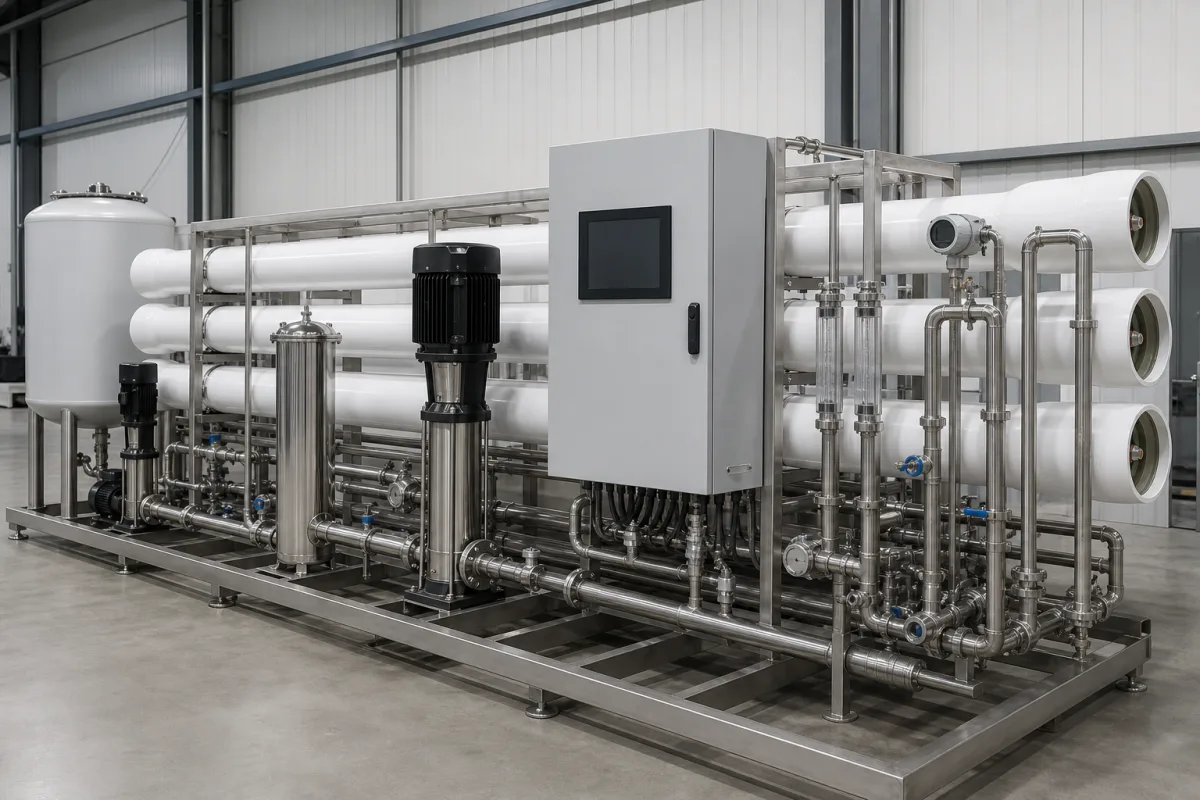
Seawater RO desalination units · 55–83 bar element pressure class, energy recovery devices, skid, split or containerized builds
A seawater reverse osmosis (SWRO) unit is a packaged desalination plant: pretreatment filters, a high-pressure pump, pressure vessels loaded with seawater-grade spiral-wound elements, and controls on one frame or in a container, producing fresh water from seawater for ships, islands, coastal sites and remote facilities. Ask three things first: what feed salinity and temperature the unit is designed for, which pressure class its elements, vessels and pipework are rated to, and whether the brine energy is recovered or thrown away across a valve.
Skid-mounted, split and containerized reverse osmosis units built for seawater and high-salinity feed, specified by operating pressure, element and vessel rating, energy recovery and packaging. Brackish-water and process-water systems with softening, dechlorination and storage are covered on the Water treatment system page, and individual spiral-wound elements on the Reverse osmosis membrane page. Wastewater recycling plants and laboratory purifiers are outside this page.
CNFX editorial research · Sources checked October 12, 2026 · 4 sources
Set the pressure class for seawater elements and vessels
Seawater elements are rated at far higher pressure than brackish ones. DuPont's FilmTec SW30HRLE-440, a seawater element for medium- and high-salinity feed, is rated at 8,000 gpd (30.2 m³/d) permeate, 99.80% stabilized salt rejection (minimum 99.65%) and 92% boron rejection at test conditions of 32,000 ppm NaCl, 5 ppm boron, 800 psi (5.5 MPa), 25 °C, pH 8 and 8% recovery, with permeate flow of individual elements varying by ±15%. [1]
The same element is limited to 1,200 psig (83 bar) operating pressure, 45 °C, 1.0 bar pressure drop per element, SDI 5 and free chlorine below 0.1 ppm, with pH 2–11 for continuous operation and 1–13 for 30-minute cleaning; it is 1,016 mm long and 201 mm in diameter, fits a nominal 8-inch (203 mm) pressure vessel, and has 41 m² of active area with a 28 mil feed spacer. [1] Editorial calculation: the 83 bar ceiling is about 1.5 times the 5.5 MPa (55 bar) test pressure, so ask for the pressure rating of the vessels, high-pressure pipework and valves, not just the element.
Huber's MENA-Water units, offered for seawater, high-brackish, industrial and municipal water, state feed limits of turbidity below 1 NTU, SDI 3–5, iron below 0.05 ppm and a maximum feed temperature of 42 °C, nominal salt rejection up to 99.8%, and note that they can run on higher-TDS feed by lowering recovery. [3] Editorial note: a unit designed for one salinity will not hold the same recovery and permeate quality on saltier or warmer water; give the supplier the worst-case feed analysis.
Give the supplier the feed source and analysis (TDS, temperature range, SDI, turbidity, iron, boron), required permeate quality and flow, recovery target, power supply, site (ship, offshore, island, land), packaging, automation level, and the pressure rating required for elements, vessels and pipework.
02
Decide whether the unit needs an energy recovery device
In a seawater unit, the concentrate leaves the membranes still at high pressure. Energy Recovery Inc. lists its PX Q650 pressure exchanger for SWRO plants at up to 99% peak efficiency, as low as 2% volumetric mixing, and a 250–650 gpm (56.8–147.6 m³/h) operating range, built around a ceramic core with one moving part and a 30-year design life. [2]
At the small end, Kysearo states that its land-based 20–200 t/d seawater plants are designed without energy recovery devices because units of this size do not draw much electricity, citing convenience and lower cost. [4] Editorial calculation: 200 t/d is about 8.3 m³/h of fresh water; assuming 40% recovery (an assumption, not a source value), the brine stream is about 12.5 m³/h, well below the 56.8 m³/h bottom of the PX Q650 range, so devices sized for small flows, or none, are the options at this scale.
Editorial note: without an energy recovery device, the high-pressure pump energy carried by the brine is dropped across a valve. Ask the supplier to state specific energy in kWh per m³ of permeate at your design feed and recovery, with and without energy recovery, so offers can be compared.
03
Plant feed limits against element limits
Huber states limits for the water entering its packaged units; DuPont states limits for one seawater element. Where both give a figure, the plant limit is equal to or below the element limit.
Huber adds that hardness above 1 grain per gallon needs a softener or antiscalant, and lists double-pass, higher-recovery, clean-in-place, UV or ozone, post-deionizer and remote-monitoring options. [3]
1,200 psig (83 bar) maximum; 1.0 bar drop per element [1]
04
Integrated skid, split layout or container
Kysearo builds its 20–200 t/d seawater plants as an integrated frame for low flows, a split layout placed to suit the room for middle flows, or a container for long-distance transport and sites without a plant room. [4] Huber offers containerized or skid-mounted units, pre-assembled and factory tested, with a stainless frame and 60 Hz supply among the options. [3]
Ask which items sit outside the package (seawater intake and feed pump, brine outfall, post-treatment and storage) and how a containerized unit is ventilated and accessed for element changes.
05
Data for a seawater RO unit enquiry
Paste it into your enquiry below or into an email to a maker, then replace every bracket.
Feed: [seawater or high brackish; TDS; temperature range; SDI; boron]
Output: [permeate flow; quality; single or double pass]
Recovery: [target]
Pressure: [element, vessel and pipework rating]
Energy: [energy recovery device; kWh/m³ target]
Packaging: [integrated skid, split or container]
Site: [ship, offshore, island, land; power supply]
Controls: [automation level; remote monitoring]
Explore company information and manufacturing capabilities, then discuss the scope of your project with a relevant supplier.
Share this page
Compiled and source-reviewed by the CNFX editorial team.
Each manufacturer above links to the page on that company's own website where the product is listed, with the date we checked it. How we source and review
· Page last updated 13 October 2026
Buyer questions
What pressure does a seawater RO element take?
DuPont tests its SW30HRLE-440 seawater element at 800 psi (5.5 MPa) and rates it to a maximum of 1,200 psig (83 bar). [1]
Do small seawater RO units use energy recovery?
Kysearo states its 20–200 t/d plants are designed without energy recovery devices; large SWRO plants can use pressure exchangers such as the PX Q650, rated up to 99% peak efficiency over 56.8–147.6 m³/h. [4][2]
How are seawater RO units packaged?
Suppliers offer integrated skids, split layouts and containerized units; Huber lists containerized or skid-mounted units pre-assembled and factory tested. [4][3]
Sources and what still needs a direct check
Sources checked 2026-10-12. Element ratings come from DuPont's FilmTec product data sheet (hosted by Lenntech); the energy recovery figures from Energy Recovery Inc.'s product page; plant limits and packaging from the Huber and Kysearo product pages. Element, device and plant values apply to the models named and must be confirmed for the unit you buy.