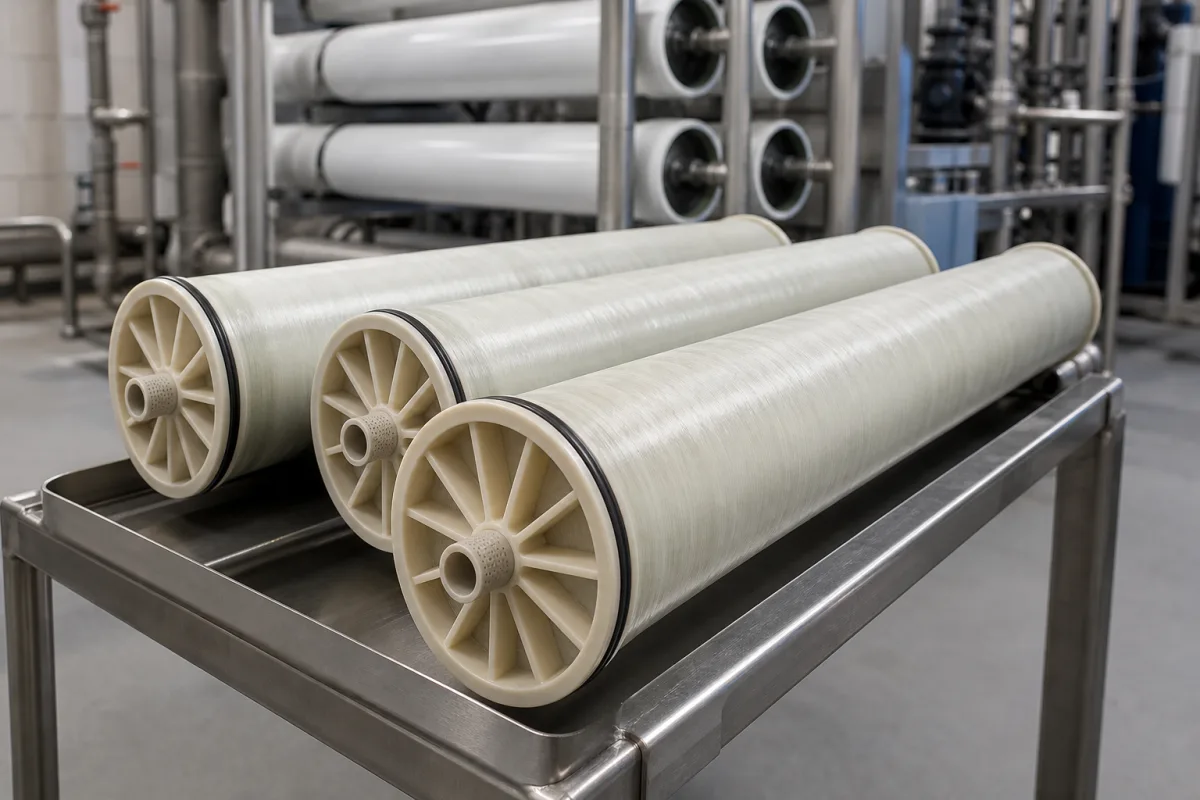
RO membrane elements in the 4040 and 2540 sizes for small commercial and light-industrial systems
4-inch (4040) and 2.5-inch (2540) RO elements for light-industrial and commercial units · 99 mm by 1,016 mm, 16 gpm feed limit, rated 2,400–2,600 gpd at 225 psig against 100 L/h in practice
Spiral-wound RO elements are built in a few standard sizes named by diameter and length. The 4040 element, about 4 inches across and 40 inches long, and the 2540 element are the sizes used in small commercial, laboratory, beverage and light-industrial units that make up to a few cubic metres of permeate an hour. Choosing one means reading a datasheet rated at fixed test conditions, fitting it to a 4-inch or 2.5-inch pressure vessel, and keeping the feed inside its per-element limits.
Spiral-wound polyamide RO elements in the 4040 (4-inch) and 2540 (2.5-inch) sizes for small commercial and light-industrial systems, with their dimensions, vessel fit, rated flow and per-element operating limits. Eight-inch brackish, tap-water and seawater elements for large plants are covered on the Reverse osmosis membrane page. Pressure vessels, anti-telescoping devices, residential 1812-size elements and complete RO units are outside this page.
CNFX editorial research · Sources checked October 12, 2026 · 3 sources
4040 and 2540 dimensions, vessel fit and the per-element feed limits
The two sizes share a 40-inch length; diameter, permeate tube and the maximum feed flow differ.
Dow's FilmTec sheet describes the 2540 size as designed for systems smaller than 1 gpm (0.2 m³/h), and recommends elements with a hard-shell exterior for housings holding three or more elements because they withstand higher pressure drops; it sells a coupler, part 89055, with two 2-210 EPR O-rings for joining elements in one housing. [1] LoyalMem reads the name the same way: BW for brackish water, 40 for the 4.0-inch diameter and 40 for the 40-inch length, and gives 82–88 ft² of active area for its BW 4040. [3]
Editorial calculation: at the 16 gpm (3.6 m³/h) maximum feed flow, a single 4040 element at the 15% recovery used in the test conditions would make about 0.54 m³/h, so long multi-element vessels, not one element, are what reach higher recoveries.
Give the supplier the feed analysis, permeate flow and quality wanted, the number of vessels and elements per vessel you plan, the vessel I.D., and whether the elements will be shipped wet-preserved or dry.
02
Rated flow at 2,000 ppm and 225 psig against what a 4040 makes in a small plant
Every rated figure on a 4040 datasheet belongs to its test condition; a unit running cooler, at lower pressure or on saltier water makes less.
FilmTec rates the BW30-4040 at 2,400 gpd (9.1 m³/d) and 99.5% stabilized rejection, and the low-energy LE-4040 at 2,500 gpd (9.5 m³/d) and 99.0%, both on 2,000 ppm NaCl at 77 °F (25 °C) and 15% recovery, but at 225 psig (15.5 bar) for BW30 and 150 psig (10.3 bar) for LE; individual elements may vary by ±20%. [1] The later BW30 PRO-4040 is rated at 2,600 gpd (9.8 m³/d) and 99.7% (minimum 99.5%) at 225 psig and pH 8, with element-to-element variation of ±15%; the BW30 PRO-2540 at 1,000 gpd (3.8 m³/d). [2]
LoyalMem gives its BW 4040 2,400 gpd at 225 psi on 2,000 ppm NaCl, describes it as designed for feed TDS between 2,000 and 10,000 ppm (2,000–8,000 ppm in its selection notes) and an LP 4040 below 2,000 ppm, and states that real-world flow is 30–80% of the rated figure. For sizing it plans on roughly 100 L/h per element and six elements in 2:1 staging for 1,000 L/h, says flow drops about 3% for every 1 °C below 25 °C, and suggests 4040 elements over 8040 for flows under 3 m³/h. [3]
Editorial calculation: 2,400 gpd is about 9.1 m³/d or 379 L/h at test conditions, so LoyalMem's 100 L/h planning figure is about 26% of the rated flow; six elements at 100 L/h give 600 L/h, below the 1,000 L/h it quotes for that array, so ask the supplier for a projection at your temperature, pressure and TDS rather than scaling either number.
03
Operating limits and start-up rules printed on a 4040 datasheet
These limits set the pretreatment and start-up controls that have to come with the elements.
DuPont adds that elements must be kept moist after initial wetting, immersed in a preservative during long shutdowns, and never exposed to static permeate back-pressure. [2] LoyalMem offers 28 mil feed spacers for clean groundwater and 34 mil for surface water, wastewater reuse or feeds with SDI above 3. [3]
Paste it into your enquiry below or into an email to a maker, then replace every bracket.
Feed: [TDS; hardness; SDI; temperature range; free chlorine]
System: [permeate flow; recovery; vessels × elements; vessel I.D.]
Element: [4040 or 2540; brackish or low-pressure; feed spacer mil; hard shell]
Rating: [test pressure and NaCl; rated flow and rejection; tolerance]
Supply: [wet or dry; couplers and O-rings; projection at site conditions]
2 companies list this product among what they make. Company figures are quoted from each
company's own website; every card states where the relationship came from.
Shandong LoyalMem Tech Co., Ltd.
Manufacturing site to be confirmed for the order
Lists 4040 RO elements in BW, LP, XLP and SW versions, with BW 4040 rated 2,400 gpd at 225 psi and 28 or 34 mil feed spacers, alongside 8040 elements.
Explore company information and manufacturing capabilities, then discuss the scope of your project with a relevant supplier.
Share this page
Compiled and source-reviewed by the CNFX editorial team.
Each manufacturer above links to the page on that company's own website where the product is listed, with the date we checked it. How we source and review
· Page last updated 13 October 2026
Buyer questions
What size is a 4040 RO membrane?
About 4 inches by 40 inches: FilmTec's BW30-4040 is 40.0 in (1,016 mm) long and 3.9 in (99 mm) in outside diameter and fits a nominal 4-inch I.D. pressure vessel. [1]
How much water does one 4040 element make?
FilmTec rates the BW30-4040 at 2,400 gpd (9.1 m³/d) at 225 psig and 25 °C on 2,000 ppm NaCl; LoyalMem plans on about 100 L/h per element in service. [1][3]
What is the maximum feed flow to a 4040 element?
DuPont gives 16 gpm (3.6 m³/h) for 4040 elements and 6 gpm (1.4 m³/h) for 2540 elements. [2]
Sources and what still needs a direct check
Sources checked 2026-10-12. DuPont (FilmTec, earlier under Dow) and LoyalMem publish ratings for their own elements; sizing figures from LoyalMem are its own planning values.