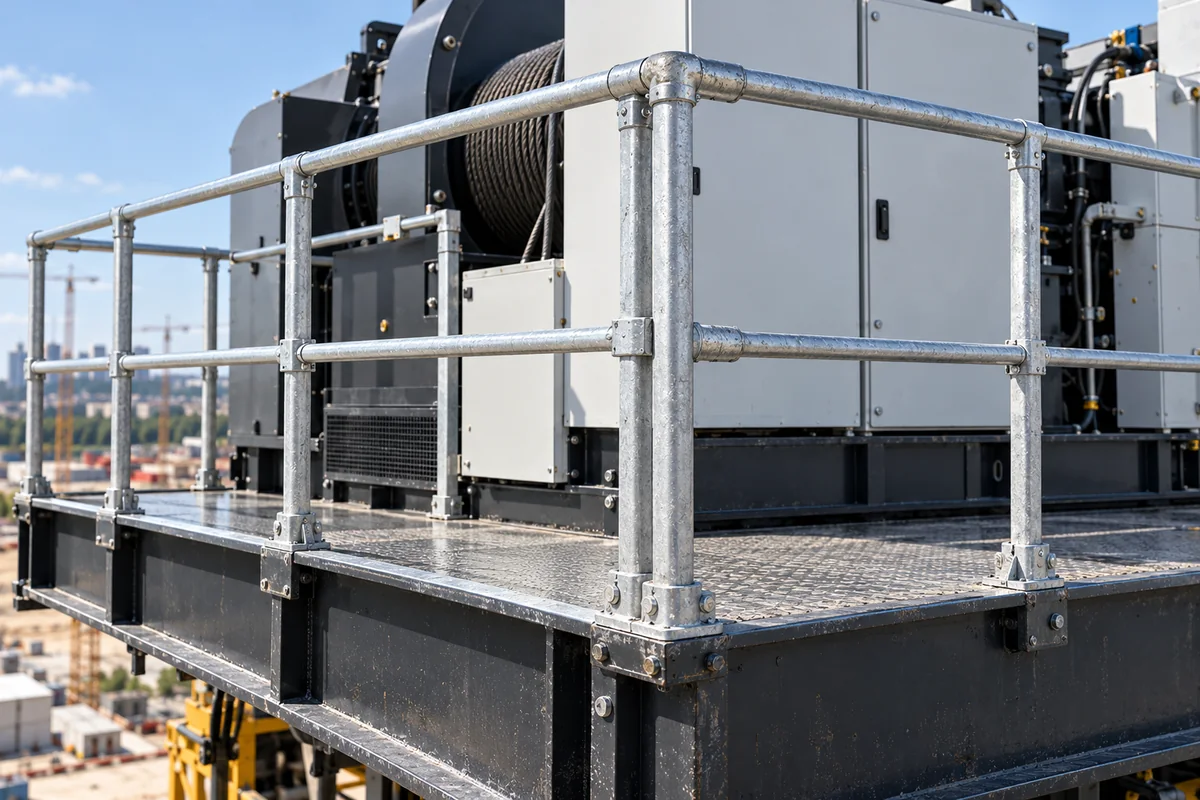
Industrial guardrails and handrails · Top rail at 42 in (107 cm) ± 3 in, midrail or 19 in openings, 200 lb (890 N) top-rail load, 3.5 in toeboards, and ladder cages being replaced by fall arrest systems, for machine platforms and walkways
A safety handrail, or guardrail, is the rail system along the open edge of a machine platform, walkway or mezzanine that stops people falling; a toeboard at its foot stops tools falling on people below. Ask three things first: which code the installation must meet (in the US, OSHA 1910.29), which heights, members and loads that code demands, and how the rail will be fixed, finished and fitted to the platform and any ladder.
Industrial guardrail and handrail systems for elevated platforms, walkways, mezzanines and machinery access — top rails, midrails, posts, toeboards, gates and fixings — and fixed-ladder cages where compared. Machine and robot cell guarding fences (see safety guarding), architectural stair balustrades, temporary edge protection for construction and personal fall arrest equipment are outside this page except where compared.
CNFX editorial research · Sources checked October 12, 2026 · 4 sources
Set rail heights, intermediate members and design loads
OSHA's general industry rule 29 CFR 1910.29(b) requires the top edge of the top rail at 42 in (107 cm) ± 3 in above the walking-working surface (higher than 45 in is allowed if all other criteria are met); where there is no wall or parapet at least 21 in high, midrails midway between top rail and surface, or screens and mesh over the full opening, or balusters no more than 19 in apart, or other members leaving openings no wider than 19 in. [1]
The top rail must withstand at least 200 lb (890 N) applied downward or outward within 2 in of its top edge at any point, without deflecting below 39 in (99 cm) above the surface under the downward test load; midrails, screens, balusters and panels must withstand 150 lb (667 N); rails must be smooth-surfaced to prevent punctures, lacerations and snagging, must not overhang terminal posts where that creates a projection hazard, must not be made of steel or plastic banding, and must be at least 0.25 in (0.6 cm) in diameter or thickness. Hoist-area openings need a removable top rail and midrail section, or chains or gates of equivalent safety. [1]
Editorial calculation: 42 in ± 3 in is 991–1,143 mm; the 39 in minimum under load allows a deflection of up to 3 in (76 mm) from a 42 in rail. [1]
A maker's guide specification turns these rules into product terms. Kee Safety's three-part specification for Kee Klamp safety railing systems (Section 05 52 00) recommends a maximum post spacing of 72 in (1,829 mm), a minimum height of 42 in (1,067 mm), an intermediate rail at 21 in (533 mm) and a 4 in (102 mm) toe board no more than 1/4 in above the floor. It designs the top rail for a 50 lbf/ft (0.73 kN/m) uniform load or a 200 lbf (0.89 kN) concentrated load in any direction, not acting together, and infill for 50 lbf (0.22 kN). It calls for Schedule 40 or 80 ASTM A53 pipe, or ASTM A500/A513 tube with a Schedule 40-compatible outside diameter, hot-dip galvanised to ASTM A123, notes that pipe walls under 1/8 in (3.17 mm) suit only lightly loaded structures, and specifies malleable iron fittings to ASTM A47 whose set screws, tightened to 29 ft·lb (39.3 N·m), each carry an axial load of 2,000 lb (907 kg) with a 2:1 safety factor. [3]
Editorial calculation: at 72 in post spacing the 50 lbf/ft uniform load puts 300 lbf (about 1.33 kN) on each top-rail span (50 × 6), more than the 200 lbf point load, so check post bases and anchors for the uniform case where that load applies. [3]
Canada's federal Occupational Health and Safety Regulations (SOR/86-304) set different numbers. Section 2.12 requires every guardrail to be highly visible, with a horizontal top rail not less than 900 mm and not more than 1,100 mm above its base, an intermediate rail midway between top rail and base, and posts no more than 3 m apart at their centres, and to be designed for a static load of 890 N applied in any direction at any point on the top rail. Section 2.5 requires guardrails (or a load-bearing cover) at wall openings with a drop of more than 1.2 m and at floor openings, and section 2.6 requires a walkway at least 500 mm wide with guardrails where workers reach open-top bins, hoppers, vats or pits from above unless a covering is fitted. [4]
Editorial calculation: OSHA's 42 ± 3 in is about 991–1,143 mm and Canada's band is 900–1,100 mm, so a top rail between 991 and 1,100 mm sits inside both; both rules use 890 N on the top rail, but OSHA applies it downward or outward while the Canadian rule says any direction. [1][4]
Give the supplier the platform layout and edge lengths, floor or steelwork to fix to, required code (OSHA 1910.29 or local), rail height, midrail or infill type, gates and openings, toeboard, material and finish (galvanized, painted, stainless), environment, fixing method, and any ladder access points.
02
Plan toeboards and fixed-ladder protection
Toeboards used for falling-object protection must be at least 3.5 in (9 cm) high (2.5 in around vehicle pits) and withstand 50 lb (222 N) in any downward or outward direction; where material is piled above the toeboard, paneling or screening must extend up to the midrail. Cages and wells on fixed ladders must allow easy access and egress, be continuous except at transfer points, and be built to contain a falling worker and direct them to a lower landing. [1]
OSHA 1910.28 requires fixed ladders extending more than 24 ft (7.3 m) above a lower level that were installed on or after 19 November 2018 to have a personal fall arrest or ladder safety system rather than relying on a cage or well; when any section of a ladder, cage or well is replaced, that section must receive a fall arrest or ladder safety system; and from 18 November 2036 all such fixed ladders must have one. Ladders fitted with these systems need rest platforms at intervals of no more than 150 ft (45.7 m), and the system must cover the full climb. [2]
Under Canada's section 2.13, where tools or objects could fall from a platform or through a floor opening, a toe board at least 125 mm high is required, or a solid or mesh panel at least 450 mm high where objects are piled above toe-board height. Editorial calculation: 125 mm is about 4.9 in, against OSHA's 3.5 in (89 mm) minimum, so a 125 mm toe board meets both. [4][1]
03
Railing makers listed, from carbon-steel rails to stainless components
Shanghai Sunway IMP. & EXP. Co., Ltd. lists handrails, stair rails, outdoor safety rails and railings; Qingdao Jiuguang Metal Products Co., Ltd. lists stainless steel railing components and step handrails in 304, 316 and other grades.
Ask any supplier for the code the system is designed and tested to, rail heights, member sizes and wall thickness, post spacing, load test results, material grade, finish and coating thickness, toeboard, gates, fixings and base plates, drawings, and installation instructions.
Where each handrail value comes from: OSHA, Canada or Kee Safety
Heights and loads come from the OSHA and Canadian rules, member sizes and grades from Kee Safety's guide specification; temperature, IP rating, weight per metre and tolerances are not in these sources.
Field
What it means and published values
Ask the supplier for
Height (mm)
e.g. 42 in ± 3 in (about 991–1,143 mm) in the US; 900–1,100 mm in Canadian federal rules. [1][4]
Rail height.
Load Capacity (N)
e.g. 890 N top rail; 667 N intermediate; 222 N toeboard. [1]
Test results.
Tube Diameter (in)
At least 0.25 in (0.6 cm) thick or diameter; e.g. Schedule 40/80 ASTM A53 pipe. [1][3]
Section; wall.
Material Grade
e.g. ASTM A53 pipe, A500/A513 tube; A47 iron fittings. [3]
Steel or aluminium grade.
Surface Treatment (μm)
Smooth-surfaced rails; e.g. hot-dip galvanised to ASTM A123. [1][3]
Coating; thickness.
Operating Temperature (°C)
Not stated in the reviewed sources.
Range.
IP Rating
Not stated in the reviewed sources.
If any electrical parts.
Weight (kg/m)
Not stated in the reviewed sources.
Weight.
Tolerance (mm)
Not stated in the reviewed sources.
Tolerances.
Mounting Hole Spacing (mm)
Post spacing e.g. 72 in (1,829 mm) max recommended. [3]
Base plate drilling.
06
Send the platform, code and finish data together
Paste it into your enquiry below or into an email to a maker, then replace every bracket.
Platform: [layout; edge length; height]
Code: [OSHA 1910.29; local]
Rail: [height; midrail or infill]
Toeboard: [height]
Openings: [gates; hoist areas; ladder access]
Material and finish: [steel; galvanized; stainless]
Fixing: [base plates; side mount]
Ladders: [fall arrest or ladder safety system]
2 companies list this product among what they make. Company figures are quoted from each
company's own website; every card states where the relationship came from.
Shanghai Sunway IMP. & EXP. Co., Ltd.
Manufacturing site to be confirmed for the order
Lists handrails, stair rails, outdoor safety rails and railings.
Explore company information and manufacturing capabilities, then discuss the scope of your project with a relevant supplier.
Share this page
Compiled and source-reviewed by the CNFX editorial team.
Each manufacturer above links to the page on that company's own website where the product is listed, with the date we checked it. How we source and review
· Page last updated 13 October 2026
Buyer questions
How high must an industrial guardrail be?
OSHA 1910.29 sets the top rail at 42 in (107 cm) ± 3 in above the walking-working surface. [1]
What load must a guardrail take?
At least 200 lb (890 N) on the top rail and 150 lb (667 N) on midrails and infill. [1]
Are ladder cages still allowed?
OSHA 1910.28 requires fall arrest or ladder safety systems on new fixed ladders over 24 ft and on all of them from 18 November 2036. [2]
How far apart should handrail posts be?
Kee Safety's railing specification recommends a maximum post spacing of 72 in (1,829 mm), with a 42 in top rail and 21 in intermediate rail designed for 200 lbf or 50 lbf/ft. [3]
What guardrail height do Canadian federal rules require?
SOR/86-304 s. 2.12 sets the top rail at 900–1,100 mm above the base, with a midrail, posts no more than 3 m apart and an 890 N design load in any direction. [4]
Sources and what still needs a direct check
Sources checked 2026-10-12. OSHA sets US general industry fall-protection rules; the Canada Occupational Health and Safety Regulations set the rules for federally regulated Canadian workplaces; Kee Safety describes its own railing system.