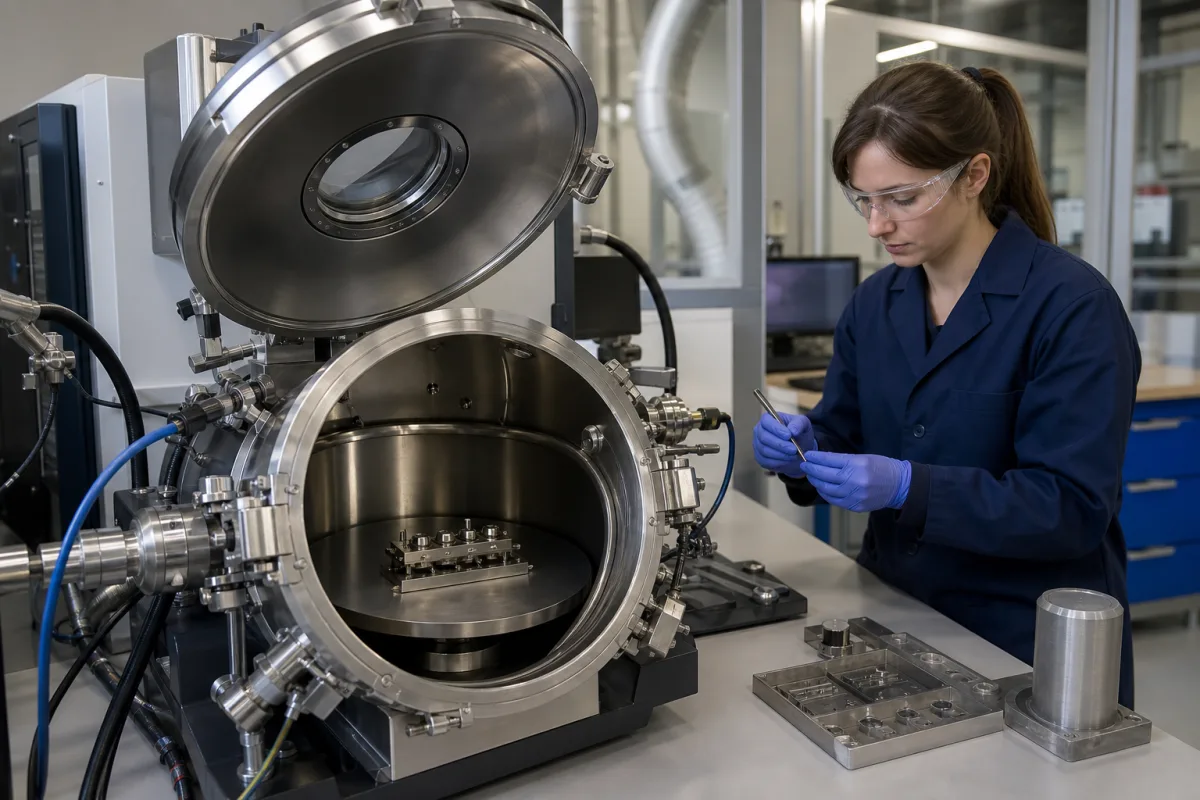
Outgassing test sample chamber (micro-CVCM): the vacuum chamber, heated compartment bar and cooled collectors used for ASTM E595
The vacuum sample chamber of an ASTM E595 outgassing tester · a heated copper bar of sample compartments at 125 °C, chromium-plated collectors at 25 °C behind 6.3 mm exit ports, below 7 × 10⁻³ Pa for 24 h, and the 1.0% TML / 0.10% CVCM screen
Before a polymer, adhesive, paint or tape goes into a spacecraft or a vacuum instrument, a small sample of it is baked in vacuum to see how much mass it loses and how much of what it gives off condenses on a nearby cool surface. The test is done in a dedicated sample chamber: a vacuum vessel enclosing a heated copper bar divided into sample compartments, each venting through a small port towards its own cooled collector plate. The chamber's geometry, temperatures and pressure are fixed by ASTM E595 so that results from different laboratories can be compared, which makes those dimensions the specification of the product rather than options.
Sample chambers and apparatus for vacuum outgassing tests of materials to ASTM E595 (micro-CVCM): the vacuum enclosure, heated multi-compartment sample bar, exit ports, separator plates and temperature-controlled collector plates, and the weighing conditions that go with them. General process and test vacuum chambers, including chamber materials, surface finish and their own outgassing rates, are covered on the Vacuum chamber page; climatic temperature and humidity test chambers on the Test chamber page. Thermal vacuum chambers for whole spacecraft units, thermogravimetric analysers and residual gas analysers are outside this page.
CNFX editorial research · Sources checked October 12, 2026 · 4 sources
What the chamber has to hold: 125 °C sample, 25 °C collector, below 7 × 10⁻³ Pa for 24 hours
ASTM E595 describes its apparatus and procedure for subjecting materials to 125 °C at less than 7 × 10⁻³ Pa (5 × 10⁻⁵ torr) for 24 h, measuring total mass loss (TML) and the collected volatile condensable materials (CVCM) that condense on a collector at 25 °C; the water vapour regained (WVR) can be measured afterwards as an option. Tolerances are ±1 °C on 25 °C and 125 °C and ±2 °C on 23 °C. [1]
The standard explains why the vacuum need not approach interplanetary levels such as 10⁻¹² Pa: it is enough that the pressure be low enough for the mean free path of gas molecules to be long compared with the chamber dimensions. [1] Weighings are made at 23 °C and 50% relative humidity, because TML and WVR are affected by the material's capacity to gain or lose water vapour. [1]
Editorial calculation: 7 × 10⁻³ Pa is about 5 × 10⁻⁵ torr (1 torr ≈ 133.3 Pa), as the standard states. A Goddard paper describes the E595 assembly at about 10⁻⁶ torr, [4] that is about 1.3 × 10⁻⁴ Pa, some fifty times below the E595 limit.
02
Heated compartment bar, 6.3 mm exit port and a collector 12.7 mm away
NASA Goddard's guide to its outgassing database describes the apparatus in use. Each sample of 100 to 300 mg, nominally 250 mg, goes in a pre-weighed, cleaned aluminium foil boat into its own compartment of a solid copper bar; each compartment is closed by a solid copper cover so that volatiles escape only through a 6.3 mm (0.25 in) exit port. The bar, with 12 compartments, is heated to 125 °C for 24 h, and a chromium-plated collector in direct line of sight of the port, 12.7 mm (0.5 in) away, is held at 25 °C, with barriers near the collectors to prevent cross-contamination between adjacent samples. [2]
Goddard's 1969 report on the first system shows how the chamber was built: two resistance-heated, vertically mounted copper bars, each 25.5 in long with a 1 in square cross-section and 12 horizontal sample chambers, whose open rears face through a perforated barrier plate onto removable chrome-plated collector plates held at ambient temperature by a heat exchanger running silicone fluid. The bars stood inside a 10-in diameter Pyrex bell jar on a feed-through collar; 18 compartments were used for tests in a 24-hour run and four as controls. [3] Its procedure brought the bar to 125 °C in 25 minutes, held 125 ± 2 °C, and raised the bell 1.5 to 2 hours after the start of the cooling cycle. [3]
The guide notes that E595 fixes a set of critical dimensions so that similar systems give similar results. [2] ASTM adds that CVCM values are comparable only for similar collector geometry and surfaces at 25 °C. [1] Editorial note: for a purchased chamber, ask for a drawing of the compartment, port and collector geometry against the dimensions in the current E595 edition, not only the temperatures.
Editorial note: specify the number of sample compartments, the collector cooling method and its stability at 25 ± 1 °C, the bar heater control at 125 ± 1 °C, the pumping system and base pressure, and how the separator plate keeps each collector to its own sample.
03
Reading the result: TML 1.0% and CVCM 0.10% as screening levels
ASTM E595 leaves acceptance criteria to the user, noting that TML of 1.00% and CVCM of 0.10% have historically been used as screening levels for rejecting spacecraft materials. [1] Goddard's database lists, in a separate section, only the materials meeting a maximum TML of 1.0% and a maximum CVCM of 0.10%. [2]
Goddard's Scialdone and co-authors give the reasoning: some materials show mechanical and physical degradation after losing 3 to 5% of their mass, a 1% TML is detrimental to the mechanical properties of elastomers, and 0.1% condensate from 1 kg of material would cover 100 m² of surface with a uniform layer of 10⁻⁶ g/cm², about 20 monolayers. [4]
Editorial calculation: on the nominal 250 mg sample, 1.0% TML is 2.5 mg of mass loss and 0.10% CVCM is 0.25 mg collected on the plate, so the weighing system has to resolve hundredths of a milligram to classify a material near the limit. Goddard's 1969 procedure weighed sample boats on a micro-balance in a conditioned 40–50% RH environment for this reason. [3]
04
Why the E595 chamber reads lower than open-sample instruments
The exit port that makes the chamber repeatable also restricts flow. Scialdone and co-authors at Goddard tested a graphite–epoxy composite at 125 °C for 24 h in four instruments and found that the ASTM E595 apparatus gave consistently lower readings than the others; they attribute it to the flow conductance of the vent passage and the sample geometry. [4]
ASTM itself frames the test as a comparison, not a prediction: the 24-hour time does not represent years of outgassing in service, the test temperature should be raised if service temperatures exceed 65 to 70 °C — at least 30 °C above the maximum service temperature is suggested — and results at other sample or collector temperatures (tests have been run from 50 to 400 °C and with collectors at 1 to 30 °C) may be compared only with materials tested under the same conditions. Materials that condense only below 25 °C are not detected. [1]
What to give a supplier of an outgassing sample chamber
Paste it into your enquiry below or into an email to a maker, then replace every bracket.
Standard: [ASTM E595 edition; any other method to be run]
Capacity: [number of sample compartments; samples per run; control compartments]
Temperatures: [bar 125 °C ± 1 °C or other; collector 25 °C ± 1 °C or other range]
Vacuum: [base pressure required below 7 × 10⁻³ Pa; pump type; pump-down time]
Geometry: [compartment, exit port and collector dimensions against E595]
Weighing: [balance resolution; 23 °C / 50% RH conditioning]
Documents: [dimension drawing; temperature mapping of the bar; reference-material results]
Explore company information and manufacturing capabilities, then discuss the scope of your project with a relevant supplier.
Share this page
Compiled and source-reviewed by the CNFX editorial team.
Each manufacturer above links to the page on that company's own website where the product is listed, with the date we checked it. How we source and review
· Page last updated 13 October 2026
Buyer questions
What are the ASTM E595 test conditions?
125 °C sample temperature, a 25 °C collector, pressure below 7 × 10⁻³ Pa (5 × 10⁻⁵ torr) and 24 h, with weighings at 23 °C and 50% RH. [1]
What are the TML and CVCM pass levels?
ASTM leaves them to the user but notes that TML 1.00% and CVCM 0.10% have historically been used to screen spacecraft materials; NASA Goddard lists materials meeting those levels separately. [1][2]
How big is the sample?
NASA Goddard uses 100 to 300 mg, nominally 250 mg, in an aluminium foil boat in one compartment of a 12-compartment copper bar. [2]
Does E595 predict outgassing in orbit?
No. ASTM says the 24-hour test is for material comparison, not prediction, and Goddard found E595 TML well below open-sample instruments for one composite. [1][4]
Sources and what still needs a direct check
Sources checked 2026-10-12. Test conditions, tolerances, screening levels and limits of comparison come from the scope and significance sections of ASTM E595-15(2021); apparatus dimensions and procedure from NASA Goddard's outgassing database user guide and its 1969 report on the micro-VCM system; the rationale for the limits and the comparison with other instruments from Scialdone et al. at Goddard.