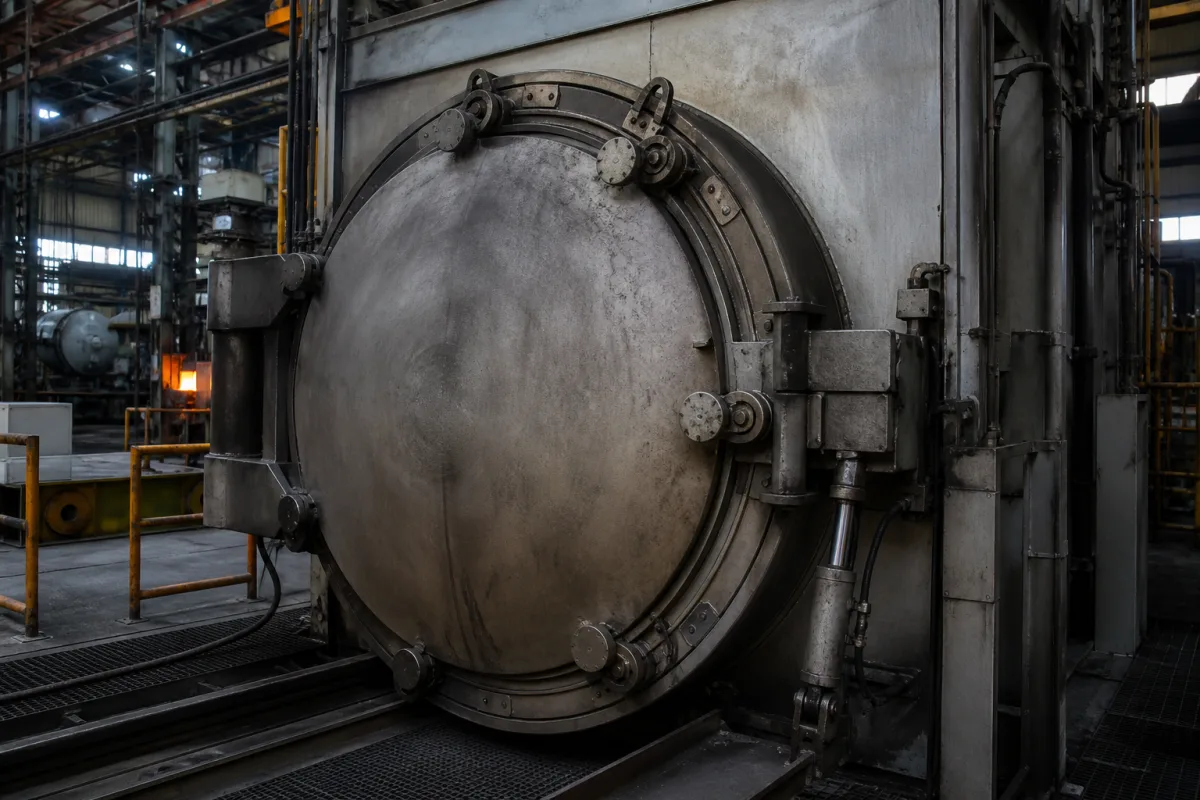
Quick-opening sealing door for retorts and autoclaves: the locking-ring closure on a pressurised sterilizing vessel and the interlocks that stop it opening under pressure
Quick-opening sealing door for horizontal retorts, autoclaves and pressure sterilizers · locking-ring and lug closures, door interlocks, nil-pressure test cock, 8 mm safety catch and ring inspection
Steam retorts for canned food, sterilizers, and curing or bonding autoclaves are horizontal pressure vessels with a door on one end that has to open every cycle. Instead of a welded head, the vessel end is closed by a door held by a rotating locking ring, interlocking lugs, clamps or swing bolts, sealed by a gasket. The accidents described by the National Board and the UK Health and Safety Executive happened at this door: opened with pressure still inside, or held by a worn locking ring. This page covers the door as a pressure closure: the load it carries, the locking types, the interlocks and nil-pressure checks that guidance and law require, and what to inspect.
Quick-opening (quick-actuating) doors and lids on pressurised batch vessels: food retorts, sterilizers and process autoclaves, with their locking rings, lugs, clamps, seals, interlocks, test cocks and safety catches. Continuous tunnel sterilizers and pasteurizers working at atmospheric pressure are covered on the Tunnel sterilizer (tunnel pasteurizer) for filled bottles and cans page, the Automated food sterilization tunnel for sealed trays and pouches page and the Sterilization zone for sealed food trays and pouches page. Vacuum chamber doors are covered on the Vacuum chamber body and Vacuum chamber door hinge system pages; machine guard doors on the Hinged access door for machine guarding page.
CNFX editorial research · Sources checked October 13, 2026 · 3 sources
The load on the door: 1,178 lb on a 10 in lid at 15 psig, over 1.13 million lb on a 10 ft door at 100 psig
M. L. Snow, writing in the National Board BULLETIN, groups retorts, sterilizers, vulcanizers and curing cylinders together as autoclaves with quick-opening doors, fitted to one or both ends of horizontal vessels or as the top head of vertical ones, and shows why the door deserves respect by working out its load. [1]
Snow lists the locking types in use as interlocking lug, expanding or contracting ring, clamp, cam latch, bar locking and swing bolt doors, and sets design aims for all of them: failure of one locking element must not release the others, the holding elements must be visible from outside so full engagement can be checked, and a pressure indicating device must be visible from the operating area. He cites a brick-curing cylinder, 8 ft 6 in by 108 ft, whose door blew off at 145 psig working pressure; the cause was traced to reduced bearing area on worn edges and possible slippage of the locking ring. [1]
Editorial calculation: load = pressure × door area. For a 1.5 m diameter retort door (area π × 0.75² = 1.77 m²), a residual 0.2 bar (20 kPa) that may hardly show on a gauge still gives 1.77 × 20,000 ≈ 35 kN, about 3.6 tonnes-force. HSE warns of exactly this: on larger autoclaves residual pressure may not register on a gauge but, over the area of a large door, releases violently. [2]
Give the supplier the design pressure and temperature, the door clear opening diameter, the locking type wanted (ring, lug, clamp or bolt) and whether the door is manual, hydraulic or automated.
02
No pressure until locked, no unlocking until vented: interlocks, the test cock and a safety catch that limits opening to 8 mm
South Africa's Pressure Equipment Regulations, 2009 (regulation 16) put the rule in law: a user must provide pressure equipment with a quick-actuating opening with an interlock or other effective means that prevents pressure rising before the opening is fully closed and locked, and prevents release before the pressure has been reduced to atmospheric or equalised. [3]
HSE wrote PM73 after two UK deaths since 2008, one of them an employee struck by an autoclave door that opened while still under pressure. [2] Snow describes simple plant-made interlocks: a pin on the vent valve stem that only lets the vent close when holes in the door ring and door line up in the fully locked position, so that the door cannot be opened unless the vent is wide open. [1]
Requirement in HSE PM73
What it asks for
Pressurising interlock
Interlock the door-securing mechanism with the pressurising fluid inlet valve (steam, air or gas), with the heat source if pressure comes from boiling liquid, or with the pump [2]
Door position
Verify door position on automated doors, for example with more than one position sensor, plus a visual indicator [2]
Venting before unlocking
Vent the autoclave to atmospheric pressure before the door-securing mechanism can be disengaged [2]
Safety catch
Strong enough to resist single-component failure of the locking assembly, released only after the mechanism is disengaged and the seal broken; HSE recommends it withstand normal working pressure [2]
Sticking seal
Break the seal with the door still captive; otherwise restrict movement so the door opens not more than 8 mm after partial release [2]
Nil-pressure check
A vent valve (test cock) to verify nil pressure; on automated systems opened by a hard-wired test sequence with independent sensors [2]
Hot contents
Optionally interlock opening with temperature sensors where the contents stay hottest [2]
Walk-in vessels
A device stopping the door closing and the cycle starting with someone inside [2]
Ask the supplier to list every interlock on the door, what each one blocks (inlet valve, heat, unlocking), how door position is sensed, and how the test cock and safety catch work.
03
Inspecting the ring, lugs and opening: four position switches, monthly checks and no more than 1 % out-of-round
Snow recommends checking the moving parts of door assemblies and safety devices at least monthly and the whole vessel annually. Because a binding locking ring can pivot about the sticking point and shift its overlap on the lugs, ring-position devices such as microswitches should sit at four equal quadrants of the ring, not one. The vessel opening's out-of-roundness, the difference between maximum and minimum inside diameter, should not exceed 1 % of nominal diameter and preferably be zero. [1]
HSE treats the rotating ring of a three-part door-locking assembly as a safety-critical single component holding the door to the vessel rim, and asks for dimension checks with close visual inspection to make sure it is not running eccentrically, plus checks that securing bolts are tight, welds are not cracked and wedges or castellations are within tolerance, with greasing as the manufacturer recommends. [2]
Editorial calculation: for a 1,500 mm nominal opening, Snow's 1 % limit allows at most 15 mm between the largest and smallest measured inside diameter.
Ask for the locking-ring and lug inspection procedure, the dimensions to measure and their limits, and the gasket specification for replacements.
04
What to send for a retort or autoclave door
Paste it into your enquiry below or into an email to a maker, then replace every bracket.
Vessel: [retort, sterilizer or autoclave; horizontal or vertical]
Design: [pressure; temperature; code of construction]
Opening: [clear diameter; one or both ends]
Locking: [ring, lug, clamp or bolt; manual, hydraulic or automated]
Seal: [gasket material; inflatable or compression]
Safety: [pressurising interlock; position sensors; test cock; safety catch; temperature interlock]
Inspection: [ring and opening dimensions and limits]
Explore company information and manufacturing capabilities, then discuss the scope of your project with a relevant supplier.
Share this page
Compiled and source-reviewed by the CNFX editorial team.
Each manufacturer above links to the page on that company's own website where the product is listed, with the date we checked it. How we source and review
· Page last updated 13 October 2026
Buyer questions
How much force acts on an autoclave door?
Pressure times door area: Snow, in the National Board BULLETIN, gives 1,178 lb for a 10 in lid at 15 psig and 1,130,976 lb for a 10 ft door at 100 psig. [1]
What stops a retort door being opened under pressure?
An interlock between the door-securing mechanism and the pressurising inlet, venting to atmospheric before unlocking, a test cock to prove nil pressure, and a safety catch; HSE PM73 limits opening to 8 mm after partial release where the seal may stick. [2]
Is a door interlock a legal requirement?
Under South Africa's Pressure Equipment Regulations, 2009, regulation 16, a user must provide quick-actuating openings with an interlock or other effective means. [3]
Sources and what still needs a direct check
Sources checked 2026-10-13. Door loads, locking types, failure cases and inspection points come from M. L. Snow's National Board BULLETIN article; interlocks, safety catch and test cock from the UK Health and Safety Executive's PM73; the legal interlock duty from South Africa's Pressure Equipment Regulations, 2009.