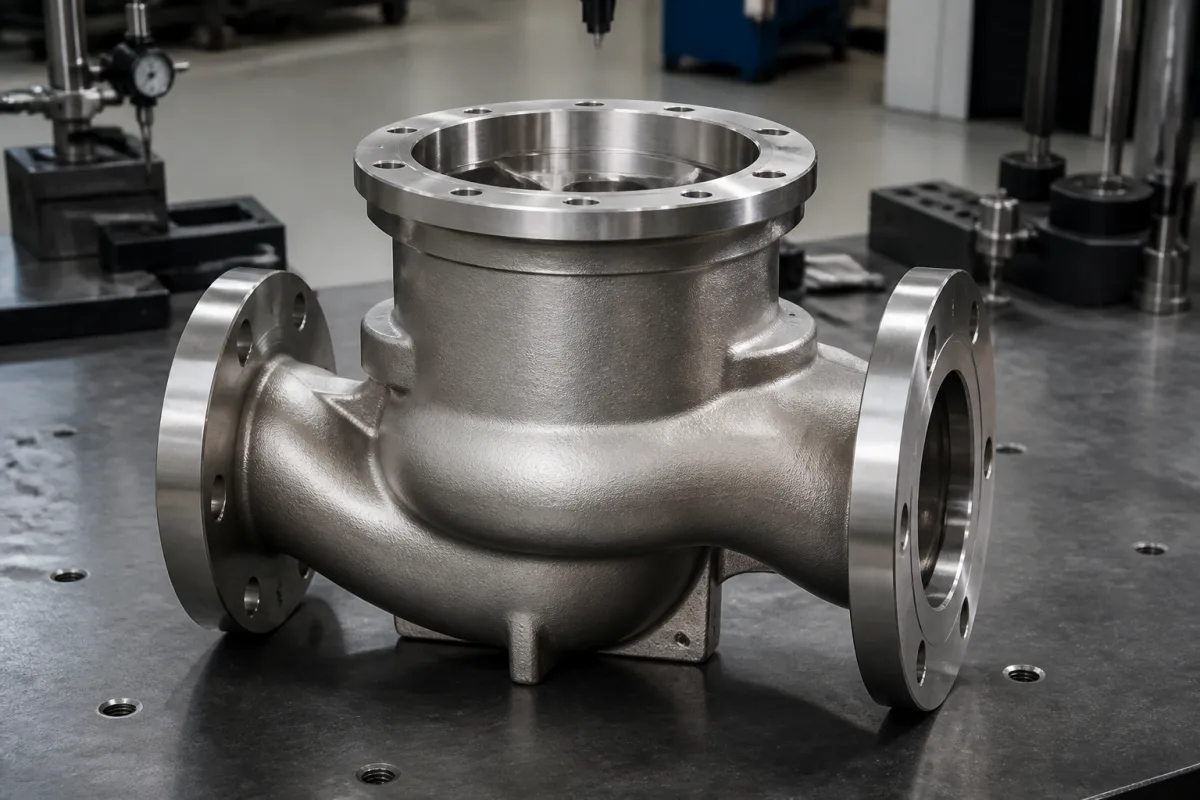
Cast stainless-steel valve body: the flanged A351 CF8M pressure shell of a globe-pattern valve, its grade, its ASME B16.34 rating and its shell test
A351 CF8M austenitic stainless castings for flanged valves · 485 MPa / 205 MPa minimum · 19.0 bar Class 150 at 38 °C · 3.0 MPa shell test
A valve body is the part that holds the line pressure: an S-shaped flow passage between two end flanges, with a third flange on top where the bonnet closes it. For a cast stainless body three things decide whether it fits a duty: the casting grade and its minimum properties, the pressure the class allows at the operating temperature, and the hydrostatic shell test the finished body passes before it ships.
Cast austenitic stainless-steel bodies for flanged valves, in particular globe-pattern bodies in ASTM A351 CF8M and CF3M, supplied as castings or machined bodies for valve assembly and repair: casting grade and heat treatment, ASME B16.34 pressure-temperature class, end flanges and face-to-face length, bonnet joint, and hydrostatic shell testing. Complete spring-loaded and pilot-operated relief valves are covered on the Pressure relief valve page, their replacement discs and nozzles on the Pressure relief valve disc and seat assembly page, and hygienic relief valves on the Sanitary pressure relief valve page. Forged carbon and alloy steel bodies are covered on the Forged steel valve body page.
CNFX editorial research · Sources checked October 13, 2026 · 3 sources
A351 CF8M: the cast 316 chemistry and the 485 / 205 MPa minimums a body casting has to certify
ASTM A351 covers austenitic castings for pressure-containing parts, and ICAST Alloys' data sheet for grade CF8M lists it for valves and pumps. The limits it gives are C 0.08 % max, Si 1.50 % max, Mn 1.50 % max, P and S 0.040 % max each, Cr 18.0 to 21.0 %, Ni 9.0 to 12.0 %, Mo 2.0 to 3.0 %, balance iron, with solution annealing as the heat treatment. [1]
ICAST cross-references the grade to A743 CF8M, wrought AISI 316 and DIN/EN 1.4409 castings, and notes that its sheet is for reference and that values in practice vary case to case. [1] For a pressure body the mill certificate from the foundry, not a reference sheet, is what proves the heat.
CF3M is the low-carbon version listed together with CF8M in the B16.34 tables. Emerson's bulletin notes that above 538 °C a material is to be used only when its carbon content is 0.04 % or higher, so the carbon limit of the grade chosen matters for high-temperature bodies. [2]
State the grade (CF8M or CF3M), the heat treatment, and the certificates required: chemical analysis and tensile test for each heat.
02
What a CF8M body is rated for: 19.0 bar in Class 150 at 38 °C, down to 6.5 bar at 400 °C
Emerson's bulletin of ASME B16.34 ratings, taken from the standard, lists cast A351 CF8M and CF3M in one column. The rating falls with temperature, and the class sets the level. [2]
Two things stand out in the bulletin's numbers. At room temperature a CF8M body in Class 300 is rated a little below a WCB carbon-steel body, 49.6 against 51.1 bar; at 538 °C it keeps 25.2 bar where WCB is down to 5.9 bar. And in Class 150 every cast grade in the table has the same rating from 250 °C upward, 12.1 bar at 250 °C and 10.2 bar at 300 °C, so stainless buys no extra pressure there in that class. [2]
The bulletin adds that flanged-end ratings terminate at 538 °C, and that a valve under the ASME Boiler and Pressure Vessel Code, a piping code or regulation is subject to that code's limits as well. [2] Editorial calculation: Class 300 at 38 °C, 49.6 bar, is 2.6 times the Class 150 value of 19.0 bar.
Give the design pressure and the highest and lowest temperatures, so the class can be checked against the CF8M column at the actual temperature, not at 38 °C.
03
Shell test at 3.0 MPa, seat test at 2.2 MPa: the test pressures on a Class 150 CF8M globe valve
Anix's drawing for its GL41W6F/150 flanged globe valve, NPS 1½ to 14, shows what is cast in CF8M: body, bonnet and disc in A351 CF8M, with an A182 F316 stem, A193 B8M studs and A194 8M nuts, and an SS316-jacketed graphite bonnet gasket. It cites ASME B16.34-2009 for design, B16.10 for face-to-face, B16.5 for end flanges and API 598-2009 for inspection and test. [3]
The test block on the same drawing gives a shell test of 3.0 MPa and a seal test of 2.2 MPa with water at normal temperature, and a gas seal test of 0.6 MPa with air; the applicable temperature is listed as −20 to 797 °F. [3] Editorial calculation: 3.0 MPa is 30 bar, 1.58 times the 19.0 bar Class 150 CF8M rating at 38 °C in Emerson's table, and 2.2 MPa is 1.16 times it. [2]
The dimension table on the OCR-read drawing gives face-to-face lengths of 7.992 in for NPS 2 and 11.496 in for NPS 4, flange diameters of 5.984 in and 9.016 in, and weights of 36.156 lb and 112.436 lb. [3] Editorial calculation: about 203 mm and 292 mm face to face, about 16.4 kg and 51.0 kg. Ask the supplier for the dimension drawing of the actual size, since the numbers here were read from a scanned drawing.
State the test medium, shell and seat pressures, hold times and the standard (API 598 edition or other) that the body or valve must pass, and whether the bare casting is to be shell-tested before machining.
04
Data for a cast stainless valve body
Paste it into your enquiry below or into an email to a maker, then replace every bracket.
Grade: [A351 CF8M / CF3M; heat treatment; certificates per heat]
Pattern: [globe / other; NPS; class 150 / 300 / 600]
Ends: [B16.5 raised-face flanges; face-to-face to B16.10]
Bonnet joint: [flange size, studs B8M, gasket type]
Duty: [design pressure; max and min temperature; fluid]
Testing: [shell test pressure and medium; seat and gas tests; standard and edition]
Supply state: [rough casting / machined / with bonnet; drawings]
Explore company information and manufacturing capabilities, then discuss the scope of your project with a relevant supplier.
Share this page
Compiled and source-reviewed by the CNFX editorial team.
Each manufacturer above links to the page on that company's own website where the product is listed, with the date we checked it. How we source and review
· Page last updated 13 October 2026
Buyer questions
What are the minimum properties of an A351 CF8M valve body casting?
ICAST Alloys lists 485 MPa tensile, 205 MPa yield and 30 % elongation, with Cr 18 to 21 %, Ni 9 to 12 % and Mo 2 to 3 %. [1]
What pressure is a Class 150 CF8M valve body rated for?
Emerson's B16.34 tables give 19.0 bar from −29 to 38 °C, 16.2 bar at 100 °C, 10.2 bar at 300 °C and 6.5 bar at 400 °C. [2]
Does a stainless body hold more pressure than carbon steel?
Not at room temperature in Emerson's Class 300 tables: CF8M is 49.6 bar against 51.1 bar for WCB. At 538 °C CF8M keeps 25.2 bar against 5.9 bar. [2]
What shell test pressure is used for a Class 150 CF8M globe valve?
Anix's GL41W6F/150 drawing gives a 3.0 MPa shell test and a 2.2 MPa seat test with water, and a 0.6 MPa gas seat test. [3]
Sources and what still needs a direct check
Sources checked 2026-10-13. ICAST Alloys' data sheet for ASTM A351 CF8M castings, Emerson's bulletin of ASME B16.34 pressure-temperature ratings by body material, and Anix Valve's drawing and product page for a Class 150 CF8M flanged globe valve.