Water treatment · Capacity from hardness, resin volume and salt dose, service flow, backwash and regeneration
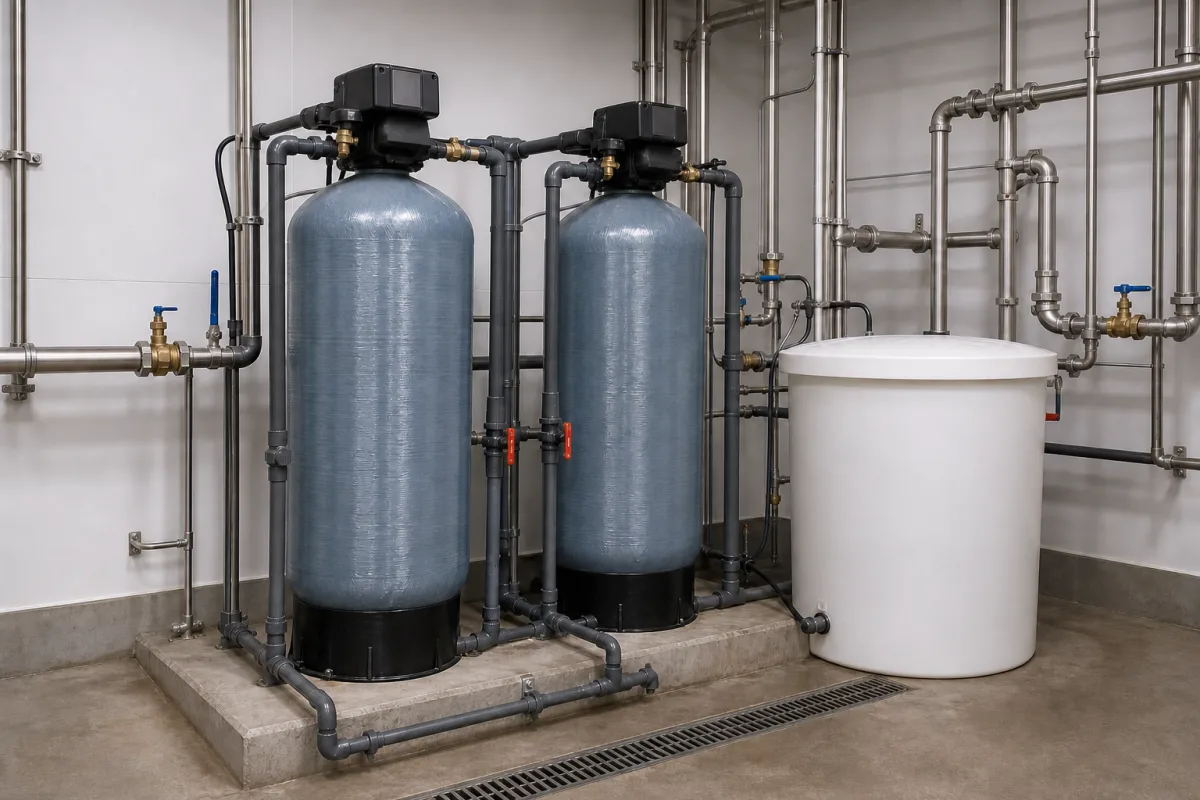
An ion exchange water softener passes water through a bed of sodium-form cation resin that removes calcium and magnesium, then regenerates the resin with brine. Ask three things first: the raw-water hardness and daily volume, the resin volume and salt dose that set capacity, and the service flow the bed can handle.
Ion exchange water softeners for commercial, industrial and household use, including single and multi-tank units with control valves and brine tanks. Reverse osmosis, demineralisers, resin sold on its own and softener components such as tanks or control boards are outside this page.
CNFX editorial research · Sources checked October 11, 2026 · 4 sources
Size the capacity from hardness, resin volume and salt dose
Chem-Aqua's technical bulletin explains that softeners remove scale-forming calcium and magnesium before boiler, cooling and reverse osmosis systems. Capacity needs three values: raw-water hardness in ppm, resin volume in cubic feet, and salt dose per cubic foot. Chem-Aqua gives a salt dosage of 15 lbs/ft3 resin (typ.) for an exchange capacity of 30,000 grains/ft3 resin [1]; lower doses reduce capacity but use salt more economically. Hardness in ppm divided by 17.1 gives grains per US gallon, and a 10% safety factor is applied to prevent hardness breakthrough. [1]
The bulletin's example: 118 ppm hardness (6.9 gpg), 6 ft³ of resin at 15 lb/ft³, giving 180,000 grains, 26,087 gallons, or 23,478 gallons after the safety factor. [1]
Editorial calculation in metric units: 6 ft³ is about 170 L of resin; 180,000 grains is about 11.7 kg of hardness as CaCO₃, which at 118 mg/L treats about 99 m³, or about 89 m³ with the 10% safety factor. The salt per regeneration is 6 × 15 = 90 lb, about 41 kg; 15 lb/ft³ is about 240 kg/m³ of resin. [1]
Editorial calculation: 30,000 grains/ft³ is about 1.37 eq/L, against a minimum total capacity of 2.0 eq/L for Purolite C100 resin, so the operating capacity Chem-Aqua gives at 15 lb/ft³ uses about 69% of the resin's total capacity. [1][2]
Give the supplier the raw-water hardness and its range, iron and other contaminants, daily and peak volume, required soft-water hardness, operating hours, whether service must continue during regeneration, salt type and drain capacity.
02
Check service flow, backwash and resin limits
Purolite C100 is a gel polystyrene strong acid cation resin in sodium form for industrial softening. Its data sheet gives service flow rates of 10 to 40 bed volumes per hour depending on water quality, application and plant design, and calls for up-flow backwash that expands the bed by 50 to 70% for at least 10 to 15 minutes; over-expansion can carry resin out of the top of the vessel. The temperature limit is 120 °C and the particle size range 300–1,200 µm. [2]
Editorial calculation: 170 L of resin at 10–40 bed volumes per hour handles about 1.7–6.8 m³/h. Pressure drop rises with flow, bed depth, particulate matter trapped in the bed and incomplete classification of the bed. [2]
Tank size sets resin volume: Chem-Aqua's table lists, for example, 1 ft³ in a 10 in diameter tank, 4 ft³ in 16 in, 10 ft³ in 24 in and 65 ft³ in a 60 in tank. [1]
03
Industrial plants, valve-and-tank packages and household units
Foren, Chunke, Roagua, Moer and Aoteng list softening systems among industrial water treatment equipment; Canature lists water softeners with control valves and brine tanks; Basidewt lists softener systems with control valves, FRP tanks and resin; Hidrotek and Jubei list household water softeners.
04
Plan for added sodium, regeneration water, iron and salt quality
University of Nebraska–Lincoln Extension's NebGuide on household ion exchange softening gives side effects a buyer should plan for. Sodium is added to the water at about 8 mg/L for each grain per gallon of hardness removed, so water that was 10 gpg of hardness will have about 80 mg/L of sodium after treatment; the guide says people on restricted sodium diets should account for this and consult their physician. [3] Each regeneration uses approximately 50 gallons of water and places additional load on a septic system, and the guide puts the time for the brine to pass through the unit and flush the tank, before soft water is available again, at sixty to 120 minutes. [3] Editorial calculation: 50 US gallons is about 189 L (50 × 3.785).
On feed water, the guide says softeners may remove as much as 5-10 ppm of iron and manganese, that buyers should check the manufacturer's removal rating, and that excess iron (above 5 ppm) or hydrogen sulfide can reduce the effectiveness of the softener, calling for pretreatment such as greensand filters. [3] On salt, it advises using rock salt only if the manufacturer suggests it and only grades averaging less than 1 percent impurities, and notes that potassium chloride adheres more strongly to the resin, reducing exchange efficiency and requiring more salt. [3] For certification, it names the NSF and Water Quality Association programs, which use the same NSF standards. [3]
05
Classify the hardness and choose how regeneration is started
North Dakota State University Extension's WQ1031 (revised May 2022) classifies hardness as calcium carbonate (table) and takes 1 gpg as 17 ppm or 17 mg/L; citing NSF International, it says consumers see a problem once hardness passes 6 to 7 gpg. Some softeners also remove up to 10 ppm of iron and manganese, and water above 10 ppm may need a dedicated iron removal system. [4]
WQ1031 sorts softeners by how regeneration is started: semiautomatic (the operator starts it), automatic on a programmable timer, demand-initiated regeneration (DIR) in response to soft-water demand, which NDSU describes with two softening tanks and a brine tank so one tank softens while the other recharges, and off-site regeneration, where a spent tank is swapped for a recharged one. Recharging too early wastes salt and water; too late, performance falls off. Potassium chloride uses about 10% more salt than sodium chloride. [4]
Editorial calculation: Chem-Aqua's 118 ppm example water sits in NDSU's moderately hard band, and 118 ÷ 17 = 6.9 gpg, matching Chem-Aqua's 6.9 gpg at 17.1. [1] Ask the supplier which of the four regeneration modes it offers and whether soft water continues during regeneration.
Hardness class (NDSU)
mg/L or ppm as CaCO₃
Grains per gallon
Soft
Less than 17
Below 1.0
Slightly hard
17–60
1.0 to 3.5
Moderately hard
61–120
3.5 to 7.0
Hard
121–180
7.0 to 10.5
Very hard
Above the hard band
Above 10.5
06
Resin bed, vessel, control valve and brine tank
The distributor and freeboard row is the one that bites with this resin: without room for 50–70% bed expansion, backwash carries resin out of the vessel. [2]
Explore company information and manufacturing capabilities, then discuss the scope of your project with a relevant supplier.
Share this page
Compiled and source-reviewed by the CNFX editorial team.
Each manufacturer above links to the page on that company's own website where the product is listed, with the date we checked it. How we source and review
· Page last updated 13 October 2026
Buyer questions
How do I calculate softener capacity?
Multiply resin volume by its exchange capacity at your salt dose (Chem-Aqua gives 30,000 grains/ft3 resin at a salt dosage of 15 lbs/ft3 (typ.)), divide by hardness in grains per gallon, and apply a 10% safety factor. [1]
Does using less salt reduce capacity?
Yes. Lower salt doses reduce capacity but use salt more economically. [1]
How fast can water flow through a softener?
For Purolite C100 resin, service flow is 10–40 bed volumes per hour depending on water quality and plant design. [2]
How much sodium does a water softener add?
University of Nebraska–Lincoln Extension gives about 8 mg/L of sodium per grain per gallon of hardness removed, so 10 gpg water ends up with about 80 mg/L. [3]
How hard does water have to be before a softener is worth considering?
North Dakota State University Extension's WQ1031 classes 7.0 to 10.5 gpg (121–180 mg/L) as hard and, citing NSF International, says consumers see a problem once hardness passes 6 to 7 gpg. [4]
Sources and what still needs a direct check
Sources checked 2026-10-11. Chem-Aqua is a water treatment company; its sizing method is its own. Purolite (Ecolab) is a resin maker; its data sheet describes one resin, used here as a worked example.