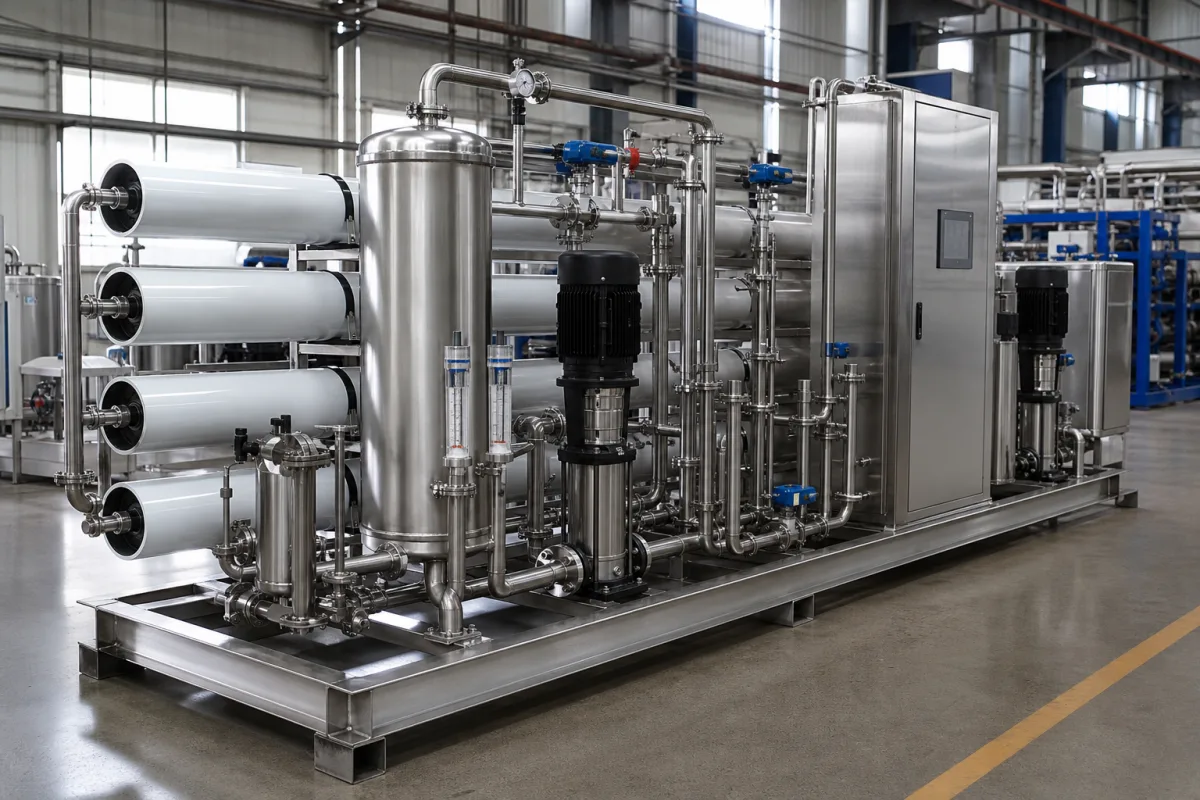
Boiler make-up water treatment module: second-pass RO or membrane CO₂ removal ahead of an EDI polishing stack
Skid modules that take first-pass RO permeate down to EDI feed quality for high-pressure boilers · caustic dosing ahead of a second RO pass or a vacuum membrane degasser, then electrodeionization stacks rated by feed hardness, silica and exchangeable anions
A single RO pass leaves dissolved carbon dioxide and traces of silica and hardness that a high-pressure boiler cannot accept, and that would load an electrodeionization (EDI) stack or a mixed bed. The module that finishes the job sits between the first-pass permeate and the boiler feedwater tank. Two layouts compete: raise the pH with caustic and send the permeate through a second RO pass, or strip the CO₂ in a vacuum membrane contactor and feed the EDI directly. Either way, the EDI stack's own feed limits decide how clean the water reaching it has to be.
Skid-mounted polishing modules that turn first-pass RO permeate into demineralised make-up water for high-pressure boilers: second-pass RO with caustic injection, membrane-contactor CO₂ removal, and the EDI stacks that follow, specified by feed hardness, silica, exchangeable anions, recovery and product resistivity. Packaged brackish-water RO systems with multimedia filtration, softening, dechlorination and storage for beverage, food and general process water are covered on the Water treatment system page; seawater desalination skids on the Seawater reverse osmosis (SWRO) unit page; ion-exchange softeners on the Water softener (ion exchange unit) page; thermal deaeration on the Deaerator page; oxygen-scavenger and phosphate dosing into the boiler on the Chemical dosing system page; the boiler plant itself on the Industrial steam generation system for process heating page; and ballast-water filter elements on the Ballast water treatment filter element page.
CNFX editorial research · Sources checked October 13, 2026 · 3 sources
Getting CO₂ out of first-pass permeate: caustic and a second RO pass, or a vacuum membrane contactor
Carbon dioxide is the problem the module has to solve first. Hydranautics explains that at pH 8.2 and above all dissolved CO₂ is converted to bicarbonate, which an RO membrane rejects, whereas CO₂ as a gas passes straight into the permeate and becomes a load on downstream polishing; that is why caustic is injected into the second-pass feed. [2] The same bulletin lists three further reasons for the higher pH (better rejection of some TOC constituents, and higher silica and boron rejection, particularly above pH 9) and says a second pass polishes first-pass permeate to as good as 4 megohm-cm. [2]
The dosing chemical is sodium hydroxide, supplied as flake or 20 % or 50 % solution; Hydranautics warns that 50 % caustic can freeze just below 15.5 °C (60 °F) and that raising pH lowers the solubility of iron, manganese and calcium carbonate. [2] On a skid that means a heated or indoor caustic day tank and a check that first-pass permeate hardness is low enough before the pH is lifted.
3M documents the alternative at a heat and power plant in north-east China, where a design of ultrafiltration, a single RO pass, Liqui-Cel hollow-fibre membrane contactors and EDI was chosen over double-pass RO plus EDI. [3] The plant runs two 80 m³/h trains; two 14-inch contactors in parallel treat 90 m³/h with air sweep and a vacuum pump of 360 m³/h at −0.094 MPa, bringing CO₂ from 10–12 ppm in the RO permeate (6.8 µS/cm) to 1–2 ppm, and the EDI product reaches 0.06–0.071 µS/cm (14–16.7 MΩ·cm) with 5 ppb silica from raw water carrying 5.5 ppm SiO₂ and 280 mg/L alkalinity as CaCO₃. [3] 3M also notes the contactor removes oxygen as well as CO₂, which it presents as a benefit when the water goes to boiler feed. [3]
Editorial calculation: share of first-pass feed reaching EDI
0.75 × 0.85 ≈ 64 %
75 %
Editorial calculation, using 3M's (typ.) splits and Veolia's up-to-96 % EDI recovery [1]: roughly 0.64 × 0.96 ≈ 61 % of first-pass feed becomes EDI product in the double-pass layout against 0.75 × 0.96 ≈ 72 % with the contactor, assuming no reject is recycled. Ask each bidder to state the recycle arrangement they assume.
02
EDI stack feed limits: hardness, silica, exchangeable anions and the counter-current rating
Whatever sits upstream is judged against the EDI stack's feed specification. Veolia's E-Cell MK-3 stack, which it lists for demineralised boiler feed water for high-pressure boilers, requires RO permeate or equivalent as feed because its packed ion-exchange beds cannot be backwashed, and asks for a 5 µm absolute or 1 µm nominal filter in front of the stack wherever there is an open tank or decarbonator between RO and EDI. [1]
On the product side Veolia offers guarantees of resistivity ≥ 16 MΩ·cm and sodium ≤ 3 ppb, silica as low as 5 ppb, with up to 96 % recovery, 0–300 V DC and 0–5.2 A DC per stack, inlet pressure up to 6.9 bar and a 1.4–2.8 bar pressure drop at nominal flow and 25 °C; it states that guarantees depend on site conditions and must be confirmed in its Winflows projection. [1] One stack is rated 3.4 m³/h nominal within 1.6–4.5 m³/h, weighs 100 kg and measures 30 × 61 × 54 cm. [1]
Editorial calculation: an 80 m³/h EDI duty like the 3M plant's [3] would need about 24 MK-3 stacks at nominal flow (80 / 3.4) and no fewer than 18 at the top of the range (80 / 4.5), which is why stack count, manifolding and the DC power supplies take up much of a module's frame.
Send the EDI supplier the analysis of the water actually reaching the stack (after the second pass or degasser), including CO₂ and silica, the flow direction (counter- or co-current) and the guarantees required; the hardness limit falls tenfold in co-current operation.
03
Data for a boiler make-up polishing module
Paste it into your enquiry below or into an email to a maker, then replace every bracket.
Feed: [first-pass RO permeate flow, conductivity, CO₂, silica, hardness, boron, temperature range]
CO₂ route: [second-pass RO with NaOH dosing to pH; or membrane contactor with vacuum and sweep]
EDI: [stack model and count; counter- or co-current; product resistivity, sodium and silica guarantees]
Recovery: [per stage and overall; reject recycle]
Boiler side: [boiler pressure; feedwater limits the plant must meet]
Skid: [frame material; DC power supplies; prefilter rating; footprint]
Explore company information and manufacturing capabilities, then discuss the scope of your project with a relevant supplier.
Share this page
Compiled and source-reviewed by the CNFX editorial team.
Each manufacturer above links to the page on that company's own website where the product is listed, with the date we checked it. How we source and review
· Page last updated 13 October 2026
Buyer questions
Why is caustic added before a second RO pass?
Above pH 8.2 dissolved CO₂ is converted to bicarbonate, which the membrane rejects; left as gas it passes into the permeate and loads the polishing stage. Higher pH also improves silica and boron rejection. [2]
Can a membrane degasser replace the second RO pass?
In a plant documented by 3M, Liqui-Cel contactors cut CO₂ in single-pass RO permeate from 10–12 ppm to 1–2 ppm, and the EDI produced 14–16.7 MΩ·cm water with 5 ppb silica without a second pass or caustic. [3]
How much hardness can an EDI stack accept?
Veolia's E-Cell MK-3 allows 1.0 ppm as CaCO₃ in counter-current operation but only 0.1 ppm in co-current operation, with silica limited to 1.0 ppm (0.5 ppm when hardness exceeds 0.5 ppm). [1]
What product water does an EDI stack guarantee?
Veolia offers resistivity of at least 16 MΩ·cm and sodium of 3 ppb or less, silica as low as 5 ppb, subject to its projection for the site conditions. [1]
Sources and what still needs a direct check
Sources checked 2026-10-13. Three manufacturer documents from different companies: Veolia's E-Cell MK-3 EDI stack fact sheet, Hydranautics' bulletin on chemical pretreatment for RO, and 3M's technical brief on a power-plant membrane system with Liqui-Cel CO₂ removal.