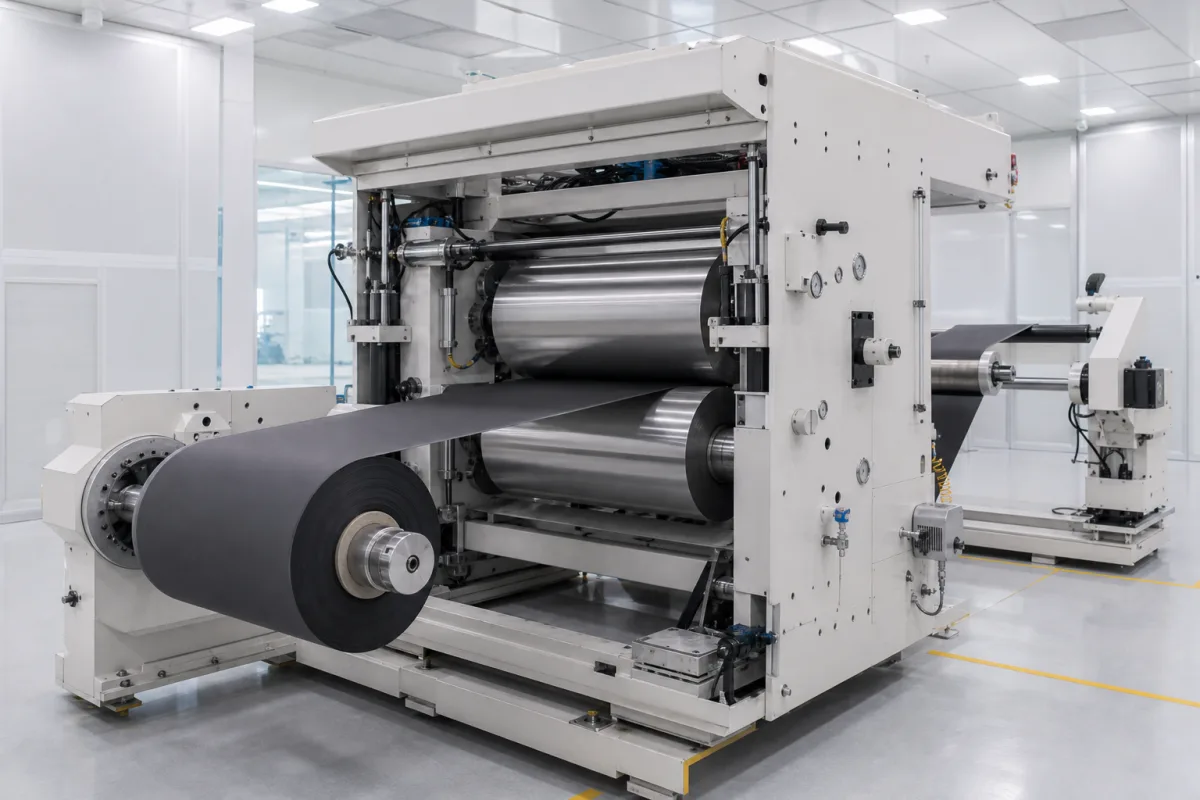
Electrode calenders (rolling presses) for lithium-ion battery anodes and cathodes · roll diameter and width, line load and total press force, roll temperature, speed, roll gap and thickness control, roll hardness and surface finish, compaction density and porosity
An electrode calender, or rolling press, squeezes a coated and dried battery electrode between two hard steel rolls to bring the coating to a set thickness and density, which fixes porosity and volumetric energy density before slitting and cell assembly. Ask three things first: the roll diameter, face width and force (as line load per mm of electrode width) needed for your electrode; the roll temperature, speed and gap control that will hold thickness; and the target density or porosity for each anode and cathode material.
Roll-to-roll and lab calenders (rolling presses) for lithium-ion and sodium-ion battery electrodes, with hydraulic press force, gap control, heated or unheated rolls, and unwinding, tension and web-guiding units. Coating and drying machines, slitters, cell hot and cold presses, powder tablet presses and roll grinding services are outside this page except where compared.
CNFX editorial research · Sources checked October 11, 2026 · 5 sources
The calender used at Karlsruhe Institute of Technology (KIT), built by Saueressig, has rolls of 700 mm diameter and 500 mm width that can be heated to 90 °C, a maximum line load of 2000 N/mm and a maximum web speed of 30 m/min; in its trials, higher compaction required higher line loads, with loads of up to 2229 N/mm. [1] Xiamen TOB lists a continuous hydraulic roll press, model DYG-703BH, with φ500 × 550 mm rolls, a maximum work pressure of 500–3000 kN, roll speed of 2–11 rpm, 15 kW power, 380 V 50 Hz supply, a 0–2 mm gap adjustment range and an unwinding and rewinding section for electrodes up to 520 mm wide. [3]
A smaller TOB model, TOB-703B, has 400 mm diameter × 450 mm wide rolls, 200 T pressure, 7 rpm, 7.5 kW and a 400 mm electrode width. [4] TOB's press for 4680 tabless-battery electrodes lists aluminium foil of 12 µm–1.5 mm and copper foil of 6 µm–1.5 mm, widths of 150–580 mm, a maximum of 30 m/min with both rolls at the same speed, PLC and touch-screen control, tension settable from 0 to 50 N and photoelectric web correction over up to 100 mm. [5]
Editorial calculation: KIT's 2000 N/mm equals 20 kN/cm. If TOB's 3000 kN maximum were spread over the full 550 mm roll face, the line load would be about 3000 ÷ 550 ≈ 5.5 kN/mm; over a 520 mm electrode it would be about 5.8 kN/mm. Ask each supplier for line load in N/mm at your electrode width, since a total force figure alone cannot be compared. [1][3]
Editorial calculation: roll surface speed is π × diameter × rpm, so a 500 mm roll at 2–11 rpm runs at about 3.1–17.3 m/min, and a 400 mm roll at 7 rpm at about 8.8 m/min. [3][4]
Give the supplier the electrode materials (anode, cathode), foil type and thickness, coated width and web width, coating thickness before and after calendering, target density or porosity, required line load in N/mm, line speed, roll diameter and face width, roll heating need and temperature, gap and thickness control method, unwinding and rewinding sizes, tension range, web-guiding range, power supply, floor space, and quantity.
02
Set density, roll temperature and thickness control
The KIT study calendered NMC811 cathodes to densities of 2.30, 2.55, 2.80, 3.05 and 3.30 g/cm³ with rolls at 90 °C; coin cells performed best at 2.55 g/cm³ (a compaction of 14.06%), while 3.30 g/cm³ (a compaction of 34.03%) gave the lowest performance up to 2C. It cites 30–40% porosity as needed for an NMC cathode, a theoretical maximum NMC density of 4.3 g/cm³, and particle fracture at the high forces needed for high density. Higher compaction also lengthened the electrode in the running direction and caused bulges or corrugations that carried into cut sheets. [1]
A Warwick pilot-plant data set (open access) calendered NMC622 cathodes at roll temperatures of 85, 120 or 145 °C to porosities of 30, 35 or 40% at about 120 or 180 g/m² loading, on a lab calender with 203 mm rolls at 0.8 m/min and a 4000 psi hydraulic set point. The roll gap was used to control pressure, and electrodes were passed 1–3 times until thickness was within ±1 µm of the target, measured at 15 points. Porosity was calculated as 1 − (electrode density ÷ theoretical density), with a theoretical density of 4.458 g/cm³. [2]
Editorial calculation: with that 4.458 g/cm³ theoretical density, 40%, 35% and 30% porosity correspond to about 2.67, 2.90 and 3.12 g/cm³ coating density (4.458 × 0.60, × 0.65, × 0.70). Ask suppliers to demonstrate the target density on your own electrode, not on a reference material. [2]
TOB states roll cylindricity under 0.003 mm, 0.4 µm surface roughness and HRC62-65 hardness with at least 18 mm hardening depth on the TOB-703B, and 0.2 µm finish with HRC65-68 on the DYG-703BH. [4][3]
03
Compare what suppliers offer
Suppliers linked to this page list electrode rolling presses; each card links to the page reviewed.
The listings reviewed range from 400 mm and 500 mm roll presses with hydraulic force control to a roll-to-roll press with unwinding, tension and web-guiding units for 4680 tabless-battery electrodes. Ask for roll inspection reports, a calendering trial on your electrode and the thickness data from that trial.
04
Trace the calender components
This is a functional reference built from the sources cited; it is not one maker's design.
Part
Role
Fix in the order
Work rolls
Compress the coating; 400–700 mm diameter in the sources. [1][3][4]
Fill the specification fields with values for your line
An electrode calender quotation needs values for your line. The table explains each field, gives published values where a reviewed source states them, and says what to obtain from the supplier.
These companies list battery electrode calendering machines.
XIAMEN TOB NEW ENERGY TECHNOLOGY CO., LTD.
Manufacturing site to be confirmed for the order
Lists electrode rolling presses, including a roll-to-roll press for 4680 tabless-battery electrodes and φ500 × 550 mm and 400 × 450 mm hydraulic roll presses.
Explore company information and manufacturing capabilities, then discuss the scope of your project with a relevant supplier.
Share this page
Compiled and source-reviewed by the CNFX editorial team.
Published product pages show what a company offers, not tested performance. Confirm the legal seller, factory and scope for your order. How we source and review
· Page last updated 13 October 2026
Buyer questions
What line load does an electrode calender need?
The KIT calender is rated to 2000 N/mm, and its trials used up to 2229 N/mm; higher compaction required higher line loads. [1]
Why heat the calender rolls?
Research calenders run heated rolls: KIT at up to 90 °C, and a Warwick data set compared 85, 120 and 145 °C for NMC622 cathodes. [1][2]
Is the densest electrode the best?
No. In the KIT study NMC811 cells performed best at 2.55 g/cm³ and worst at 3.30 g/cm³ up to 2C. [1]
Sources and what still needs a direct check
Sources checked 2026-10-11. Two sources are research publications from KIT and the University of Warwick; three are Xiamen TOB product pages. Values for your machine must come from the supplier's specification and a trial on your electrode.