Electrode slitting · Burrs and short circuits, blade hardness and roughness, clearance and overlap, blade speed versus feed
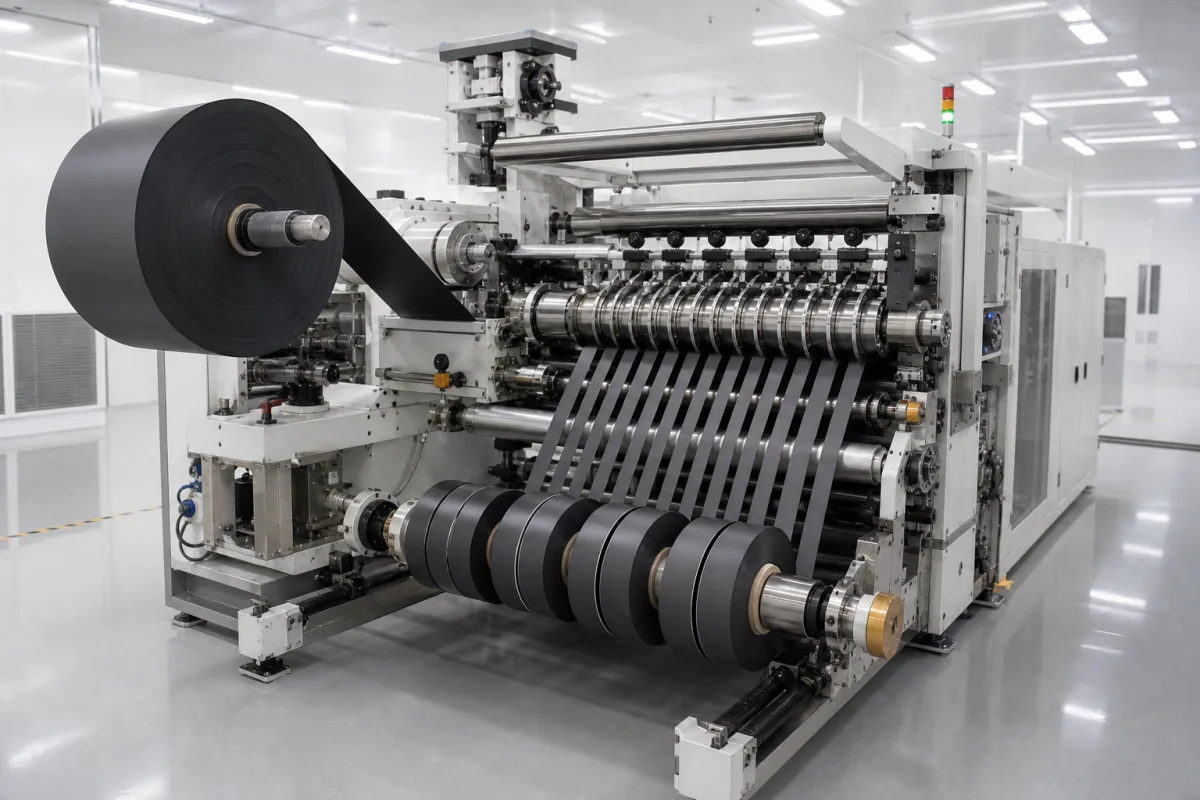
A battery electrode slitting machine unwinds a wide coated and calendered electrode roll, cuts it lengthwise into narrower strips with pairs of rotary upper and lower knives, and rewinds each strip under controlled tension for cell winding or stacking. Ask three things first: how the machine keeps burrs and loose particles off the cut edges, what knife material, geometry and finish it uses for copper and aluminium foils, and how knife clearance, overlap and speed are set and held.
Roll-to-roll rotary-knife slitters for lithium-ion and similar battery electrodes, from laboratory to production widths. Foil-mill slitters for bare aluminium foil, laser slitting systems, notching and die-cutting machines are outside this page.
CNFX editorial research · Sources checked October 11, 2026 · 4 sources
A TDK patent on slitter apparatus explains that when a coated electrode is cut by upper and lower rotary blades, the active-material layer scatters the shear force so the metal collector stretches and burrs form at the cut. On copper-foil anodes it notes burrs and copper chips, and warns that a large burr projecting above the active-material layer can break the separator and short-circuit anode and cathode. Burrs pressed down after cutting can stand up again. [1]
Its claims specify upper blades at least 1 mm thick with an included angle of 75–88°, upper and lower blade hardness of 6.9 × 10³ to 8.8 × 10³ N/mm² differing by no more than 4.9 × 10² N/mm², and surface roughness of no more than 4 μm on both blades, differing by no more than 2 μm; the description prefers 2–4 μm. It names die steels such as SKD11, high-speed steels and carbides as blade materials, preferring die or high-speed steel. [1]
Editorial note: these values are one patent's claimed design, not a standard; ask suppliers to state blade material, hardness, finish and regrinding practice, and to show burr measurements on your copper and aluminium electrodes.
Give the supplier the electrode types (anode on copper, cathode on aluminium), foil and coating thickness, roll width and diameter, number and width of strips, width tolerance, allowed burr height and dust level, line speed, tension range, core sizes, and dry-room conditions.
02
Set clearance, overlap and blade speed
A Toyota patent application on rotary slitting notes that electrode sheets use foils of about 10–15 μm, and that a clearance between the two rotary blades prolongs blade life, but a separator laminated on the electrode can flow into the clearance and cause defective cuts. Its tests used high-speed steel blades with a 45° edge, a 100 μm lap (overlap) and a feed of 30 m/min on a separator-integrated negative electrode sheet. [2]
With smooth blades (Ra 0.2) the sheet cut only at zero clearance and failed from 5 μm. With a 50 μm wide band of blasted roughness (Ra 0.5) at the edges it cut at 0–20 μm and failed from 25 μm; raising blade peripheral speed about 10% above feed, or edge roughness to Ra 1.0, extended this to 0–30 μm, failing from 35 μm. The application gives the blade speed range as V2 ≤ V1 ≤ 1.1 V2. [2]
Editorial calculation: at the tested 30 m/min feed, a 10% overspeed is a blade peripheral speed of 33 m/min. Use the patent's tests as an example of the settings to agree and verify, not as limits for your machine. [2]
03
Specify upper-knife geometry to limit dust
LG Energy Solution's US patent 12,440,906 (Korean priority 25 November 2019, granted 14 October 2025) addresses a different slitting defect from burrs: cutting the electrode plate after the active-material slurry has cured generates dust and other foreign substances, which stick to the upper and lower knives and cause defects in the cut electrode. [3]
Its upper knife has a first inner surface inclined from the tip toward the lower knife at a first angle of 0.6° to 1.1° from the vertical (preferably 0.9° to 1.0°), an outer circumferential surface inclined at 80° to 90° (preferably 85° to 90°), and an optional second inner surface at 2.6° to 3.1° (preferably 2.8° to 3.0°) stepped back from the support surface. The upper knife may be in line contact with the lower knife, with the horizontal distance from the tip to the contact point 0.01 to 0.5 mm (preferably 0.1 to 0.4 mm), and a total knife thickness of 3 to 5 mm, with the tip the first part to touch the electrode. [3]
Editorial note: the three patents set different parameters — TDK claims blade thickness of at least 1 mm, a 75–88° included angle, hardness and roughness; Toyota tests clearance and blade overspeed; LG specifies small relief angles and the contact distance. Ask each slitter supplier to give all of these on the knife drawing and to show dust and burr results on your coated electrodes. [1][2][3]
04
Set the targets and choose between knife and laser slitting
A 2025 review in iScience of battery manufacturing equipment (Concordia University) states that slitting machines should ideally hold a slitting error tolerance of 0.1 mm at a rewinding speed of 100 m/min, and that researchers and industry are working toward burr edges below 10 μm. It describes parallel blades cutting strips of equal width at once, rotary knife slitting for cylindrical-cell electrodes and die cutting for pouch and prismatic electrodes, both with hardened-alloy blades, and notes that mechanical cutting suffers wear that lowers edge quality over time. Dust from slitting coated electrodes can harm electrochemical performance and cause short circuits if it settles on the electrode, so a vacuum suction system removes it continuously. [4]
The review reports laser cutting as an alternative with reduced risk of burrs, smoother edges and no mechanical wear, but at cutting speeds of 25 to 50 m/min, which it says can be slower than conventional cutting; it adds that longer pulses can leave heat-affected zones on the cut edge, which femtosecond pulses can reduce. [4]
Editorial calculation: against the review's 100 m/min target, a laser cutting at 25–50 m/min runs at one-quarter to one-half the speed, so matching the output of one 100 m/min knife slitter would take two to four laser cutting lanes or heads. The 10 μm burr target compares with the 10–15 μm foil thickness in the Toyota patent above, so a burr at the target can still be about as high as the foil is thick. [4][2]
Widths, speed, tension and knife material to state on the slitter order
Only the feed speed and blade material rows carry a published value, both from patents; burr height belongs in the slitting accuracy row alongside width tolerance.
Xiamen TOB New Energy lists an automatic electrode slitter among its battery line equipment, Guang Dong Xiaowei New Energy lists electrode slitting in its lithium battery production lines, and KINTEK Solution lists laboratory electrode slitters.
XIAMEN TOB NEW ENERGY TECHNOLOGY CO., LTD.
Manufacturing site to be confirmed for the order
Lists a 500 mm maximum width automatic electrode slitting machine among battery line equipment.
Explore company information and manufacturing capabilities, then discuss the scope of your project with a relevant supplier.
Share this page
Compiled and source-reviewed by the CNFX editorial team.
Each manufacturer above links to the page on that company's own website where the product is listed, with the date we checked it. How we source and review
· Page last updated 13 October 2026
Buyer questions
Why are burrs on slit electrodes dangerous?
A TDK patent warns that a burr projecting above the active-material layer can break the separator and short-circuit the cell. [1]
What blade finish limits burrs?
The TDK patent claims blade surface roughness of no more than 4 μm, with upper and lower blades differing by no more than 2 μm. [1]
Should the knives run faster than the electrode?
In Toyota's tests, running blades about 10% faster than the feed widened the clearance that still cut cleanly. [2]
How can knife geometry reduce dust when slitting electrodes?
LG Energy Solution's US patent 12,440,906 uses an upper knife with a 0.6–1.1° inner relief angle, line contact with the lower knife 0.01–0.5 mm from the tip, and 3–5 mm total thickness. [3]
Is laser slitting faster than knife slitting for battery electrodes?
No; a 2025 iScience review gives laser cutting speeds of 25–50 m/min against a 100 m/min rewinding target, though lasers reduce burrs and blade wear. [4]
Sources and what still needs a direct check
Sources checked 2026-10-11. Three sources are patents (TDK, Toyota and LG Energy Solution) describing their own slitter designs and tests, and a 2025 iScience review from Concordia University summarises slitting targets and the mechanical-versus-laser choice; values are examples to verify on your electrodes, not standards.