SIP desk phones for business · PoE class and switch power budget, codecs and wideband audio, SIP accounts, ports, display and environmental limits
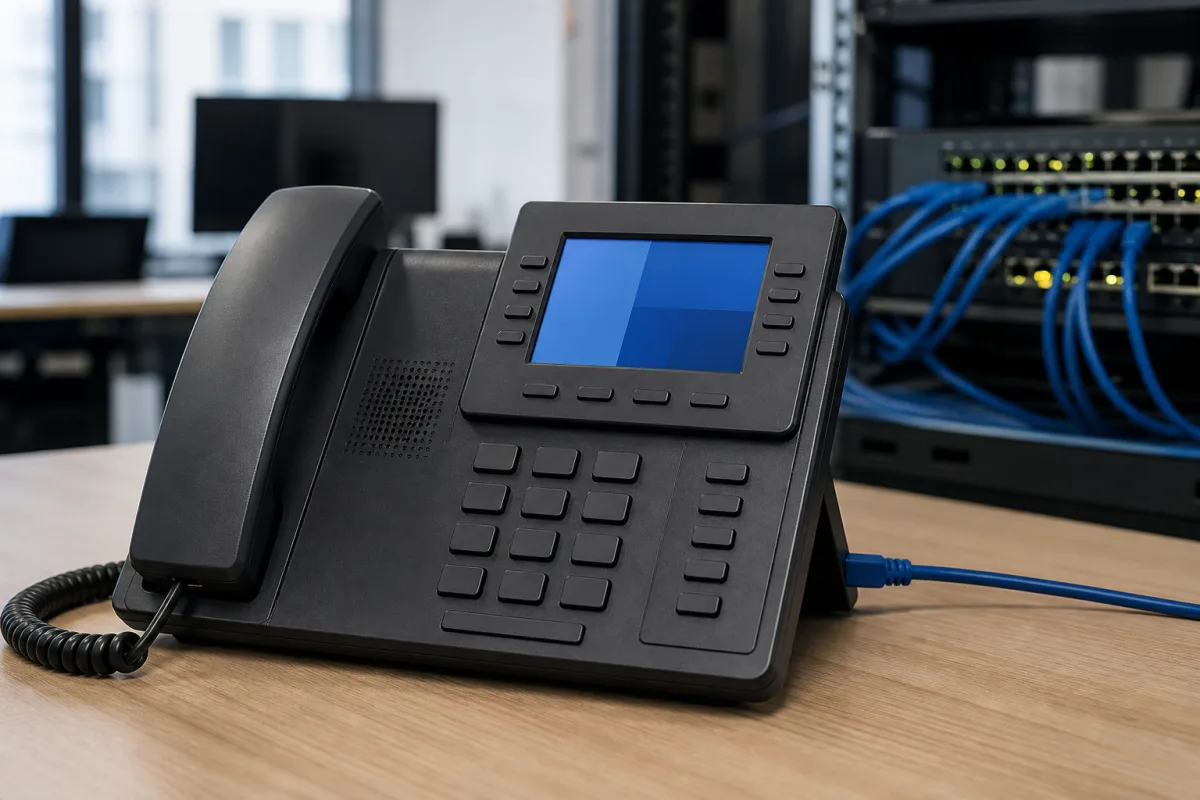
An enterprise VoIP desk phone is a SIP endpoint with handset, keypad, display and network ports that registers to an IP PBX or cloud phone system and can take its power from the network cable. Pin down three things before comparing models: the PoE class and how many phones your switches must power, the codecs and audio bandwidth your platform uses, and the number of SIP accounts, line keys, network ports and accessories each user needs.
Wired SIP desk phones for offices and contact centres, including their PoE and adapter power, audio and network interfaces. DECT cordless phones, video phones, conference speakerphones, door phones, analogue telephone adapters and softphones are outside this page.
CNFX editorial research · Sources checked October 11, 2026 · 5 sources
Snom's data sheet for its D865 desk phone lists power over Ethernet to IEEE 802.3af, class 3, with IEEE 802.3az as a software option, and an alternative power adapter (available separately) rated 100–240 V AC, 50–60 Hz input and 5 V DC, 2 A, 10 W output. [1]
Texas Instruments' data sheet for its TPS2378 PoE powered-device controller tabulates the IEEE 802.3at power classes at the powered device: class 1 up to 3.84 W, class 2 from 3.84 to 6.49 W, class 3 from 6.49 to 12.95 W, class 0 from 0.44 to 12.95 W and class 4 from 12.95 to 25.5 W. It says the maximum power in that table determines the class the device must advertise and that the switch may disconnect a device drawing more than its stated class power. [2]
Editorial calculation: a 48-port switch feeding 48 class 3 phones must be able to deliver up to 48 × 12.95 = 621.6 W at the phones, before cable losses and any expansion modules or USB accessories. Compare that with the switch's PoE budget and how it allocates power per class.
Editorial note: in a mixed fleet, read the PoE class from each model's data sheet rather than assuming one value for all phones. [1]
Give the supplier the call platform and SIP server, number of users and roles, line or BLF keys per user, codecs required, PoE class and switch budget, VLAN and security requirements, provisioning method, headset and accessory needs, languages and quantities per model.
02
Set codecs, audio bandwidth and SIP accounts
The ITU-T titles Recommendation G.722 as 7 kHz audio coding within 64 kbit/s. [3] Snom's D865 data sheet lists the codecs G.711 (A-law and µ-law), G.722, G.723.1, G.726, G.729 and Opus, a speakerphone frequency range of 100 Hz–8.0 kHz and a handset range of 150 Hz–8.0 kHz, full-duplex HD audio, packet-loss concealment, an adaptive jitter buffer and hearing-aid compatibility. [1]
The same data sheet lists 12 SIP identities and up to 12 simultaneous calls; SIP, SDP, RTP, RTCP and RTCP-XR with SIPS (SIP over TLS) and SRTP; two Gigabit Ethernet RJ45 ports; two USB 2.0 ports; RJ9 handset and headset sockets; a 5.0 in, 1,280 × 720 tiltable colour display; 10 programmable keys with up to 40 functions over four pages; provisioning by HTTP, HTTPS or TFTP with DHCP options 43, 60, 66 and 67 and TR-069; operating temperature 0 to +35 °C; and humidity 5–95% non-condensing. Dimensions are about 193 × 243 × 165 mm with footstand and weight about 1.12 kg. [1]
Editorial note: wideband audio needs both ends and the call path to support the same codec. Confirm which codecs your PBX or cloud platform and trunks offer, and list them in order of preference in the request.
A linked supplier describes its V64 business phone as having a colour LCD screen, built-in Bluetooth 4.2 and 2.4 GHz/5 GHz Wi-Fi, and lists V-series models from the V50 to the V67. [5][4]
03
IP phone listings and the data sheets they leave out
The listing reviewed offers a range of business IP phones from basic to video models, but its model pages refer specifications to local sales; ask for the data sheet of each model with PoE class, codecs, SIP accounts and environmental limits.
1 company lists this product among what they make. Company figures are quoted from each
company's own website; every card states where the relationship came from.
Fanvil
Manufacturing site to be confirmed for the order
Lists V-series business IP phones from the V50 to the V67, including the V64 with colour LCD, Bluetooth 4.2 and dual-band Wi-Fi.
Explore company information and manufacturing capabilities, then discuss the scope of your project with a relevant supplier.
Share this page
Compiled and source-reviewed by the CNFX editorial team.
Each manufacturer above links to the page on that company's own website where the product is listed, with the date we checked it. How we source and review
· Page last updated 13 October 2026
Buyer questions
How much PoE power does a class 3 desk phone draw?
TI's PoE controller data sheet gives class 3 as 6.49 to 12.95 W at the powered device. [2]
What is G.722?
The ITU-T titles G.722 as 7 kHz audio coding within 64 kbit/s. [3]
How many SIP accounts does a business desk phone support?
Snom's D865 data sheet lists 12 SIP identities and up to 12 simultaneous calls. [1]
What operating temperature do desk phones allow?
Snom's D865 data sheet lists 0 to +35 °C and 5–95% non-condensing humidity. [1]
Sources and what still needs a direct check
Sources checked 2026-10-11. Snom is a SIP phone maker publishing a model data sheet; Texas Instruments publishes PoE class limits in a powered-device controller data sheet; the ITU-T publishes the G.722 recommendation; Fanvil is a linked supplier.