Industrial-grade mesh Wi-Fi router: multi-hop Wi-Fi nodes that relay each other's traffic across a plant
Wi-Fi mesh nodes for plant floors · hop count and throughput, cabinet versus pole enclosures, self-healing routing, node spacing from receive sensitivity
A mesh Wi-Fi router does two jobs at once: it serves Wi-Fi clients such as tablets, scanners and vehicles, and it links by radio to neighbouring nodes, passing traffic along until it reaches a node with a wired uplink. If a node or link drops, traffic is rerouted through the others. The questions for a plant are how much throughput survives the number of hops the layout needs, whether the node lives in a cabinet or on a pole, how the mesh reroutes, and how far apart nodes can be placed.
Industrial Wi-Fi mesh routers and mesh access points: DIN-rail or panel-mounted nodes in control cabinets and IP67 nodes for outdoor or pole mounting, with dual-band radios, external antenna ports and self-healing multi-hop routing. Industrial cellular (4G/5G) and wired routers for automation, utilities and remote sites are covered on the Industrial automation router page; embedded radio modules on the Wireless module page; enclosed point-to-point data radios on the Wireless transceiver page; Ethernet switches without Wi-Fi are outside this page.
CNFX editorial research · Sources checked October 12, 2026 · 3 sources
From 140 Mbit/s on one hop to 7.3 Mbit/s on eight: what hop count costs
A University of Leipzig measurement study built an 8-hop chain of IEEE 802.11n nodes in an indoor testbed in the 2.4 GHz band and sent saturated UDP traffic along it. With channel bonding, one hop carried 140 Mbit/s, against 75 Mbit/s without it; on the 8-hop chain, throughput was 7.3 Mbit/s with channel bonding and 4 Mbit/s without. The authors report that throughput degrades as the path length increases, and name medium contention and collisions as the limiting factors on longer paths. [3]
Editorial calculation: 7.3 / 140 ≈ 5 %, so the eighth hop delivered about one-twentieth of the single-hop throughput in that testbed; without channel bonding, 4 / 75 ≈ 5 % as well. [3] HMS's Anybus AWB5141 mesh access point allows up to 8 hops in its self-healing multi-hop routing, so a design at that limit lands at the far end of the Leipzig curve. [1] The Leipzig chain used one radio per node in 2.4 GHz; Meshmerize lists multi-radio routing on PCTEL's dual-radio node to maintain throughput and minimise per-hop latency. [2] Ask the supplier for measured throughput at the hop count of your layout, not the radio's PHY rate.
The Leipzig team also found that restricting the radios to single-stream rates cut 1-hop throughput by about 60 %, while at 8 hops the restriction made almost no difference, because the weakest links and contention set the limit. [3]
Count the worst-case hops from the farthest client to the wired gateway node, and state the traffic each client needs (control data, video, file transfer).
02
IP30 steel box on a DIN rail or IP67 housing on a pole: two published mesh nodes side by side
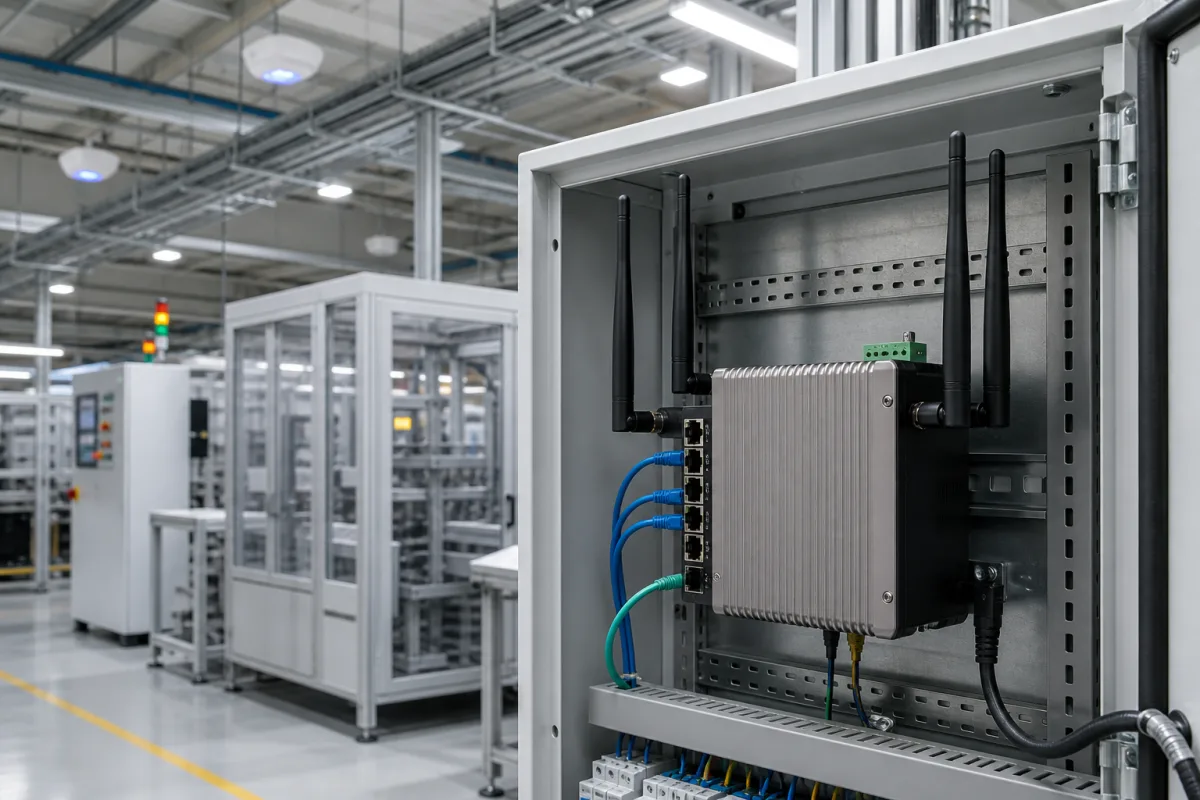
The pictured unit is a cabinet node: a finned metal housing on the back plate of a control cabinet, with rod antennas on top, a row of RJ45 ports and a pluggable terminal block for DC power. The two datasheets below show how far the specification moves between a cabinet node and an outdoor node.
HMS lists EN 61000-4 immunity tests and EN 300 328 and EN 301 893 radio standards for the AWB5141, and a built-in firewall with 1:1 NAT and port forwarding. [1] PCTEL lists FCC Part 15.247 and 15.407 and the same two ETSI radio standards for its node, and approves it with dual-band omni antennas of 5 dBi at 2.4 GHz and 7 dBi at 5 GHz. [2] A node inside a metal cabinet needs its antennas outside the cabinet or on a feed-through; the HMS unit's RP-SMA ports and PCTEL's N-connectors take external antennas.
Item
HMS Anybus AWB5141
PCTEL AP-WiFi-1200 (Meshmerize)
Radios
802.11ac Wave 2, concurrent 2.4 and 5 GHz, up to 867 + 300 Mbit/s [1]
2x2 802.11b/g/n at 2.4 GHz and 2x2 802.11a/n/ac Wave 2 at 5 GHz; PHY 300 Mbps (40 MHz) and 866.7 Mbps (80 MHz) [2]
Mesh method
Qualcomm Wi-Fi SON, self-healing auto-rerouting, up to 8 hops [1]
Meshmerize proactive multi-path routing; more than 100 nodes listed [2]
Mounting and enclosure
DIN rail (bracket included), steel housing, IP30 [1]
Wall or light-pole mounting, IP67, 199 × 148 × 64 mm [2]
State the mounting place (inside a cabinet, on a wall, on a pole or a vehicle), the cabinet material, ambient and solar load, available DC voltage or PoE class, and the radio approvals needed for the country.
03
Rerouting around a lost node: Wi-Fi SON multi-hop versus multipath routing
The two datasheets describe different ways of healing the mesh. HMS's node uses Qualcomm Wi-Fi SON with self-healing auto-rerouting through up to 8 hops. [1] Meshmerize, on PCTEL's node, routes over multiple paths at once, so that when a path breaks other redundant paths are already carrying the message; it states a self-healing time of 0 ms downtime for handovers on that basis. [2]
Meshmerize also lists use of a wired Ethernet backbone between nodes where one exists, to take traffic off the radio mesh, traffic prioritisation with packet redundancy by QoS, cellular or satellite backhaul selection by measured latency, and concurrent mesh and Wi-Fi access-point operation. [2] These are vendor statements about the routing software, not test results; for moving vehicles such as AGVs, ask for a handover test on your own route and traffic.
Editorial note: where some nodes can be cabled, every wired node shortens the radio path for the clients near it, which moves them back up the Leipzig hop curve. [3][2]
Ask which mesh protocol the node runs, whether it interoperates with other vendors' nodes, the maximum hops and nodes, and the measured reroute or handover time.
04
Spacing nodes from receive sensitivity: −88 dBm at the lowest rate, −56 dBm at the highest
PCTEL publishes receive sensitivity for every rate. In 802.11ac VHT80 with two spatial streams, the node needs −82 dBm at MCS0 and −56 dBm at MCS9; in VHT20 with two streams, MCS0 needs −88 dBm. Total transmit power is 24 dBm at 5 GHz and 26 dBm at 2.4 GHz. [2]
Editorial calculation: under free-space conditions, received power falls 20 dB for each tenfold increase in distance, so a 26 dB gap between MCS0 and MCS9 corresponds to a distance ratio of 10^(26/20) ≈ 20. A link that runs at MCS9 at 10 m would, in free space, hold MCS0 out to about 200 m. Walls, racks and machines change this indoors; the ratio only shows how much range the top rates give up. [2]
Editorial calculation: moving from 20 MHz to 80 MHz channels costs 6 dB of MCS0 sensitivity (−88 to −82 dBm) and 8 dB at MCS9 (−64 to −56 dBm) on this node. [2] Wider channels raise the single-hop rate, as channel bonding did in the Leipzig chain, but shorten each hop. [3]
Send a floor plan with node positions, ceiling height, obstructions and the client positions; ask for a site survey with measured signal at each node.
05
Data to send for an industrial mesh Wi-Fi network
Paste it into your enquiry below or into an email to a maker, then replace every bracket.
Layout: [floor plan; node positions; wired uplink points; worst-case hops]
Clients: [type and number; roaming or fixed; traffic per client]
Node: [cabinet or outdoor; IP rating; temperature; DC voltage or PoE]
Radio: [bands; channel width; antenna type and gain; external antenna feed]
Mesh: [protocol; maximum hops and nodes; reroute or handover time; wired backbone use]
Network: [VLAN; firewall and NAT; management system]
Compliance: [country radio approvals; EMC; safety]
Tests: [throughput at design hop count; handover test on vehicle route]
Explore company information and manufacturing capabilities, then discuss the scope of your project with a relevant supplier.
Share this page
Compiled and source-reviewed by the CNFX editorial team.
Each manufacturer above links to the page on that company's own website where the product is listed, with the date we checked it. How we source and review
· Page last updated 13 October 2026
Buyer questions
How much throughput is left after eight mesh hops?
In a University of Leipzig 802.11n chain, 140 Mbit/s on one hop fell to 7.3 Mbit/s on eight hops with channel bonding, about 5 % (editorial calculation). [3]
How many hops does an industrial mesh access point allow?
HMS's Anybus AWB5141 allows up to 8 hops of self-healing multi-hop routing; Meshmerize lists more than 100 nodes on PCTEL's node. [1][2]
What temperature range do industrial mesh nodes cover?
HMS's IP30 DIN-rail node is rated −40 to 70 °C; PCTEL's IP67 node −40 to +65 °C, or +55 °C with full sun load. [1][2]
Sources and what still needs a direct check
Sources checked 2026-10-12. HMS and PCTEL datasheets give the specifications of one cabinet node and one outdoor node; the University of Leipzig paper measured throughput along an 802.11n multi-hop chain.