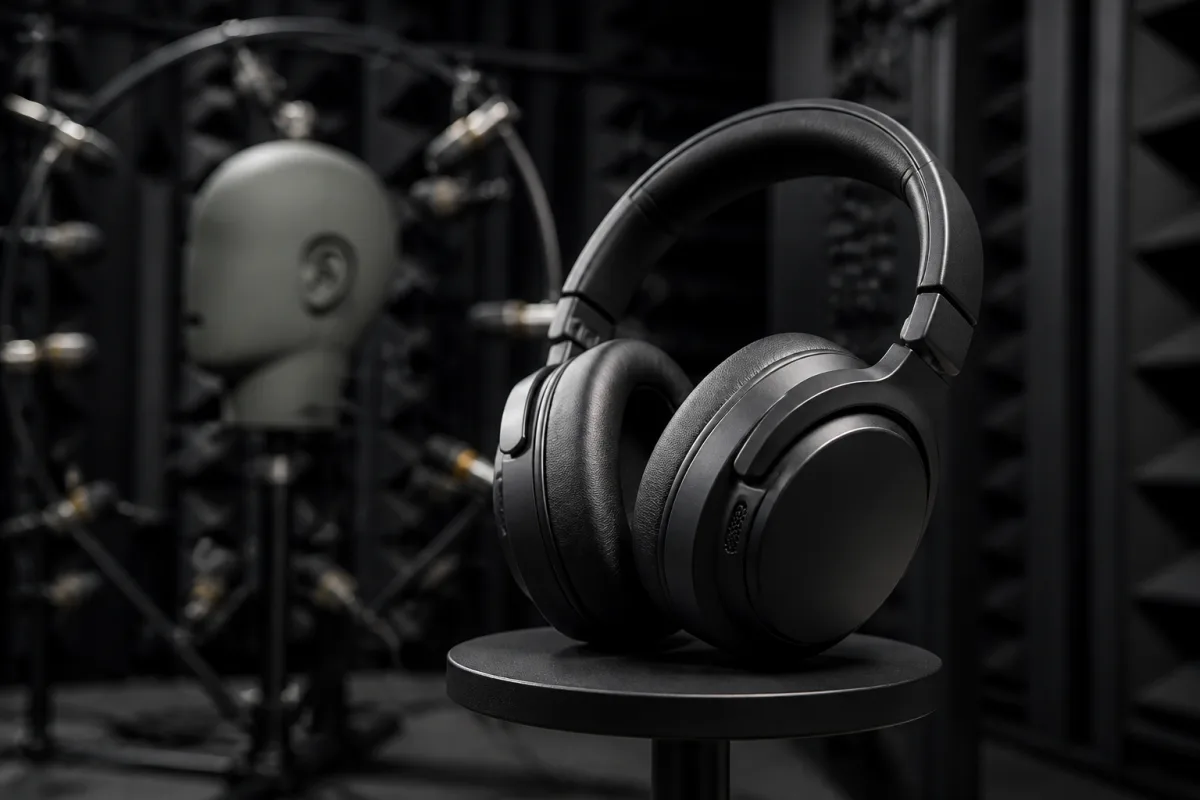
Bluetooth active noise-cancelling (ANC) headphones for OEM/ODM sourcing · Bluetooth version and codecs (SBC, AAC, LDAC, LE Audio LC3), noise-reduction depth in dB, battery life by codec, charging, driver size, headband and hinge, FCC Part 15 and Bluetooth SIG qualification
Portable Bluetooth noise-cancelling headphones are battery-powered headsets that receive audio over Bluetooth and use microphones and processing to cancel ambient noise, built around a Bluetooth audio chip, a pair of dynamic drivers, a lithium battery and a folding headband. Ask three things first: which Bluetooth version and codecs the chip supports and how that changes battery life; what noise-reduction depth the maker claims and how it was measured; and who holds the Bluetooth qualification and radio approvals for your brand.
Over-ear and on-ear Bluetooth headphones with active noise cancellation, sold as finished OEM/ODM or private-label products, including the headband yoke and hinge assembly that lets the ear cups swivel and fold. True-wireless earbuds, wired headphones, aviation and industrial hearing protectors, and loose drivers or Bluetooth modules are outside this page except where compared.
CNFX editorial research · Sources checked October 11, 2026 · 7 sources
Set the Bluetooth version, codecs and radio approvals
Sony's help guide for the WH-1000XM5 shows how a branded ANC headphone states its radio: Bluetooth specification version 5.2, Power Class 1, a line-of-sight range of about 10 m, the 2.4000–2.4835 GHz band, the A2DP, AVRCP, HFP and HSP profiles, and the SBC, AAC and LDAC codecs. Its A2DP transmission range is 20 Hz–20,000 Hz at 44.1 kHz sampling and 20 Hz–40,000 Hz with LDAC at 96 kHz and 990 kbps. [1] An OEM ANC headphone listed by Joy2hear at an HKTDC electronics fair gives Bluetooth V5.3 on a JL/AC7006 chip but does not list its codecs, so the codec list has to be requested. [4]
The Bluetooth SIG's LE Audio overview says the Core Specification was enhanced in December 2019 to carry audio over Bluetooth LE, with LE Isochronous Channels, and that LC3, the Low Complexity Communications Codec released in September 2020, defines a high-quality, low-power audio codec. Ask whether the chip and firmware support LE Audio and LC3 or only Classic A2DP codecs. [6]
The Bluetooth SIG states that all Bluetooth products must complete its qualification process on or before the date they are sold, that a supplier cannot qualify a product on your behalf, that the product name and model number must match those used in marketing, and that products which appear unqualified may be impounded by customs. A fee is charged for the first product with a given design. [5]
In the United States, 47 CFR 15.247 covers transmitters in the 2400–2483.5 MHz band: frequency-hopping systems there must use at least 15 channels; peak conducted output is limited to 1 W for hopping systems with at least 75 non-overlapping channels and 0.125 W for other hopping systems; digitally modulated systems are limited to 1 W with a power spectral density of no more than 8 dBm in any 3 kHz band; and portable devices are subject to the RF exposure rules. [7]
Give the supplier the Bluetooth version, chip and firmware source, codecs required (SBC, AAC, LDAC, aptX, LC3), profiles, multipoint need, range, the markets you will sell in, and who will hold the Bluetooth SIG qualification and the FCC and other radio approvals under your brand and model number.
02
Set noise-reduction depth, battery life and charging
The Joy2hear OEM listing states a noise-reduction depth of 20±3 dB, with a 450 mAh lithium battery supplied with MSDS and UN38.3 documents, about 25 hours of play at 70% volume, standby up to 100 hours, about 1.5 hours to charge, 40 mm drivers, 20 Hz–20 kHz response, 32 Ω ±15% impedance and 95±3 dB sensitivity. It quotes a minimum order of 2,000 units and a 20-day production lead time. [4] Sony's WH-1000XM5 spec page reviewed gives no noise-reduction figure in dB, so ANC depth claims need a stated test method before they can be compared. [1]
Battery life depends on codec and ANC mode. Sony gives maximum music playback with noise cancelling on of 26 hours with LDAC, 30 hours with AAC and 28 hours with SBC, rising to 36, 40 and 38 hours with it off; call time is 24 hours with noise cancelling on. About 1 hour of playback is available after 3 minutes of charging and about 5 hours after 10 minutes. [3]
Sony charges the headset through the supplied USB Type-C cable in about 3.5 hours, needs a USB adaptor of at least 1.5 A, and recommends a USB Power Delivery adaptor with 5 V/2 A or 9 V/3 A output for shorter charging. Its power source is DC 5 V/1.6 A, or 9 V/2.3 A with USB PD, and the built-in lithium-ion battery operates at DC 3.8 V. Operating temperature is 0–40 °C and charging temperature 5–35 °C. [2][1]
Editorial calculation: in Sony's table, LDAC with noise cancelling on gives 26 hours against 30 hours for AAC, so the high-bit-rate codec costs about (30 − 26) ÷ 30 ≈ 13% of playback time; turning noise cancelling off adds 10 hours in each codec. [3]
Editorial calculation: charging the Joy2hear 450 mAh battery in about 1.5 hours implies an average charge current of about 450 ÷ 1.5 = 300 mA. [4]
03
Chip, ANC curve, battery papers and hinge tests to request from a headphone supplier
When requesting quotations, ask each supplier for the Bluetooth chip and codec list, a noise-reduction curve with its test method, battery capacity with UN38.3 and MSDS documents, playback time by codec with ANC on, charging time, driver size, headband and hinge test results, minimum order quantity, lead time and samples.
04
Bluetooth chip, drivers, battery, USB-C port and headband hinge
The hinge row is the one no reviewed source backs with data; the chip, driver and battery rows use the Joy2hear OEM listing as the worked example. [4]
Lets the ear cups swivel and fold; no reviewed source gives hinge data.
Material, fold-cycle test, clamp force.
05
Drivers, impedance, Bluetooth version, playback hours, charging time and ANC depth for an OEM headphone
Battery life and ANC depth are the rows to compare with care: Sony's playback hours change with the codec, and the 20±3 dB OEM figure comes without a stated test method. [3][4]
Field
What it means and published values
Ask the supplier for
Frequency Response
20 Hz–20 kHz OEM example; Sony 20 Hz–40,000 Hz with LDAC 96 kHz. [4][1]
Find Bluetooth noise-cancelling headphone manufacturers
2 companies list this product among what they make. Company figures are quoted from each
company's own website; every card states where the relationship came from.
Minami Acoustic Limited
Manufacturing site to be confirmed for the order
Its website has a product page for portable bluetooth noise-cancelling headphones.
Explore company information and manufacturing capabilities, then discuss the scope of your project with a relevant supplier.
Share this page
Compiled and source-reviewed by the CNFX editorial team.
Each manufacturer above links to the page on that company's own website where the product is listed, with the date we checked it. How we source and review
· Page last updated 13 October 2026
Buyer questions
How much does codec choice change battery life?
In Sony's WH-1000XM5 table, playback with noise cancelling on is 26 hours with LDAC, 30 with AAC and 28 with SBC. [3]
Can my supplier's Bluetooth qualification cover my brand?
The Bluetooth SIG says a supplier cannot qualify your product on your behalf; qualification must be under your own membership before sale. [5]
What noise-reduction depth do OEM ANC headphones claim?
One OEM listing at an HKTDC fair states 20±3 dB with Bluetooth 5.3 and 40 mm drivers; ask for the measurement method. [4]
Sources and what still needs a direct check
Sources checked 2026-10-11. Sources are Sony's WH-1000XM5 help guide pages, an OEM headphone listing on an HKTDC trade-fair page, two Bluetooth SIG pages and the US eCFR text of 47 CFR 15.247.