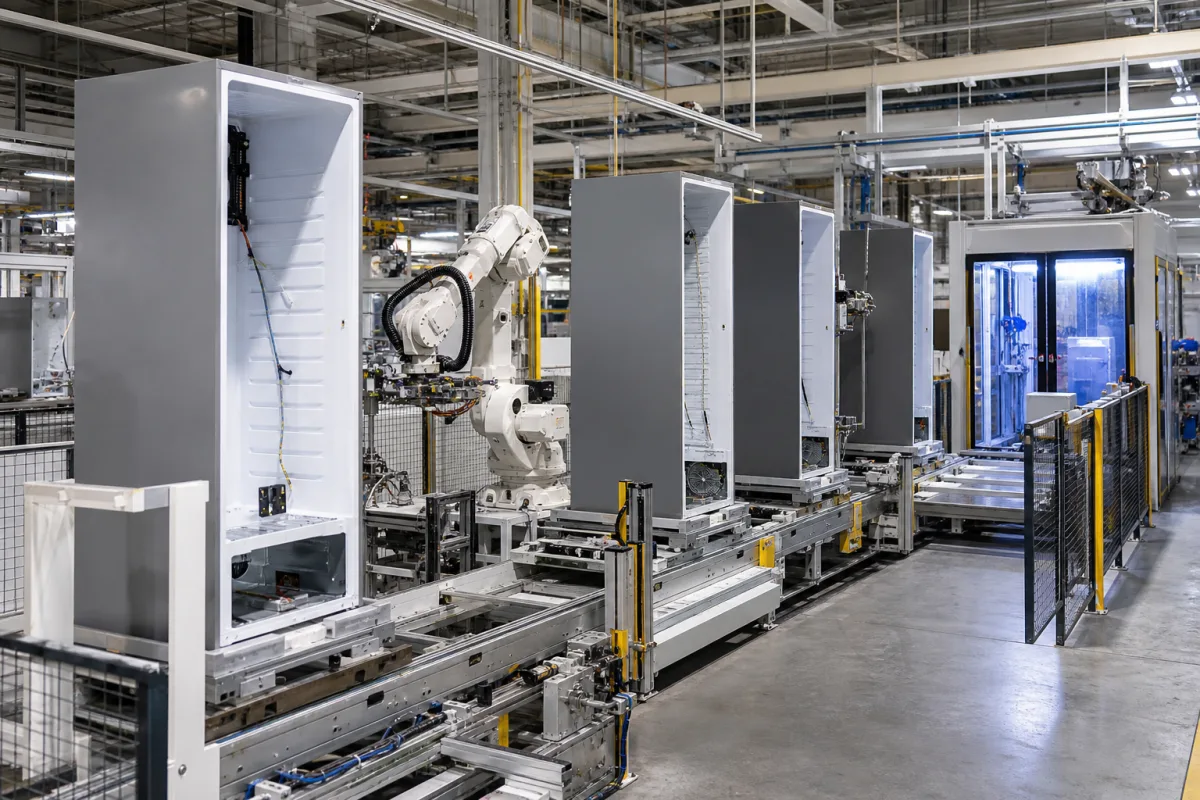
Automated refrigerator assembly line (cabinet foaming, leak testing and final assembly)
Refrigerator cabinet line · pre-foam assembly, polyurethane foaming fixtures and demold time, refrigerant-circuit leak testing, final assembly
An automated refrigerator assembly line takes a cabinet from pre-foam assembly of the outer shell, liner, wiring and lights, through polyurethane foaming in fixtures, to final assembly of doors, compressor and evaporator, leak testing of the refrigerant circuit and charging. Ask three things first: how many foaming fixtures the line needs for its demold time and output, how and to what limit the refrigerant circuit is leak tested, and how cabinets move between stations.
Production lines for household and commercial refrigerator cabinets: pre-foam assembly, cabinet and door foaming fixtures, final assembly, leak testing and the conveyors that link them. Individual assembly robots are covered on the Assembly robot page; compressors, refrigerants and foam chemicals as products are outside this page.
CNFX editorial research · Sources checked October 12, 2026 · 3 sources
Size the foaming station from demold and residence time
Assembly Magazine's article on refrigerator manufacturing places foaming between the pre-foam assembly that creates the metal shell, wiring, lights and liner and the final assembly where doors, compressors, evaporators and other components are added. The pre-foamed cabinet or door is held in a fixture that limits the foam's expansion; the pour "generally takes less than five seconds" and the foam fills the space between the shells in less than 30 seconds; the part stays in the fixture for a specified time, "typically two to seven minutes", before it is demolded, and the total residence time may be five to 20 minutes. [1]
The article warns that demolding too soon can cause splits in the centre of thick foam and swelling that can push the cabinet over its stated width or stop shelves fitting, while longer demold time costs productivity or more foaming equipment; objects placed in the walls, such as lights, wiring and control panels, can obstruct foam flow. [1]
Editorial calculation: if the line releases one cabinet every 30 s (an assumed rate) and each cabinet occupies a fixture for its whole residence time, 5 minutes needs 5 × 60 ÷ 30 = 10 fixtures in rotation and 20 minutes needs 40; ask the supplier how many fixtures and what residence time its layout assumes for your foam system and wall thickness. [1]
Give the supplier the cabinet models and sizes, output per shift, foam system and its demold time, fixture count and changeover between models, pre-foam and final assembly content, leak test method and limits, refrigerant and charging, end-of-line tests, conveyor layout, floor space and utilities.
02
Plan the refrigerant-circuit leak test
Pfeiffer lists refrigerators among the HVAC-R products that are leak tested and distinguishes two approaches: integral leak testing, which quantifies the total leakage of a part in a vacuum or under pressure and suits high-throughput production, and sniffing, which locates leaks. In helium vacuum tests the gas is carried through leaks by the pressure difference and measured with a mass spectrometer, and Pfeiffer states that vacuum testing can detect leaks down to 10⁻⁹ mbar·l/s or lower; in overpressure methods helium can be detected with a sniffer probe. [2]
INFICON describes its PROTEC helium sniffer leak detector as tuned for leak-testing refrigeration systems before filling or components during production, warning if sample gas is not reaching the sensor, and its ECOTEC II multi-gas sniffer for production-line quality assurance as detecting refrigerants, noble gases and SF6, measuring up to four gases at once against separate pass/fail limits and displaying leak rates in g/a, oz/yr, mbar l/s or ppm. [3]
Editorial note: state the reject limit in the same unit the test will report (for example g/a of refrigerant or mbar·l/s of helium), and ask the supplier which method tests the circuit before charging and which checks the charged unit.
03
Refrigerator and appliance lines from Seikonveyor and Hongdali
Seikonveyor lists refrigerator assembly lines with TV, air-conditioner and washing-machine lines and conveyor systems; Shenzhen Hongdali lists commercial refrigerator assembly lines and big home appliance lines made of flat and roller conveyors. Ask each whether foaming fixtures, leak testing and charging are in the quoted scope or bought separately.
04
Pre-foam, foaming fixtures, leak test and charging stations
Each cabinet sits in a foaming fixture for its demold and residence time, so the number of fixtures follows from that time and the line's release interval.
Release interval, foam residence time and line length
Two rows carry published values: the pour and fill times at the foaming head, and the 5 to 20 minute fixture residence that sets the foaming loop length.
Field
What it means and published values
Ask the supplier for
Cycle time (seconds)
Line release interval; pour under 5 s and fill under 30 s at foaming. [1]
Cycle per station.
Positioning accuracy (millimeters)
Cabinet location at robot and test stations.
Accuracy.
Power consumption (kilowatts)
Conveyors, fixtures, test and charging.
Connected load.
Conveyor speed (meters/minute)
Transfer between stations.
Speed and buffers.
System uptime (percentage)
Availability of the line.
Basis of the figure.
Operating pressure (MPa)
Test pressures and air supply.
Pressures.
Operating temperature (°C)
Foaming fixtures and shop conditions.
Fixture temperature.
Relative humidity (% RH)
Shop conditions.
Range.
IP rating
Electrics on the line.
Ratings.
Voltage (V AC)
Site supply.
Voltage.
Line length (m)
Pre-foam to final test; fixtures for 5-20 min residence. [1]
Layout.
Line width (m)
Includes fixture carousels and test booths.
Layout.
Total weight (t)
Floor loading of fixtures and conveyors.
Weights.
06
Send the model, output and test data together
Paste it into your enquiry below or into an email to a maker, then replace every bracket.
Explore company information and manufacturing capabilities, then discuss the scope of your project with a relevant supplier.
Share this page
Compiled and source-reviewed by the CNFX editorial team.
Each manufacturer above links to the page on that company's own website where the product is listed, with the date we checked it. How we source and review
· Page last updated 13 October 2026
Buyer questions
How long does a refrigerator cabinet stay in the foaming fixture?
Assembly Magazine reports demold times of "typically two to seven minutes" and total residence of five to 20 minutes. [1]
What happens if a cabinet is demolded too early?
The article states thick foam can split in the centre and swell, pushing the cabinet beyond its stated width. [1]
How are refrigerator circuits leak tested?
Pfeiffer describes integral testing that measures total leakage, including helium vacuum tests with a mass spectrometer, and sniffing that locates leaks. [2]
Can one sniffer detect refrigerants and helium?
INFICON's ECOTEC II detects refrigerants, noble gases and SF6, up to four gases at once with separate limits. [3]
Sources and what still needs a direct check
Sources checked 2026-10-12. Assembly Magazine is a trade publication; Pfeiffer and INFICON are leak detection makers describing their methods and instruments.