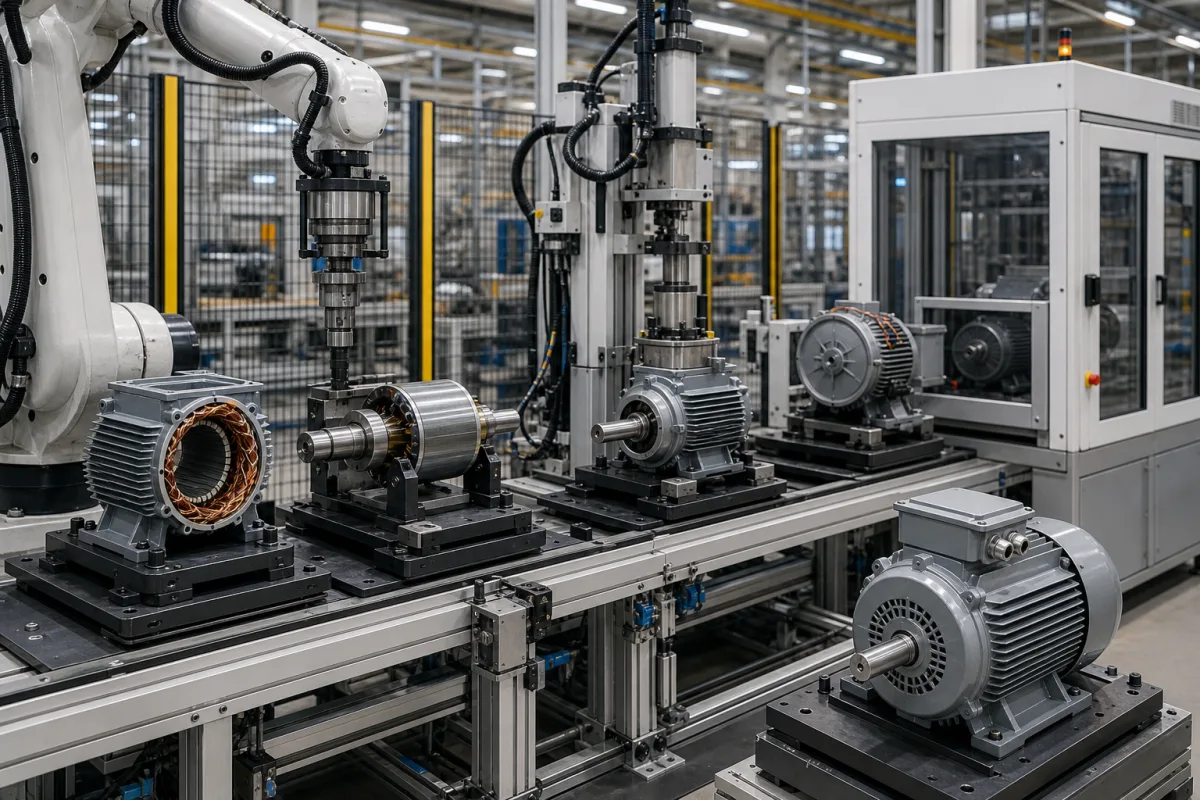
Electric motor final assembly and end-of-line test line
Motor final assembly and end-of-line test · Stator joined to housing, rotor and end shields pressed in, then hipot, surge, resistance, run and leak tests on every motor
A motor final assembly and test line starts where winding ends. It takes a wound stator, a finished rotor, housings, end shields and bearings, joins them on a pallet conveyor through pressing, shrink-fitting and screwing stations, and then runs every motor through an end-of-line loop of electrical, running and leak tests before marking. Buying one means fixing the station list and press forces, the takt and the test sequence that decides which motors ship.
Automated and semi-automatic lines and cells for the final assembly of complete electric motors (joining stator and housing, inserting the rotor, pressing bearings and end shields, screwing, sealing) together with their end-of-line test stations. Machines that wind or insert stator coils are covered on the Three-phase motor stator winding machine page and, for tooth-wound BLDC stators, on the Concentrated-winding stator winding machine page; the wound stator as a component on the Stator assembly page; rotary-dial cells for small massager motors on the Vibration motor module assembly and test cell page. Other end-of-line lines with their own pages, such as the Automated dishwasher production line and the Battery busbar welding station, build different products. Rotor manufacturing lines and stand-alone laboratory dynamometers are outside this page.
CNFX editorial research · Sources checked October 12, 2026 · 3 sources
Shrink-fit, rotor joining, A-shield wedding: one line's 22 stations
An auction listing by Maynards for two high-voltage e-motor lines built for Valeo in 2020 and 2021 gives a complete station list. Each line has a rotor line (by Teamtechnik), a stator line (by Grob / Tecnofirma) and a final assembly line by PIA; the final assembly line in Poland occupies 855 m², runs at an 86 s cycle and lists TRP/OEE of 85%. [1]
Editorial calculation: 3,600 s ÷ 86 s ≈ 41.9 motors per hour at the stated cycle; at the listed 85% OEE that is about 35.6 motors per hour, or roughly 850 in a 24-hour day. [1]
Editorial note: this is a traction-motor line with magnetised permanent-magnet rotors, a resolver and a coolant jacket, hence the magnetising station and leak tests. An industrial induction-motor line has no magnetising step and may have no coolant circuit, so the station list has to be drawn up from the motor's own bill of materials rather than copied.
Send the motor drawings and bill of materials, frame sizes, the joining method for stator and housing (shrink-fit or press), bearing and end-shield fits, target takt and OEE, and the share of manual stations acceptable.
02
Hipot, surge, partial discharge and winding resistance at the end of the line
Marposs, which builds motor end-of-line systems, says insulation testing at the final stage "is critical in ensuring that assembly operations have not compromised" the insulation, using insulation resistance, hi-pot, surge or partial discharge measurements; it offers its AMT320/W series for automatic production testing and the ATC320/W for laboratories. [3]
Schleich's MTC2 R7 shows what one tester for these steps covers: surge voltage up to 50 kV, 2,000 A surge current, 125 J surge energy and rise time up to 60 ns, with AC and DC high-voltage, inductance and capacitance, insulation resistance, PI/DAR and step-voltage, 4-wire winding resistance with temperature compensation, partial discharge and rotation-direction tests in one device. [2]
For line use the maker points to speed: surge tests at a pulse rate of up to 50 Hz, which Schleich says cuts the time to find partial discharge inception voltage by up to 75%. Insulation resistance runs at up to 50 kV DC and reads up to 500 GΩ (1 TΩ optional), with temperature compensation to IEEE Std 43, and switches between methods without changing test leads. [2]
In the Valeo line the end-of-line loop combines a hipot tester, a precision resistance meter, an EOL analyser and Sinamics S120 drives with Yokogawa DL850 and WT1800 instruments for running measurements. [1] Editorial note: whatever the instruments, the end-of-line loop has to finish inside the line takt, or be split across parallel nests; give suppliers the takt and the full test list together.
List the tests and limits per motor type (insulation resistance, hipot voltage and time, surge, partial discharge, resistance, no-load or load run, NVH, leak), the data each must record, and how failed motors leave the line.
03
Data to send for a motor assembly and test line
Paste it into your enquiry below or into an email to a maker, then replace every bracket.
Motor: [type; frame sizes or diameters; mass; variants]
Parts flow: [wound stator; rotor; housing; end shields; bearings]
Joining: [shrink-fit or press; press forces; screwing torques]
Takt and volume: [cycle time; OEE target; shifts]
End-of-line: [hipot; surge; PD; resistance; run; NVH; leak]
Traceability: [marking; data per motor; MES link]
Manual stations: [allowed or not]
Explore company information and manufacturing capabilities, then discuss the scope of your project with a relevant supplier.
Share this page
Compiled and source-reviewed by the CNFX editorial team.
Each manufacturer above links to the page on that company's own website where the product is listed, with the date we checked it. How we source and review
· Page last updated 13 October 2026
Buyer questions
What stations does an electric motor final assembly line have?
One documented line lists robot loading, stator shrink-fit into the housing, housing joining, rotor magnetization, press-fitting rotor, bearing and resolver into the A-shield, screwing, an end-of-line test loop, two leak tests and laser marking. [1]
What cycle time do motor assembly lines run at?
The Valeo e-motor final assembly line in the Maynards listing states 86 s per unit with 85% OEE. [1]
Which electrical tests run at end of line?
Insulation resistance, hi-pot, surge and partial discharge tests per Marposs, plus winding resistance and run tests; Schleich's MTC2 R7 combines these with surge up to 50 kV. [3][2]
What press forces are used?
The Valeo line used TOX servo presses of 30 kN for rotor, bearing and resolver into the A-shield and 10 kN for the A-shield into the housing. [1]
Sources and what still needs a direct check
Sources checked 2026-10-12. The station list is from an auctioneer's description of two used Valeo lines built by Teamtechnik, Grob / Tecnofirma and PIA; it records one installation, not a norm. Test capabilities are from Schleich's brochure and Marposs' application page.