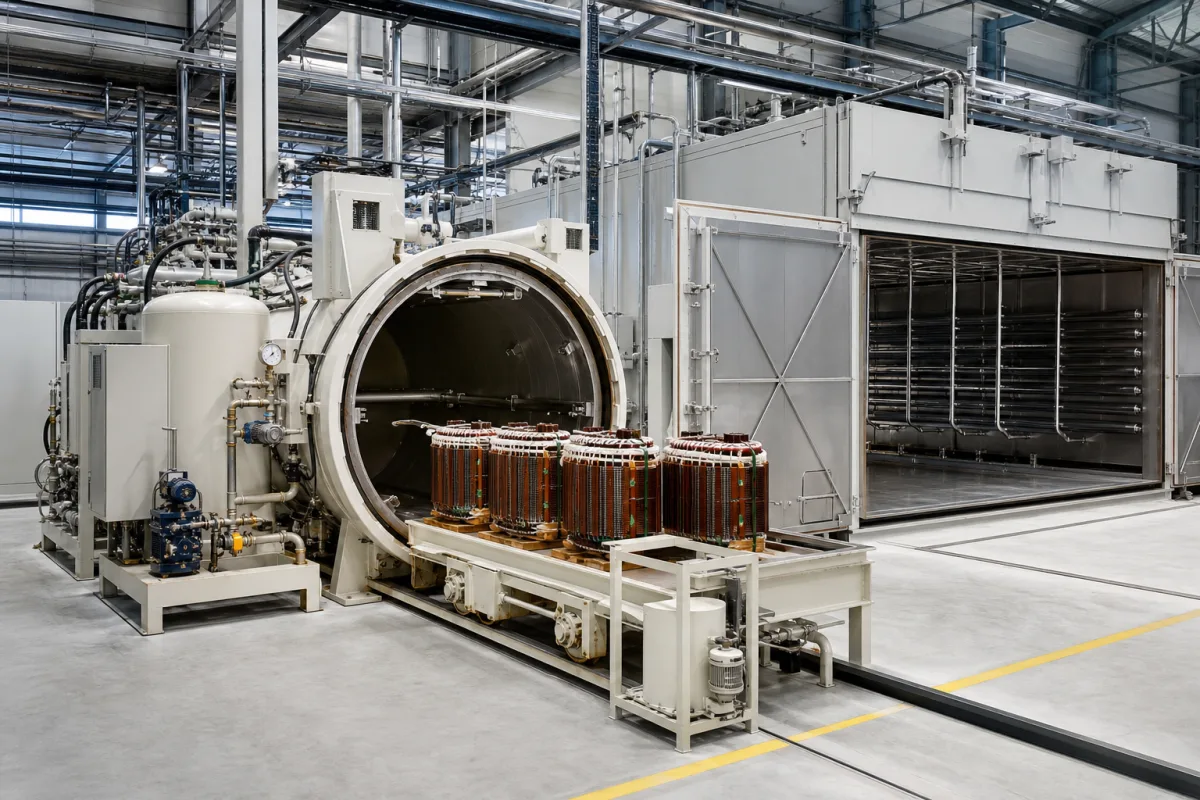
VPI-line curing oven for large motor and generator windings: preheat before the tank, cure-at-temperature hold and rotate-cure after it
Motor, generator and transformer winding shops · the curing oven that preheats windings before impregnation and bakes the resin afterwards: cure-to-temperature timing, oven size and heat input beside a large VPI tank, rotation, and the cure profile's effect on residual stress
The impregnation vessel fills a winding with resin; the oven next to it does the rest. It dries and preheats the winding before impregnation, then holds the impregnated part at the resin's cure temperature for hours, on a cart that in large ovens can also rotate the part. The picture shows this pairing: a round VPI vessel with stators on a transfer car, and a walk-in curing oven with its door open beside it. The oven is specified by three things: the cure schedule of the resin it has to deliver, the size and heat input for the largest part, and the temperature profile including the cool-down.
Preheat and curing ovens that work as part of a vacuum pressure impregnation (VPI) line for solventless resins on large motor, generator and transformer windings: the preheat-cool-impregnate-cure sequence, walk-in and car-type ovens sized to the VPI vessel, heat input, rotate-cure carts and the cure profile. Forced-air ovens for dip-varnished windings, with solvent ventilation and interlocks, are covered on the Batch curing oven for varnish-impregnated windings and transformer coils page; winding-current and induction heating on the Electric heating system for curing motor winding resin page; and general truck-in drying ovens on the Walk-in and truck-in drying oven page. The impregnation vessel itself, with its resin storage, transfer, vacuum and pressure systems, is covered on the Vacuum pressure impregnation (VPI) chamber page; hydraulic pressure intensifiers on the Pressure intensifier page; insulating resins themselves are outside this page except for their published cure data.
CNFX editorial research · Sources checked October 12, 2026 · 3 sources
Preheat, cool to 38–49 °C, impregnate, then hold 6 h at 149 °C or 4 h at 163 °C counted from when the winding reaches temperature
The oven's job is set by the resin. ELANTAS's data sheet for Epoxylite E 478 Thixo, a single-component, 100 % solids epoxy VPI resin for medium-voltage machines below 7 kV and random-wound motors, gives the full sequence. [1]
Editorial calculation: because the 4 or 6 hours start only when the winding itself is at temperature, total oven time is heat-up plus hold. A heavy stator that takes, say, 3 hours to reach 163 °C occupies the oven for about 7 hours on the shorter schedule; the same part at 149 °C needs at least 9 hours. The heat-up figure here is an assumption for illustration; the oven supplier should demonstrate it with thermocouples in a representative load.
ELANTAS states the cured resin's glass transition at 92 °C (DSC) and its UL recognition in insulation systems up to Class 180; these are resin properties, but they show why the cure must be complete rather than shortened. [1]
Step
Published value
Oven requirement it creates
Preheat
Preheat units as necessary to remove moisture and set tapes [1]
A drying and preheat cycle before the part goes into the vessel
Before immersion
Cool units to 38–49 °C (110–120 °F) to promote penetration without overheating the resin [1]
Controlled cool-down or a holding area after preheat
Cure
6 h at 149 °C (300 °F) or 4 h at 163 °C (325 °F) [1]
A stable hold at either setpoint for hours
Timing basis
Cure time counts from when the unit reaches the specified temperature [1]
Thermocouples on or in the winding, not only in the air
How quickly resin stops flowing once the part is hot
Resin tank
Replenish 10 % or more per month; keep resin at 20 °C or below [1]
Keep oven heat away from the resin storage
Give the oven supplier the resin's cure schedule and gel time, the largest and heaviest part, the number of thermocouples to be placed on windings, the preheat and cool-down sequence, and the temperature tolerance required during the hold.
02
Sizing the oven to the VPI tank: a 24 × 24 × 22 ft chamber, a 4,000,000 BTU/h gas burner, 400 °F working and a rotate-cure cart
Leonardo DRS publishes the oven and VPI system it runs for large motors, generators and transformers in Fitchburg, Massachusetts; the pairing shows how the oven follows the vessel.
Editorial calculation: the 400 °F (204 °C) working limit sits about 41 °C above the 163 °C cure of the epoxy in the first section, leaving room for faster heat-up. [2][1] A 19 ft vessel takes parts up to about 5.8 m across, and a 24 ft (7.3 m) internal oven width leaves about 1.5 m beside such a part; check the door opening and, if the part is rotated, its swept diameter on the cart.
Leonardo DRS states that the oven can preheat and cure any equipment that fits inside it, and offers a fully automated VPI control system with data-recording options and a complete record of the process. [2]
Two sliding rolling doors; cart for large equipment that can rotate cure if required [2]
—
VPI vessel beside it
19 ft internal diameter × 9.5 ft workable depth; vacuum below 5 Torr; 90 psi [2]
About 5.8 × 2.9 m; below 6.7 mbar; about 6.2 bar
Resin
Von Roll Permafil 74050 epoxy; 10,000 gal storage tank [2]
About 37,900 litres
State the largest part (diameter, length, mass), whether it must rotate during cure and at what speed, the heat source available (gas or electric), the maximum and working temperatures, and the data recording required for each batch.
03
The cure profile also sets residual stress: peak varnish stress cut from 45.1 to 38.6 MPa by ending the cure at 130 °C instead of 150 °C
Ma and co-authors at Changchun University of Science and Technology measured temperature and strain with fibre Bragg grating sensors during the curing of an unsaturated polyester-imide varnish on a hairpin motor stator, and modelled the stresses. [3]
In their drip-dip test the stator was heated to 80 °C before the varnish was applied, ramped to 130 °C and held for 10 minutes while curing proceeded, then held at 150 °C for 15 minutes to complete the cure, and cooled to room temperature. They attribute residual stress to cure shrinkage in the rubbery stage and, during cooling, to uneven shrinkage from structural differences, cooling rate and the thermal-expansion mismatch between varnish and stator. [3]
Reducing the maximum cure temperature to 130 °C lowered the maximum stress at the conductor-insulator interface from 45.1 MPa to 38.6 MPa, a 14.4 % reduction, and the authors conclude that the post-curing temperature stage has a significant effect on residual stress. Their oven was a DZF-6020 laboratory unit, and they assumed natural convection with a heat transfer coefficient of 25 W/(m²·K). [3]
Editorial note: these figures come from one varnish applied by drip-dip, not VPI, on one hairpin stator design with short holds; they show that the oven's final setpoint and cool-down are process variables to qualify, not that a lower temperature suits every resin. The resin maker's minimum cure schedule still applies.
Ask that the oven controller can run multi-step profiles with programmable ramps, holds and controlled cooling, and record winding temperatures throughout, so that the cure profile can be qualified against bond strength and stress for your design.
04
Parts, resin and profile details for a winding curing oven
Paste it into your enquiry below or into an email to a maker, then replace every bracket.
Parts: [stators, rotors, coils or transformers; largest diameter, length and mass; batch size]
Resin: [type; cure schedule; gel time; preheat and immersion temperatures]
Oven: [internal size; door type; cart or rails; rotate-cure speed]
Heat: [gas or electric; heat input; working and maximum temperature]
Control: [ramps, holds, cooling; winding thermocouples; batch records]
VPI interface: [vessel size; transfer route between vessel and oven]
Explore company information and manufacturing capabilities, then discuss the scope of your project with a relevant supplier.
Share this page
Compiled and source-reviewed by the CNFX editorial team.
Each manufacturer above links to the page on that company's own website where the product is listed, with the date we checked it. How we source and review
· Page last updated 13 October 2026
Buyer questions
How long are VPI-impregnated windings cured?
For Epoxylite E 478 Thixo, ELANTAS gives 6 hours at 149 °C or 4 hours at 163 °C, counted from when the unit reaches the specified temperature. [1]
How big can a winding curing oven be?
Leonardo DRS runs a 24 × 24 × 22 ft oven with a 4,000,000 BTU/h gas burner, working up to 400 °F, with a cart that can rotate cure. [2]
Does the cure temperature affect winding insulation stress?
In a 2024 hairpin-stator study, lowering the final cure stage from 150 °C to 130 °C reduced peak interface stress from 45.1 to 38.6 MPa. [3]
Sources and what still needs a direct check
Sources checked 2026-10-12. ELANTAS PDG publishes the processing data of its VPI resin; Leonardo DRS describes its own VPI and curing oven facility; Ma and co-authors report measured and modelled curing stresses in Polymers (2024).