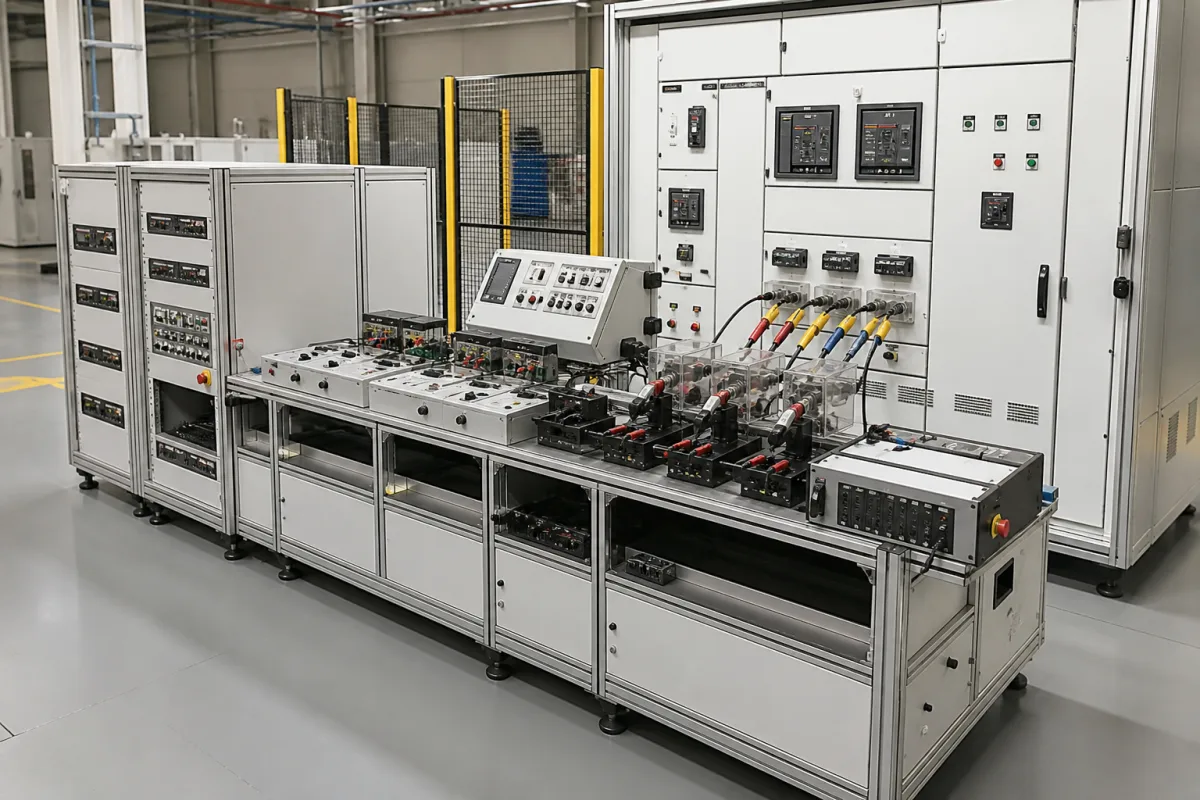
Breaker and switchgear test benches · Trip tests at 300%, instantaneous trip, contact resistance current, insulation test voltage, timing
A power distribution test bench is a workstation or cabinet line that connects circuit breakers, contactors or switchgear assemblies to programmable current, voltage and timing sources, then runs and records trip, resistance, insulation and functional tests. Ask three things first: which tests and acceptance limits your products must meet, what current and voltage the bench must source for the largest ratings, and how results are measured, recorded and traced to each unit.
Test benches and systems for low- and medium-voltage circuit breakers, switchgear and distribution panels: primary current injection, trip timing, contact resistance, insulation resistance and power-on functional tests. Transformer test systems, cable test vans and handheld meters alone are outside this page.
CNFX editorial research · Sources checked October 12, 2026 · 5 sources
Set the trip tests and the current the bench must supply
The US Bureau of Reclamation's FIST Volume 3-16, Maintenance of Power Circuit Breakers (minor revisions May 2024), requires inverse-time overcurrent and/or instantaneous trip tests on critical moulded-case breakers. The inverse-time test is made on individual poles at 300% of the trip rating, following NEMA AB 4-2017 Section 6.5, and the manual notes that UL testing shows these breakers withstand hundreds of such trips. [1]
Its Table 3-1 gives NEMA-recommended maximum trip times at 300% of rated current, for example 50 s (≤250 V) or 70 s (251–600 V) for 0–30 A breakers, 140 s or 160 s for 51–100 A, 300 s or 350 s for 226–400 A, and 450 s for 401–600 A at 251–600 V, rising to 1,000 s for 6,000 A. Instantaneous trip points are tested by the run-up or pulse method with equipment giving a constant rate of current rise or a pulse, using a primary or secondary test set depending on breaker size (NEMA AB 4-2017 Section 6.6). [1]
Editorial calculation: testing a 400 A breaker at 300% needs 1,200 A per pole, held for up to 350 s at 251–600 V; a bench for breakers up to 1,600 A needs 4,800 A for up to 775 s. Size the current source, cables and duty cycle for the largest rating you will test. [1]
Give the supplier the products and ratings to be tested (breaker frames, trip units, switchgear types), tests and acceptance limits, maximum test current and duration, test voltages, timing channels, fixtures and connections, automation and barcode traceability, data export, safety interlocks and guarding, supply and floor space.
02
Set contact resistance, insulation and timing tests
For moulded-case breakers FIST 3-16 specifies contact resistance measured with a digital low-resistance ohmmeter or four-point tester, not a multimeter, at a test current equal to the breaker rating, or 500 A for breakers rated 500 A or more. For power circuit breakers it requires at least 100 A DC, with results within the manufacturer's limit, or 200% of factory test data, or no pole more than 50% above the lowest. [1]
Insulation resistance is measured on each pole for 1 minute at the manufacturer's voltage or at least 1,000 V DC, with the breaker closed (other poles and frame grounded) and open; where no minimum is published the manual uses 1 MΩ. Timing tests cover close, open and close-open operations (and open-close and close-open-close with reclosing), measured across the main contacts; times must meet the manufacturer's limits and the manual sets a general limit that phases must not differ by more than 2 ms. [1]
Editorial note: these are maintenance acceptance criteria for an operator's breakers; a production bench should also follow the product standard and the manufacturer's routine test plan. Ask suppliers which tests their bench automates and how each measurement is calibrated.
03
Size the current source and the resistance meter
Megger's SPI4000 primary injection data sheet states that the maximum current "is determined primarily by the impedance of the load circuit, and the input voltage", and its duration "primarily by thermal conditions within the test set". At 480 V input it lists 4,000 A continuous, 4,500 A for 30 min on / 30 min off, 6,000 A for 15 min on / 45 min off, 15,000 A for 2 min on / 60 min off and 40,000 A for 2.5 s on / 12 min off; with a 240 V input it gives half the rated output. It describes firing angles of 10–30° for moulded-case breakers on cables and 50–85° for air-frame breakers on busbars to avoid DC offset in instantaneous tests, automatic regulation against current decay as leads heat, and stab sets for draw-out breakers. [2]
DV Power's RMO-A catalogue describes six models from 100 A to 600 A, Kelvin (four-point) connection, test durations by current, and mains demand from 1,210 VA (RMO100A) to 4,560 VA (RMO600A). [3]
Editorial calculation: the 4,800 A needed to test a 1,600 A breaker at 300% for up to 775 s (about 12.9 min) falls between the SPI4000's 4,500 A for 30 min and 6,000 A for 15 min ratings, so it sits inside the 15-minute duty band. A 50 µΩ contact measured at 100 A gives 5 mV, and 0.1 µΩ resolution is 0.2% of that reading; at 600 A, 5.3 mΩ needs 600 × 0.0053 ≈ 3.2 V of compliance. [2][3][1]
Instrument value
Primary injection set (SPI4000)
Micro-ohmmeter series (RMO-A)
Output
Up to 40,000 A AC, by duty cycle
100 to 600 A DC, ripple-free
Duration at maximum
2.5 s on / 12 min off at 40,000 A
20 s at 600 A; 300 s at 100 A (up to 30 min)
Measurement
Ammeter 400/4,000/40,000 A; ±1% rdg ±0.1% range (continuous, upper scales)
State the current, on-time and off-time for each test, input supply, connection method (cables or stabs), meter resolution and accuracy at your resistance range, and the compliance voltage for your longest cables.
04
Check what a multifunction primary test set can cover
OMICRON's product page for the CPC 100 primary injection test set lists up to 800 A AC or 2,000 V with up to 5 kVA over 15–400 Hz, or 400 A DC, rising to 2,000 A or 12 kV / 15 kV with current or voltage boosters, in a 29 kg unit; it uses test frequencies different from mains frequency to suppress mains interference, and up to three units can be synchronised. [4] Its CIBANO 500 page describes a 20 kg breaker test system combining a micro-ohmmeter, a timing analyser and an AC/DC coil and motor supply, recording command-coil current signatures and testing breaker behaviour at undervoltage, with OMICRON claiming wiring effort and time reduced by up to 50%. [5]
Editorial calculation: FIST 3-16's inverse-time test at 300% of trip rating [1] needs 3 × In, so the CPC 100's 800 A AC covers trip ratings up to about 266 A and its 2,000 A booster up to about 666 A; larger breakers need a high-current set such as the 4,000 A continuous unit described above. [2] For contact resistance, FIST asks for at least 100 A DC on power breakers and the breaker rating up to 500 A on moulded-case breakers, so the CPC 100's 400 A DC meets the first but not the 500 A case. At 800 A and 5 kVA the available output voltage is about 5,000 ÷ 800 ≈ 6.3 V, which limits the length and cross-section of test leads and the number of poles in series. [4]
Ask a bench supplier which of these functions are integrated (current source, micro-ohmmeter, timing channels, coil supply, insulation tester), the current and voltage each can deliver at your lead length, and the duty cycle at each current.
OMICRON item
Value
CPC 100 AC output
Up to 800 A or 2,000 V, up to 5 kVA, 15–400 Hz [4]
Power-on benches, characteristic testers and loop resistance testers on supplier sites
Listings include switchgear power-on test benches, circuit breaker characteristic testers, loop resistance testers, dielectric withstand testers and primary current injection sets alongside transformer test systems.
06
Current source, micro-ohmmeter, insulation tester, timing analyser, fixtures and controls
The current source and micro-ohmmeter rows carry the sizing numbers from FIST 3-16 and the Megger and DV Power data above; fixtures and controls have none in the reviewed sources and follow from your product range. [1][2][3]
Part
Role
Fix in the order
Primary current source
Trip tests at 300% and instantaneous [1]; duty cycle by current. [2]
Current, duration, ramp or pulse.
Low-resistance meter
Contact resistance at rated current [1]; Kelvin connection, up to 600 A DC. [3]
Test current, test voltage, accuracy and supply demand for a breaker test bench
Test current capacity is the row that sizes the rest: 300% of your largest breaker rating, held for its NEMA maximum trip time, as the 1,600 A example above works through. [1]
1 company lists this product among what they make. Company figures are quoted from each
company's own website; every card states where the relationship came from.
Sansion Power Electric Co., Ltd.
Manufacturing site to be confirmed for the order
Lists switchgear power-on test benches, circuit breaker testers and loop resistance testers.
Explore company information and manufacturing capabilities, then discuss the scope of your project with a relevant supplier.
Share this page
Compiled and source-reviewed by the CNFX editorial team.
Each manufacturer above links to the page on that company's own website where the product is listed, with the date we checked it. How we source and review
· Page last updated 13 October 2026
Buyer questions
At what current are breaker overcurrent trip tests run?
FIST 3-16 tests moulded-case breakers per pole at 300% of the trip rating, against NEMA maximum trip times. [1]
What test current is used for contact resistance?
The breaker rating up to 500 A for moulded-case breakers, and at least 100 A DC for power circuit breakers, per FIST 3-16. [1]
What insulation test voltage is used?
At least 1,000 V DC for 1 minute per pole unless the manufacturer specifies otherwise, with 1 MΩ minimum where no value is given. [1]
How long can a primary injection set hold high current?
One 480 V set lists 4,000 A continuous, 6,000 A for 15 minutes and 40,000 A for 2.5 seconds, each with a stated off-time. [2]
What resolution do breaker micro-ohmmeters offer?
One 100–600 A series lists 0.1 µΩ resolution and ±(0.1% of reading + 0.1% of full scale). [3]
Can one portable test set cover breaker trip and contact-resistance tests?
Partly: OMICRON's CPC 100 gives 800 A AC (2,000 A with a booster) and 400 A DC, enough for 300% trip tests up to about 266 A (666 A with booster) and 100 A DC contact tests, but not 500 A contact tests. [4][1]
Sources and what still needs a direct check
Sources checked 2026-10-12. FIST 3-16 is a US Bureau of Reclamation maintenance manual for its own plants, citing NEMA AB 4 and NFPA 70B; Megger, DV Power and OMICRON publish data for their own test sets; product standards for routine factory tests were not read for this page.