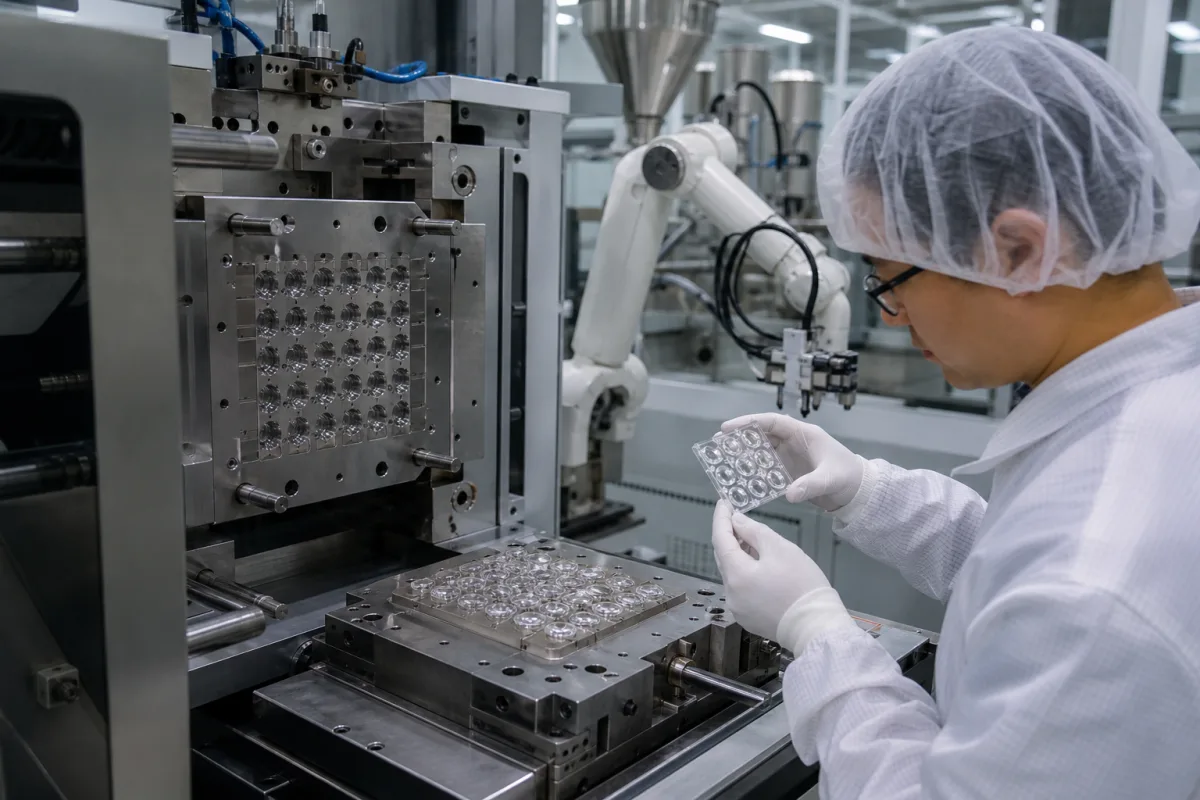
LED lens injection moulding machine for thick-walled PMMA and polycarbonate optics: multilayer overmoulding versus one shot with controlled packing
Thermoplastic optics for LED lighting · thick PMMA and polycarbonate collimator lenses whose cooling time grows with the square of wall thickness, multilayer overmoulding with external preform cooling, and the pressure and speed limits for a single shot
An LED lens moulding machine is a thermoplastic injection moulding machine and mould set up for transparent optics: collimator lenses and lens arrays in PMMA or optical polycarbonate that must leave the mould without sink marks, voids, flow lines or yellowing. Thick lenses are the hard case, because the time a part must cool before ejection rises with the square of its wall thickness, so the choice of process, single shot or a preform with overmoulded layers, decides the cell.
Injection moulding machines, moulds and cells for transparent thermoplastic LED optics in PMMA and polycarbonate, single-shot and multilayer (preform plus overmoulded layers) processes, external preform cooling and the process windows that control sink marks, voids and yellowing. General thermoplastic injection moulding machines are covered on the Injection molding machine page; barrels and screws on the Injection unit barrel and screw for thermoplastics page; injection drives on the Injection drive and control system page; liquid silicone optics and their dosing on the Silicone molding machine and LSR metering and mixing unit pages; ground and polished glass lenses on the Precision aspheric lens element page.
CNFX editorial research · Sources checked October 12, 2026 · 3 sources
A 22 mm PMMA headlamp lens built in three layers, with the preform cooled outside the mould
Covestro, which supplies Makrolon LED polycarbonate grades, notes that collimator lenses in headlamps need high wall thicknesses for physical reasons, and that cooling time before demoulding rises with the square of wall thickness, so doubling the thickness quadruples it. Single-layer moulding, which Covestro calls the standard lens process, leads to cycle times of up to 15 or even 20 minutes. [1]
ENGEL's optimelt multilayer cell, shown at Chinaplas 2018 with 22 mm thick PMMA LED lenses for vehicle headlamps, splits the lens into a preform and two further layers of the same material. A duo 1060/400 machine moulds four preforms in a 4-cavity mould; a robot moves them to an external cooling station and feeds four already-cooled preforms into the 4+4-cavity mould of a duo 600H/600H/500 combi rotary-table machine, which adds two PMMA layers in turn. The cycle is well under 3 minutes although each preform cools for about 30 minutes; the number of positions in the cooling station sets that cooling time. [2]
ENGEL states that overmoulding compensates for sink marks in the previous layer and that optical tests showed no influence of the layer boundaries on the lighting optics. Covestro describes the same principle as splitting the lens into layers moulded in parallel. [2][1]
Editorial calculation: by the square-law rule Covestro and ENGEL cite, a 22 mm lens moulded as three layers of about 7.3 mm each needs roughly (7.3 / 22)² ≈ 0.11 of the single-shot cooling time per layer. The rule is a simplification; actual layer thicknesses and cooling times for the exhibited lens were not published. [1][2]
Give the lens thickness profile, material grade, cavities, annual volume and target cycle; ask the supplier how many layers and cooling-station positions it proposes, and for sink-mark depth measured on the finished lens.
02
Single-shot PC lenses 12.5–20.5 mm thick: yellowing above 100 MPa, flow marks below 60 MPa, bubbles above 20 mm/s
A 2024 study at Tomas Bata University in Zlín moulded test lenses of 12.5, 16.5 and 20.5 mm thickness in Covestro's Makrolon LED 2245 polycarbonate on an Arburg Allrounder 470 E 1000-290, in a P20 tool-steel mould with oil coolant at 8 L/min through 8 mm channels, after drying the granulate at 120 °C for 3 hours. [3]
The simulations varied melt temperature at 250, 275 and 300 °C and mould temperature at 80, 100 and 120 °C, with a 2 s fill, switchover at 99% of cavity volume, packing at 80% of injection pressure for 10 s and ejection at 130 °C. On a 16.5 mm lens the thick centre was predicted to reach ejection temperature 218 s into the cycle against 10 s for the 3 mm edge, a gradient that pulls the hot core inward and forms sink marks on the flat back face. [3]
In moulding trials, injection pressures above 100 MPa and packing pressures above 80 MPa yellowed the polycarbonate through shear at the gate, injection pressures below 60 MPa left visible flow marks on both faces, and injection speeds above 20 mm/s trapped air bubbles in the lens. The authors found that lower melt temperature and higher mould temperature reduced dimensional defects, and that film gates filled and packed more evenly than point gates; Moldflow gave gate freeze times of 5.6 to 5.9 s for point gates against 7.5 to 7.7 s for fan and film gates. [3]
Editorial calculation: 218 s / 10 s ≈ 22 times longer for the 16.5 mm centre than the 3 mm edge to reach ejection temperature; by the square law, (16.5 / 3)² ≈ 30, so the simulation sits below the simple rule, which Covestro gives as a guide rather than a prediction. [3][1]
Ask for the injection pressure, packing pressure and injection speed window the supplier will run, the gate type, and how it controls melt and mould temperature for your lens thickness.
03
Machines, mould and peripherals in a thick-lens cell
duo 600H/600H/500 combi with rotary table, 4+4 cavities [2]
Number of injection units and layers
External cooling station
Preforms cool about 30 minutes; positions set cooling time [2]
Positions, handling, contamination control
Single-shot machine
Arburg Allrounder 470 E 1000-290 in the PC lens study [3]
Pressure and speed resolution for optics
Mould
P20 tool steel, oil at 8 L/min, 8 mm channels; film gate preferred [3]
Gate type, temperature control medium and range
Material handling
Drying at 120 °C for 3 h for Makrolon LED 2245 [3]
Dryer capacity, conveying, dew point
04
Lens geometry, material and cycle for an LED lens moulding cell
Paste it into your enquiry below or into an email to a maker, then replace every bracket.
Lens: [type; maximum and minimum wall thickness; aperture]
Material: [PMMA or PC grade]
Optics: [sink-mark limit; surface form; transmission or yellowness]
Process: [single shot or multilayer; number of layers]
Cavities and volume: [cavities per mould; parts per year]
Cycle: [target cycle; external cooling allowed]
Mould: [gate type; temperature range]
Cleanliness: [cleanroom class; part handling]
Explore company information and manufacturing capabilities, then discuss the scope of your project with a relevant supplier.
Share this page
Compiled and source-reviewed by the CNFX editorial team.
Each manufacturer above links to the page on that company's own website where the product is listed, with the date we checked it. How we source and review
· Page last updated 13 October 2026
Buyer questions
Why are thick LED lenses slow to mould?
Covestro notes that cooling time before demoulding rises with the square of wall thickness, giving single-layer cycles of up to 15 or 20 minutes for thick headlamp collimators. [1]
How does multilayer moulding shorten the cycle?
In ENGEL's 2018 cell a 4-cavity preform is cooled outside the mould for about 30 minutes and two PMMA layers are then overmoulded, giving a cycle well under 3 minutes for 22 mm lenses. [2]
What process limits apply to a single-shot polycarbonate lens?
In the Tomas Bata University study, injection above 100 MPa or packing above 80 MPa caused yellowing, below 60 MPa flow marks, and injection speed above 20 mm/s air bubbles. [3]
Sources and what still needs a direct check
Sources checked 2026-10-12. Covestro writes as a supplier of optical polycarbonate; ENGEL describes its own multilayer exhibit; the Tomas Bata University paper reports simulation and moulding trials on polycarbonate lenses.