Editorial Technical Reference

Precision Optical Lens Array

This page explains how Precision Optical Lens Array is classified within Manufacture of Lighting Equipment. Technical values and manufacturer relationships are research references; confirm the current specification and supplier evidence for each order.

Technical Definition & Core Assembly

Multi-element optical component for controlled light distribution in professional lighting systems.
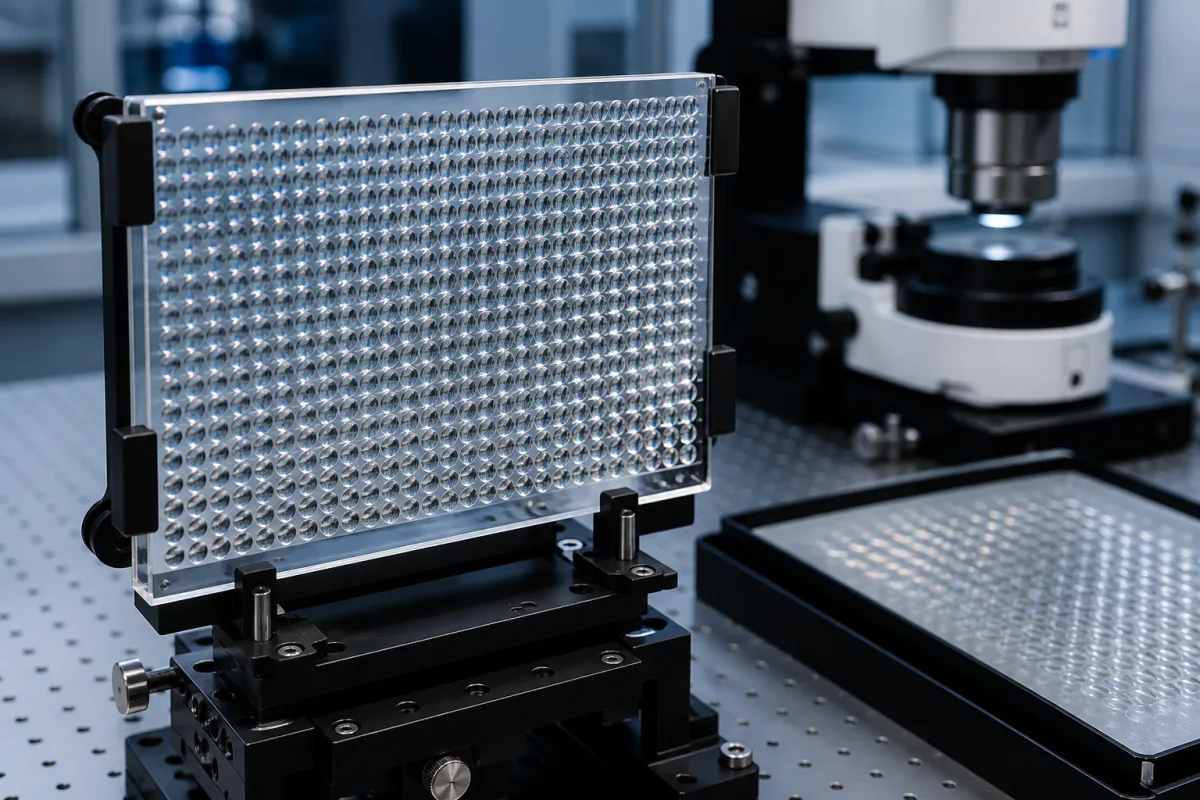
Precision Optical Lens Array in a manufacturing environment
Representative product image. Confirm appearance and specifications with the manufacturer.

Product Specifications

Technical details and manufacturing context for Precision Optical Lens Array

Definition
The Precision Optical Lens Array is a component used in the manufacture of professional lighting equipment. It consists of multiple lens elements arranged in a specific pattern to manipulate light output from LED or other light sources. This component is critical in achieving precise beam shaping, light diffusion, and intensity control, serving as a key sub-assembly in B2B supply chains for architectural, stage, and industrial lighting systems. Optical performance directly impacts product quality and compliance with lighting standards. Manufacturers integrate these arrays into luminaires to achieve specific photometric distributions required for various applications. The array is available in configurations from 2x2 to 8x8 rows and columns, with individual lens diameters ranging from 25 to 100 mm. Focal length ranges from 15 to 60 mm. Materials on file include optical-grade polycarbonate, borosilicate glass, and optical silicone, with a refractive index between 1.49 and 1.59 at 589 nm. Transmittance is at least 92% per ISO 9050. Surface accuracy is ±0.05 μm and center thickness tolerance is ±0.1 mm, both per ISO 10110. Operating temperature ranges from -40 to 85 °C, and non-condensing humidity from 10 to 90 %RH. Ingress protection is rated IP54 to IP65 per IEC 60529. Weight ranges from 50 to 500 g depending on size and configuration. These values are reference ranges; verify model-specific specifications with the manufacturer or supplier before procurement.
Working Principle
The array uses refraction through precisely shaped glass or polymer lens elements to redirect, focus, or diffuse light rays from the source. Each lens element is designed to bend light according to its curvature and refractive index, creating controlled illumination patterns. The arrangement of multiple elements allows for complex light distribution that cannot be achieved with a single lens. Optical design principles govern the relationship between element shape, spacing, and material properties to achieve the desired beam characteristics.
Common Materials
Optical-grade polycarbonate, Borosilicate glass, Optical silicone
Technical Parameters
ParameterTypical rangeNotes & selection driver
Focal LengthRequired15–60 mmDistance from lens to focal point
Lens DiameterRequired25–100 mmIndividual lens element diameter
Array ConfigurationRequired2x2–8x8 rows x columnsNumber of lens elements in array
TransmittanceRequired≥92 %Percentage of light transmitted through materialISO 9050
Operating TemperatureRequired-40–85 °CTemperature range for reliable operation
Refractive Index1.49–1.59 nDMaterial's light bending capability at 589nmISO 489
Surface Accuracy±0.05 μmCritical for beam quality and uniformity.ISO 10110
Center Thickness Tolerance±0.1 mmAffects focal length consistency.ISO 10110
Operating Humidity10–90 %RHNon-condensing; high humidity may cause fogging.
Ingress ProtectionIP54–IP65Protects against dust and water jets.IEC 60529
MaterialPMMAOptical grade PMMA for high clarity and UV stability.ASTM D788
Weight50–500 gDepends on size and configuration.

Ranges are indicative industry figures for RFQ preparation, not a supplier commitment. Confirm every value and standard with the legal manufacturer before ordering.

Components / BOM
  • Lens Element Part
    Primary light refraction surface
    Material: Optical-grade polycarbonate or glass
  • Mounting Frame Part
    Structural support and alignment of lens elements
    Material: Aluminum alloy or engineering plastic
  • Anti-reflective Coating Optional Part
    Reduces surface reflections and increases light transmission
    Material: Magnesium fluoride or multi-layer dielectric
  • Sealing Gasket Optional Part
    Environmental protection against dust and moisture
    Material: Silicone rubber

Industry Taxonomies & Aliases

Commonly used trade names and technical identifiers for Precision Optical Lens Array.

Industrial Ecosystem & Supply Chain Structure

Complementary Systems
Downstream Applications
Specialized Tooling

Application Fit & Sizing Matrix

Operational Limits
pressure: Atmospheric to 2 bar
other spec: Wavelength range: 380-780 nm, Humidity: 0-95% RH non-condensing
temperature: -40°C to +85°C
Media Compatibility
✓ Clean air environments ✓ LED light sources ✓ UV-stable polymer housings
Unsuitable: Abrasive particulate-laden atmospheres
Sizing Data Required
  • Required beam angle distribution
  • Target illumination uniformity
  • Source-to-lens distance

Reliability & Engineering Risk Analysis

Failure Mode & Root Cause
Surface contamination and adhesion of particulates
Cause: Inadequate cleanroom protocols during handling or assembly, leading to dust, oils, or residues that scatter light and degrade optical performance.
Delamination or micro-cracking of anti-reflective coatings
Cause: Thermal cycling stress or exposure to high humidity, causing differential expansion between coating layers and the substrate, compromising optical clarity.
Maintenance Indicators
  • Visible haze, streaks, or discoloration on lens surfaces under inspection lighting
  • Audible clicking or grinding during automated alignment, indicating particulate interference or mechanical stress
Engineering Tips
  • Implement strict cleanroom handling procedures (e.g., Class 1000 or better environment, use of lint-free gloves, and regular HEPA filter maintenance) to minimize particulate contamination.
  • Control environmental conditions (maintain stable temperature ±1°C and humidity below 40% RH) to reduce thermal and moisture-induced stress on coatings and substrates.

Indicative industry ranges for design and RFQ preparation. Confirm the exact figures and applicable standard with the manufacturer before specifying.

Compliance & Manufacturing Standards

Applicable Standards
ISO 10110-7:2017 (Optics and photonics - Preparation of drawings for optical elements and systems - Surface imperfection tolerances) ANSI/OPC 1-2020 (Optical Performance Criteria for Precision Optical Components) DIN 3140-7:2016 (Optics and optical instruments - Preparation of drawings for optical elements and systems - Part 7: Surface form tolerances)

Quoted from the published standard.

Manufacturing Precision
  • Surface figure error: λ/10 RMS (λ=632.8nm)
  • Centration tolerance: ±0.02mm
Quality Inspection
  • Interferometric surface testing
  • MTF (Modulation Transfer Function) measurement

Manufacturers of Precision Optical Lens Array

Manufacturer profiles associated with Precision Optical Lens Array.

Sourcing Precision Optical Lens Array from China?
Tell us your specification and target quantity — we will match it against manufacturer records and come back with the factories that fit.
Request manufacturers We manufacture this

Manufacturer listings support early research and capability understanding. They are not certification, ranking, or transaction guarantees.

Share this page
Technical documentation
Request current drawings, revision history, and a signed specification sheet.
Manufacturing capability
Verify equipment lists, process limits, capacity, and representative production evidence.
Inspection readiness
Confirm test methods, calibrated equipment, sampling plans, and traceable reports.
Supplier transparency
Check the legal entity, factory address, ownership, certifications, and direct contacts.

CNFX does not score or rank suppliers. Buyers must verify all claims and documents with the legal manufacturer before ordering.

Frequently Asked Questions

What is the typical application of this lens array?

It is used in professional lighting fixtures for architectural, stage, and industrial applications to control light distribution, such as beam shaping and diffusion.

What materials are available?

Optical-grade polycarbonate, borosilicate glass, and optical silicone are listed as possible materials. Confirm the specific material with the supplier.

What standards are referenced?

ISO 9050 for transmittance, ISO 489 for refractive index, ISO 10110 for surface accuracy and center thickness tolerance, and IEC 60529 for ingress protection.

How should I verify specifications?

Contact the legal manufacturer or supplier to confirm model-specific values for focal length, dimensions, tolerances, and compliance with relevant standards.

Data Basis

Editorial classification, named public sources where available, and source-reviewed manufacturer records.

Preliminary Technical Classification
This page supports structured research, RFQ preparation, and supplier evaluation. It does not replace buyer-led supplier qualification, standards review, or technical approval.
Buyer enquiry

Request manufacturing insight for Precision Optical Lens Array

Ask for use case, specification boundaries, supplier type, and RFQ preparation information for this product.

Where it goes
Straight to the CNFX editorial desk, and to the manufacturer if this product is linked to a claimed profile. Nothing is broadcast to a supplier list.
Your details stay here
We do not sell or rent enquiry data, and we do not add you to a mailing list. Used only to answer this request.
No commission, no middleman
CNFX is a directory. We take no cut of any order and never negotiate on a supplier's behalf.
What we don't claim
A listing is not an endorsement. Qualify every supplier and verify every figure yourself before ordering.

Your business information is used only to process this request.

Thank you! Your message has been sent. We'll respond within 1–3 business days.
Sorry, we couldn't send your message. Please try again, or email us at [email protected].

Need to Manufacture Precision Optical Lens Array?

Compare manufacturer profiles with relevant product and process capability.

Previous Product
Precision LED Lens Molding Machine
Last Product
Get QuotesChat