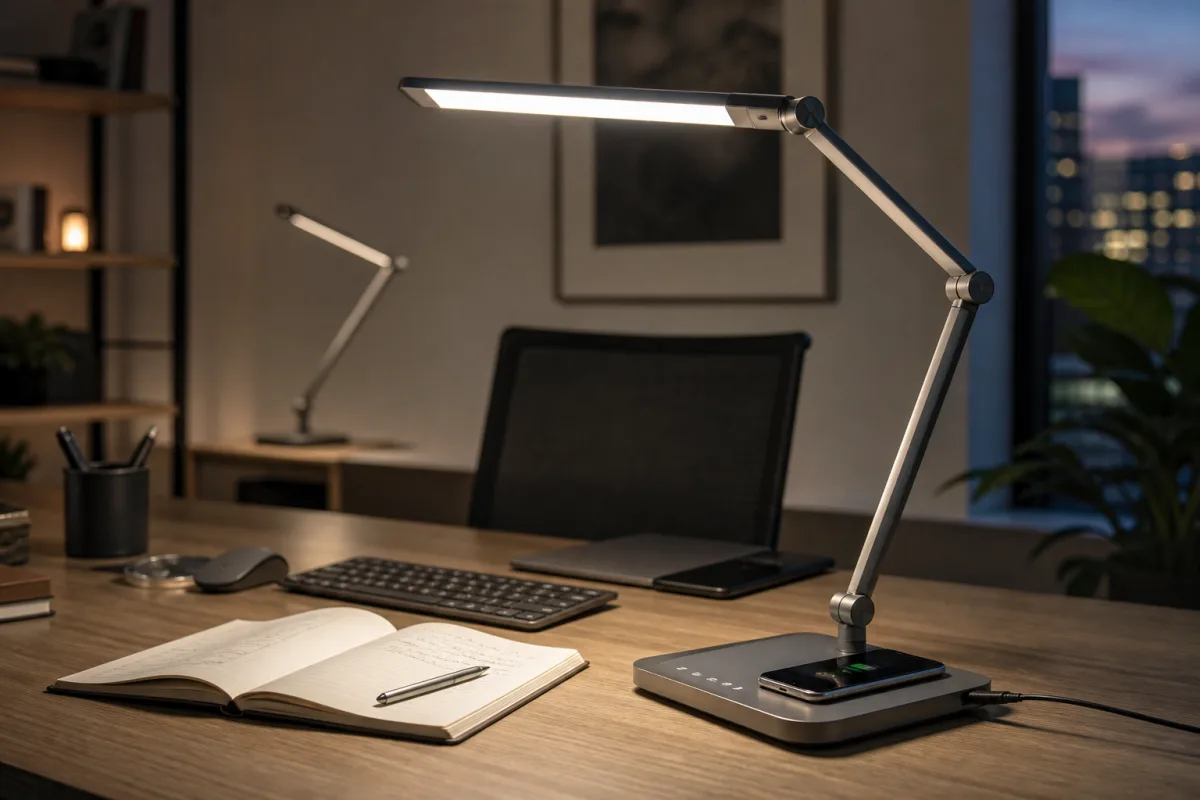
Desk lighting · Light quality, declared light-source data and controls
A desk lamp combines an LED light source, driver, light-positioning structure and controls. Sensor-controlled brightness, touch dimming and a network connection are different features. Define the task lighting and control functions, then identify the light source and control gear whose declared measurements support the target market documentation.
Household and office LED desk and task lamps with integrated or replaceable LED light sources and smart controls. Floor and ceiling luminaires, bare LED modules, and flashlights or work lights are outside this page.
CNFX editorial research · Sources checked October 18, 2026 · 6 sources
Check colour rendering, flicker and colour consistency
For in-scope light sources, Annex II of Regulation (EU) 2019/2020 sets CRI ≥ 80, subject to its stated exceptions, and LED/OLED colour consistency within a six-step MacAdam ellipse. The current consolidated table specifies Pst LM ≤ 1.0 at full load for mains LED/OLED light sources; its SVM ≤ 0.4 limit applies from 1 September 2024, with the stated application exceptions. [1][5]
For mains LED/OLED light sources, the displacement-factor thresholds are: no limit at on-mode power ≤5 W; at least 0.5 above 5 W through 10 W; at least 0.7 above 10 W through 25 W; and at least 0.9 above 25 W. Establish the declared light-source type and power before applying these rows. [5]
Request dimmed-output and colour-setting measurements as part of the product specification, in addition to the full-load regulatory data. Keep Pst LM and SVM results separate from a claim made against IEEE 1789. [5][4]
BenQ’s Genie page describes screen mode at 500 lux and 4,000 K and paper mode at 1,000 lux directly below the lamp and 5,700 K. It lists a 2,700–5,700 K adjustment range, 13 colour-temperature steps, 23 brightness levels, Ra 95 and automatic modes using an ambient-light sensor. Its comparison table gives 90 cm lighting width at 500 lux, 100–240 V at 50/60 Hz and maximum 18 W for Genie. Ask for the measurement geometry for desk illuminance. [4]
BenQ reports 12,500 on/off operations at 110 V and 230 V and 10,000 head adjustments from +35° to +120°. Its −20 °C to 65 °C statement describes an extreme-temperature test, and its 0–90% humidity statement describes transportation testing. Obtain a separate continuous operating-environment specification. BenQ also advertises LED life as 17 years at 8 hours daily. Editorial conversion: assuming exactly 365 days each year, 17 × 365 × 8 = 49,640 hours, approximately 49,600 hours. This converts the stated usage assumption; it establishes neither measured service life nor whole-lamp warranty. [4]
Identify whether the lamp is a containing product with a separately verifiable light source and control gear. The regulations also exempt specified battery-operated products, including desk lamps operating only on batteries; check the actual supply arrangement. [5][6]
02
Check the power limit and standby draw
For an applicable light source, the ecodesign expression is P_onmax = C × (L + Φ_use/(F × η)) × R. The “other light sources” row uses η = 120 lm/W and L = 1.5 W, with L = 2.0 W for a connected light source. These are calculation constants. F is 1.00 for non-directional and 0.85 for directional sources. For CRI >25, R = (CRI + 80)/160, rounded to two decimals. Select C and any permitted bonus from the declared source characteristics. [1][5]
The +0.10 CTLS bonus applies to the regulation’s defined colour-tuneable light source, which can emit a wide range of colours outside the defined white-light range as well as white light. Tuneable-white sources and dim-to-warm sources are expressly excluded from CTLS. An adjustable white colour-temperature range alone does not qualify for this bonus. [5]
The light-source standby and connected-light-source networked standby limits are each 0.5 W, with the allowances not added together. The regulation separately addresses control gear and defines the test states, including treatment of non-lighting parts. Obtain those test results and a separate whole-lamp power schedule for any phone charger or other functions. [5]
Editorial calculation: assume an in-scope connected LED source in the “other” row, classified as non-directional and non-mains, genuinely meeting the CTLS definition, with no further C bonuses, declared useful flux 500 lm and CRI 90 at its reference control setting. Then C = 1.10, L = 2.0 W, F = 1.00, η = 120 lm/W and R = 1.06 after rounding; P_onmax = 1.10 × (2.0 + 500/120) × 1.06 ≈ 7.19 W. This is hypothetical light-source arithmetic, not a desk-lamp input-power limit or a rating for either lamp example. [5]
03
Calculate the class from the declared light-source measurements
Regulation (EU) 2019/2015 uses η_TM = (Φ_use/P_on) × F_TM for the light source. The class thresholds below and F_TM values are retained in the current consolidated Annex II. F_TM is 1.000 for non-directional mains, 0.926 for non-directional non-mains, 1.176 for directional mains and 1.089 for directional non-mains sources. [2][6]
Lucide’s VARIO LED 24656/10/30 listing gives touch dimming, 2,700–6,500 K colour temperature, 8 W, 480 lm, CRI 85, a 100° beam angle, stated 40,000-hour light-source life, class G, IP20, electrical class 2, 1 kg and dimensions 13.5 × 60 × 42 cm. The listing is an example of supplied product information; request the declared light-source measurement boundary and product information sheet. [3]
Editorial label calculation: assume 480 lm is the declared useful flux and 8 W is the corresponding declared light-source on-mode power, with a non-directional mains classification (F_TM = 1.000). Then η_TM = 60 lm/W, class G. If the same hypothetical source retained 480 lm and F_TM = 1.000, the class E threshold of 110 lm/W would require P_on ≤480/110 ≈4.36 W. These assumptions are not verified by the luminaire listing, so the arithmetic does not independently validate Lucide’s label or establish a feasible redesign. [6][3]
A beam-angle value alone does not determine the regulatory directional classification, which depends on the fraction of total flux within the specified solid angle. Use the declared classification and reference control settings for both useful flux and power. [5][6]
Class
Total mains efficacy η_TM (lm/W)
A
210 or more
B
185 to below 210
C
160 to below 185
D
135 to below 160
E
110 to below 135
F
85 to below 110
G
below 85
Obtain the contained light-source identifier, product information sheet, declared useful flux and power, source classification and applicable energy-label information. [6]
04
Touch dimming, sensing and network control are separate offers
Flylit lists an 886A desk lamp under an “Eye Protect Smart” title and a 436S rechargeable lamp with touch control. Confirm the actual dimming and supply arrangement, plus any required connectivity. BenQ’s sensor modes and Lucide’s touch controls illustrate different control functions; neither example establishes Wi-Fi or voice control for another lamp. [4][3]
05
Light engine, driver, controls and positioning hardware
1 company lists this product among what they make. Company figures are quoted from each
company's own website; every card states where the relationship came from.
Yuyao Flylit Appliance Co.,Ltd
TBC
Lists 886A desk lamps and 436S rechargeable touch-dimmable desk lamps. Confirm the supplied control and power arrangement, including any requested connectivity.
Explore company information and manufacturing capabilities, then discuss the scope of your project with a relevant supplier.
Share this page
Compiled and source-reviewed by the CNFX editorial team.
Each manufacturer above links to the page on that company's own website where the product is listed, with the date we checked it. How we source and review
· Page last updated 13 October 2026
Buyer questions
What CRI must an LED desk lamp have in the EU?
For in-scope light sources, the EU ecodesign rule sets CRI ≥80 with stated exceptions. Establish the source and product scope first. [5]
What are the flicker limits for LED lamps?
For applicable mains LED/OLED light sources, Pst LM ≤1.0 at full load; SVM ≤0.4 applies from 1 September 2024 with the stated exceptions. Request separate dimmed-setting results. [5]
How much standby power can a smart lamp use?
The light-source standby and connected-light-source networked standby limits are each 0.5 W without adding the allowances. Obtain the specified test states separately from total lamp consumption. [5]
How is the EU energy class of a desk lamp light source set?
Use declared useful light-source flux and corresponding on-mode power with the applicable F_TM. The thresholds run from class A at 210 lm/W or more to G below 85 lm/W. [6]
What class does a 480 lm, 8 W lamp get?
If 480 lm and 8 W are matching declared light-source values and F_TM is 1.000, the calculated 60 lm/W is class G. Luminaire listing values alone do not verify that measurement boundary. [6][3]
How much light should a desk lamp put on the desk?
BenQ's Genie lamp, for example, holds 500 lux at 4,000 K in its screen mode and 1,000 lux at 5,700 K in its paper mode, with 90 cm coverage at 500 lux. [4]
Sources and what still needs a direct check
Sources checked 2026-10-18. EU ecodesign is checked against the EUR-Lex consolidation dated 1 September 2021, and energy labelling against the consolidation dated 30 September 2023. The UK-hosted 2020 snapshots provide additional source context. BenQ and Lucide describe named lamp examples; the May 2020 date on BenQ’s page belongs to its cookie-settings notice.