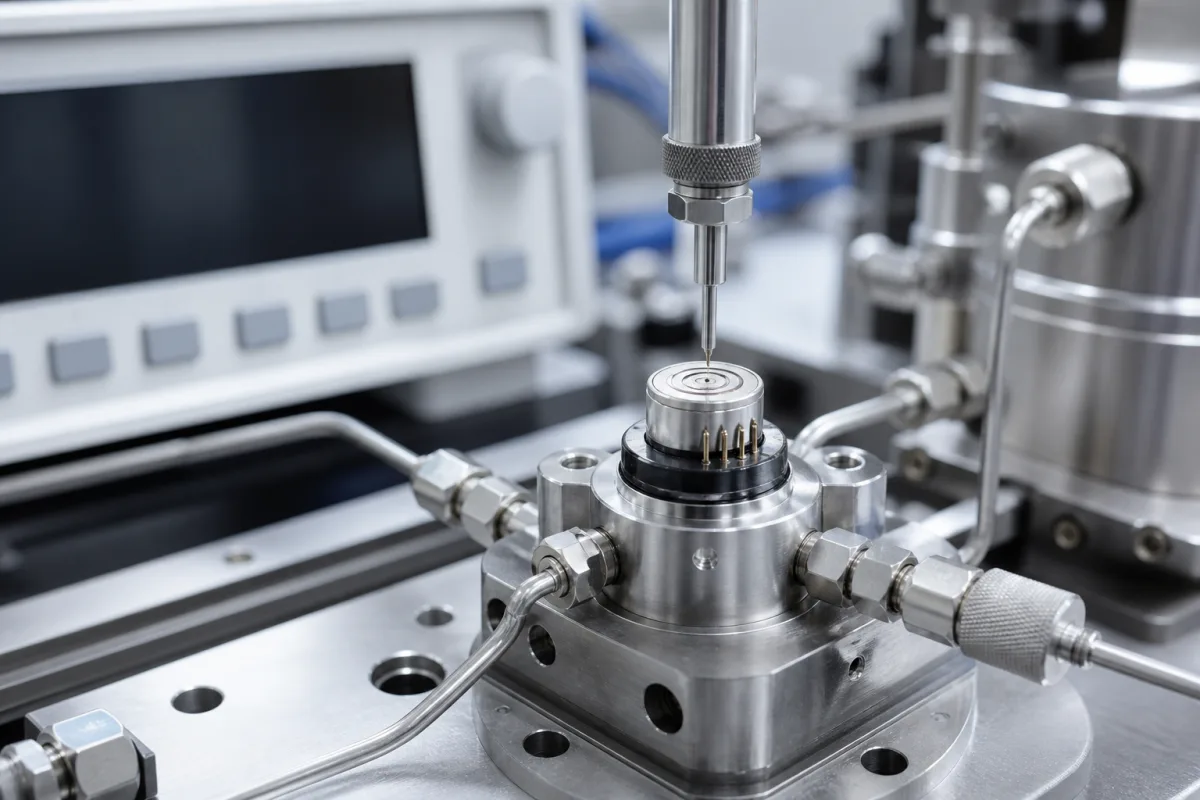
OEM pressure sensor cores · oil-filled isolated piezoresistive cells, millivolt bridge output, excitation, zero and temperature drift, overpressure
A pressure transducer sensing element, sold as a pressure sensor core, is the bare measuring cell that transmitter makers build into their housings: a silicon piezoresistive bridge sealed behind a stainless-steel isolation diaphragm, with silicone oil carrying the pressure to the chip and pins or wires carrying an unamplified millivolt signal. Ask three things first: what excitation the bridge needs and what full-scale output and zero it gives, how much the zero and span drift with temperature before you compensate them, and what overpressure the diaphragm and oil fill survive.
OEM pressure sensor cores (sensing elements): oil-filled isolated piezoresistive cells in 12.6–19 mm stainless housings with millivolt bridge output, and related glass micro-melt and differential cores, supplied for assembly into transmitters. Complete transducers and transmitters with amplified 4–20 mA or 0–10 V output, housings and process connections are covered on the Industrial pressure sensors and transmitters page. Bare MEMS dies, pressure switches and mechanical gauges are outside this page.
CNFX editorial research · Sources checked October 12, 2026 · 4 sources
Match excitation to the bridge and read the millivolt output
The WT19 data sheet describes a 19 mm industrial sensor core with a high-sensitivity silicon chip in an oil-filled housing that transmits the pressure. It is excited at 1.5 mA constant current as standard, with 5 V DC and 10 V DC options, has a bridge resistance of 2,600–5,500 Ω, and gives a typical span output of 100 mV (60 mV for the 10 kPa range) with zero output within ±2 mV. [1]
Holykell's CYX19, also a 316L stainless core of 19 mm diameter run from a constant-current supply, lists 100 mV full-scale output for a 0–3.5 MPa range, zero output of ±1 mV typical and ±2 mV maximum, non-linearity of 0.2% FS typical (0.5% max) and hysteresis and repeatability of 0.05% FS typical. [2] ZHYQ's PT124G-3101 isolated oil-filled core is offered in 12.6 mm, 16 mm and 19 mm diameters, each in gauge or absolute versions. [3]
Editorial calculation: at 1.5 mA the WT19 bridge drops 0.0015 A × 2,600 Ω = 3.9 V to 0.0015 A × 5,500 Ω = 8.25 V, so the current source in your transmitter needs headroom above 8.25 V across the full resistance range. A ±2 mV zero on a 100 mV span is ±2% of span before trimming. [1]
Give the supplier the pressure range and reference (gauge, absolute, sealed gauge), media and wetted materials, excitation (current or voltage) and the electronics you will use, core diameter and sealing (O-ring material or front welding), pin or wire connection, temperature range to compensate over, overpressure and burst requirements, stability needed and quantity.
02
Budget temperature drift and overpressure before compensation
A core's raw output moves with temperature; the transmitter maker compensates it. The CYX19 table lists zero temperature drift of ±0.4% FS typical (±1.6% max) for a 10 kPa core and ±0.15% FS typical (±0.8% max) for a 35 kPa core, with sensitivity temperature error of ±0.4% and ±0.2% FS typical, a 0–50 °C compensation range (80 °C optional), 125 °C working limit, ±0.10% FS long-term stability and 1 × 10⁸ pressure cycles. [2]
The WT19 data sheet lists zero and span temperature coefficients of 0.02% F.S. for ranges of 100 kPa and above and 0.03% F.S. below 100 kPa, compensation over −10 to 70 °C, operation over −40 to 125 °C, long-term stability of 0.2% F.S. a year or better, and overpressure of 300% F.S. below 70 kPa, 200% F.S. below 25 MPa and 150% F.S. from 25 MPa. It explains that low ranges need a larger diaphragm because oil expansion with temperature builds internal pressure against the diaphragm, which makes zero compensation harder on small diaphragms. [1]
Not every core uses oil: ZHYQ lists a glass micro-melt high-pressure core with no oil filling and no isolation diaphragm alongside its oil-filled and monocrystalline silicon differential cores. [4] Editorial note: compare drift and stability on the same pressure range, because both data sheets show that low-range cores drift more.
Send the range, electronics and media data together
Paste it into your enquiry below or into an email to a maker, then replace every bracket.
Range: [pressure; gauge, absolute or sealed gauge]
Electronics: [excitation current or voltage; amplifier input range]
Compensation: [temperature range; who compensates]
Mechanics: [core diameter; O-ring or welded; pins or wires]
Media: [fluid; diaphragm and fill oil]
Limits: [overpressure; burst; stability]
1 company lists this product among what they make. Company figures are quoted from each
company's own website; every card states where the relationship came from.
Shanghai Zhaohui Pressure Apparatus Co., Ltd.
Manufacturing site to be confirmed for the order
Lists diffused silicon and monocrystalline silicon pressure sensor cores, including isolated oil-filled cores in 12.6, 16 and 19 mm diameters and differential cores.
Explore company information and manufacturing capabilities, then discuss the scope of your project with a relevant supplier.
Share this page
Compiled and source-reviewed by the CNFX editorial team.
Each manufacturer above links to the page on that company's own website where the product is listed, with the date we checked it. How we source and review
· Page last updated 13 October 2026
Buyer questions
What output does a pressure sensor core give?
An unamplified millivolt bridge signal: the WT19 and CYX19 data sheets list about 100 mV at full scale with zero output within ±2 mV. [1][2]
Why do low-pressure sensor cores have larger diaphragms?
The WT19 data sheet explains that oil expansion with temperature builds internal pressure against the diaphragm, and a small diaphragm makes zero compensation difficult. [1]
How much overpressure can a sensor core take?
The WT19 lists 300% FS below 70 kPa, 200% FS below 25 MPa and 150% FS from 25 MPa. [1]
Sources and what still needs a direct check
Sources checked 2026-10-12. WT Sensor (WT19, data sheet hosted on a TI community forum), Holykell (CYX19, product table hosted by a distributor) and ZHYQ (a listed supplier) publish these values for their own cores.