Editorial Technical Reference

Precision Thermocouple Probe Assembly

This page explains how Precision Thermocouple Probe Assembly is classified within Manufacture of Measuring, Testing, Navigation and Control Equipment. Technical values and manufacturer relationships are research references; confirm the current specification and supplier evidence for each order.

Technical Definition & Core Assembly

A precision thermocouple probe assembly is a critical temperature sensing component used in industrial measurement, testing, and control equipment.

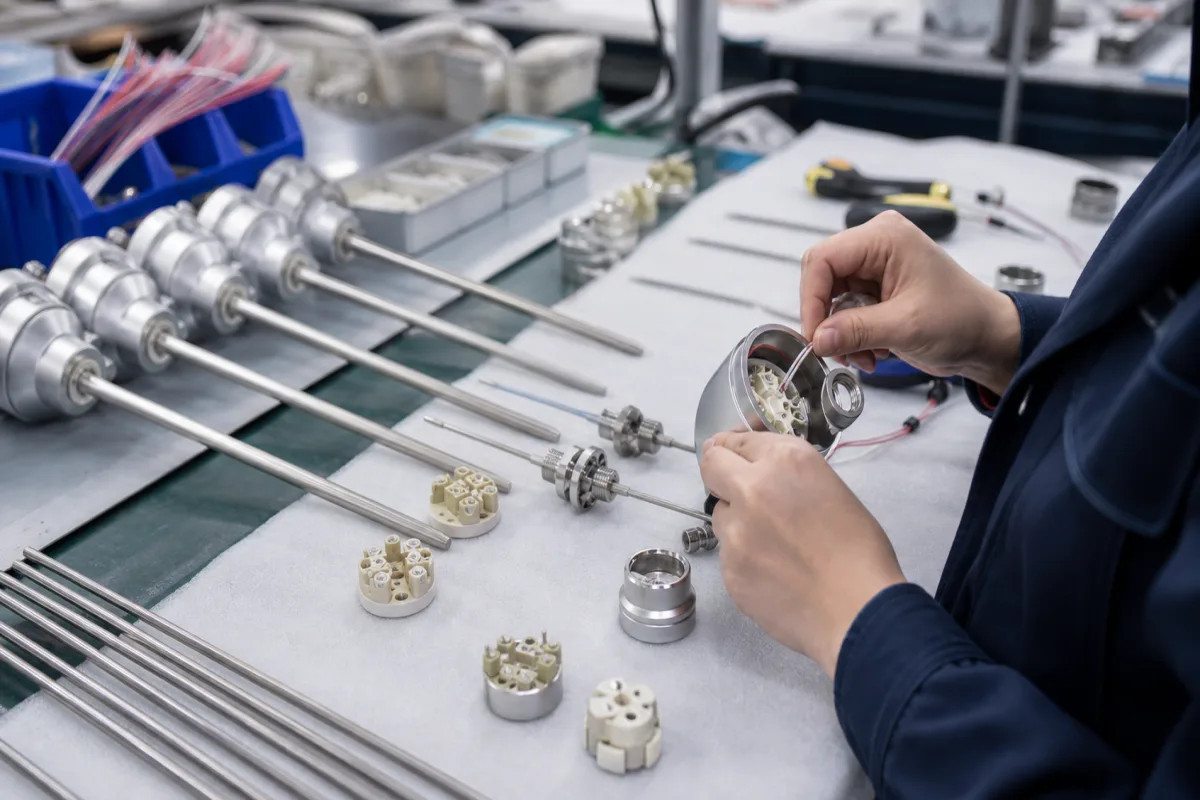
Representative product image. Confirm appearance and specifications with the manufacturer.

Product Specifications

Technical details and manufacturing context for Precision Thermocouple Probe Assembly

Definition
A precision thermocouple probe assembly is a critical temperature sensing component used in industrial measurement, testing, and control equipment. It converts thermal energy into electrical signals through the Seebeck effect, providing accurate temperature readings in harsh industrial environments. These assemblies are designed for integration into larger systems like process controllers, data loggers, and monitoring equipment. They ensure reliable temperature measurement for quality control, safety monitoring, and process optimization across various industries.

The probe assembly typically consists of a thermocouple element, a protective sheath, and a connection head. The thermocouple element is made of two dissimilar metal wires joined at the measuring junction. The protective sheath, often made of stainless steel 316L or Inconel 600, shields the element from mechanical damage and corrosion. Alumina ceramic and magnesium oxide are used as insulation and filler materials to maintain electrical isolation and mechanical stability.

Key parameters include a temperature range of -40 to 850 °C, response time of 0.5 to 2.0 seconds, and accuracy class 1 per IEC 60584. The sheath diameter ranges from 3 to 8 mm, and insertion length from 50 to 500 mm. The thermocouple type is K, and insulation resistance is at least 100 MΩ at 500 V DC and 25 °C. Operating pressure is 1.0 to 1.6 MPa, with IP ratings from IP65 to IP68. Weight varies from 0.2 to 1.5 kg depending on length and diameter.

These assemblies are used in various industries, including chemical, petrochemical, power generation, and food processing. They are suitable for measuring temperatures in pipelines, reactors, and storage tanks. The probe can be installed via threaded or flanged connections, and the connection head provides electrical termination and environmental protection.

When selecting a probe, consider the required temperature range, accuracy, response time, and environmental conditions. Verify that the probe's materials are compatible with the process media and that the IP rating meets the installation environment. Always confirm model-specific values and standards with the legal manufacturer or supplier, as the listed parameters are reference ranges for typical configurations.
Working Principle
The working principle of a thermocouple probe is based on the Seebeck effect. Two dissimilar metal wires are joined at one end, forming the measuring junction. When the measuring junction is exposed to the process temperature, a voltage is generated that is proportional to the temperature difference between the measuring junction and the reference junction (cold junction). This voltage is measured and converted to a temperature reading using a calibration curve. The probe assembly includes a protective sheath and insulation to ensure accurate and reliable measurement in industrial environments.
Common Materials
Inconel 600, Stainless Steel 316, Alumina Ceramic, Magnesium Oxide
Technical Parameters
ParameterTypical rangeNotes & selection driver
Temperature RangeRequired-40–850 °CMinimum to maximum measurable temperatureIEC 60584
Response TimeRequired0.5–2.0 secondsTime constant (63.2% response)IEC 60584
Accuracy ClassRequired1 classIEC 60584 accuracy classification (1, 2, 3)IEC 60584
Sheath DiameterRequired3–8 mmOuter diameter of protective sheath
Insertion LengthRequired50–500 mmLength of sensing portion
Thermocouple TypeRequiredK typeJ, K, T, E, N, R, S, B per IEC 60584IEC 60584
Insulation Resistance≥100 At 500 V DC, 25°CIEC 60751
Probe Material316LStainless steel; Inconel availableASTM A276
IP RatingIP65–IP68For junction head and connectionIEC 60529
Weight0.2–1.5 kgDepends on length and diameter

Ranges are indicative industry figures for RFQ preparation, not a supplier commitment. Confirm every value and standard with the legal manufacturer before ordering.

Components / BOM
  • Thermocouple Wires Part
    Generate voltage signal proportional to temperature
    Material: Dissimilar metal alloys (e.g., Chromel-Alumel for Type K)
  • Protective Sheath Part
    Mechanical protection and environmental isolation
    Material: Stainless steel or Inconel
  • Mineral Insulation Part
    Electrical insulation and thermal conduction
    Material: Magnesium oxide powder
  • Termination Head Part
    Connection interface to instrumentation
    Material: Stainless steel or aluminum
  • Compression Fitting Optional Part
    Secure installation in process connection
    Material: Stainless steel

Industry Taxonomies & Aliases

Commonly used trade names and technical identifiers for Precision Thermocouple Probe Assembly.

Industrial Ecosystem & Supply Chain Structure

Complementary Systems
Downstream Applications
Specialized Tooling

Application Fit & Sizing Matrix

Operational Limits
pressure: Up to 1000 bar (dependent on sheath material and construction)
other spec: Response time: 0.5-10 seconds (dependent on sheath diameter and construction)
temperature: -200°C to 1200°C (dependent on thermocouple type and sheath material)
Media Compatibility
✓ High-temperature process gases ✓ Molten metals and alloys ✓ Chemical process liquids
Unsuitable: High-velocity abrasive slurry environments
Sizing Data Required
  • Process temperature range and accuracy requirements
  • Sheath material compatibility with process media
  • Required insertion length and mounting configuration

Reliability & Engineering Risk Analysis

Failure Mode & Root Cause
Thermal fatigue cracking
Cause: Repeated thermal cycling from process temperature fluctuations, leading to stress concentration and micro-cracking in the probe sheath material, particularly at weld joints or transition points.
Signal drift/calibration loss
Cause: Degradation of thermocouple junction due to oxidation, contamination from process media, or diffusion of dissimilar metals at the hot junction over time, resulting in inaccurate temperature readings.
Maintenance Indicators
  • Erratic or fluctuating temperature readings without corresponding process changes, indicating potential junction degradation or loose connections
  • Visible physical damage such as cracks, bulges, or discoloration on the probe sheath, suggesting material fatigue or chemical attack
Engineering Tips
  • Implement regular calibration checks using certified reference standards and document drift trends to predict end-of-life before critical failure occurs
  • Ensure proper installation with adequate immersion depth (minimum 10x probe diameter) and use thermal conductive paste in thermowells to minimize thermal lag and stress concentrations

Indicative industry ranges for design and RFQ preparation. Confirm the exact figures and applicable standard with the manufacturer before specifying.

Compliance & Manufacturing Standards

Applicable Standards
ASTM E230/E230M Standard Specification and Temperature-Electromotive Force (EMF) Tables for Standardized Thermocouples CE Marking for Electromagnetic Compatibility Directive 2014/30/EU

Quoted from the published standard.

Manufacturing Precision
  • Temperature Accuracy: +/-0.5°C or +/-0.4% of reading (whichever is greater)
  • Sheath Diameter: +/-0.05mm
Quality Inspection
  • Calibration Verification against NIST-traceable standards
  • Insulation Resistance Test at 500V DC

Manufacturers of Precision Thermocouple Probe Assembly

Manufacturer profiles associated with Precision Thermocouple Probe Assembly.

Sourcing Precision Thermocouple Probe Assembly from China?
Tell us your specification and target quantity — we will match it against manufacturer records and come back with the factories that fit.
Request manufacturers We manufacture this

Manufacturer listings support early research and capability understanding. They are not certification, ranking, or transaction guarantees.

Technical documentation
Request current drawings, revision history, and a signed specification sheet.
Manufacturing capability
Verify equipment lists, process limits, capacity, and representative production evidence.
Inspection readiness
Confirm test methods, calibrated equipment, sampling plans, and traceable reports.
Supplier transparency
Check the legal entity, factory address, ownership, certifications, and direct contacts.

CNFX does not score or rank suppliers. Buyers must verify all claims and documents with the legal manufacturer before ordering.

Frequently Asked Questions

What is the temperature range of this thermocouple probe?

The temperature range is -40 to 850 °C, as per IEC 60584. However, the actual range may vary depending on the specific model and materials. Always verify with the manufacturer.

What thermocouple type is available?

The standard type is K, but other types (J, T, E, N, R, S, B) may be available per IEC 60584. Confirm the required type with the supplier.

What is the response time?

The response time (time constant, 63.2% response) is 0.5 to 2.0 seconds, depending on the probe design and installation. Verify the specific value for your application.

What is the IP rating?

The IP rating is IP65 to IP68, indicating protection against dust and water. The exact rating depends on the connection head and assembly. Check the product specification.

Data Basis

Editorial classification, named public sources where available, and source-reviewed manufacturer records.

Preliminary Technical Classification
This page supports structured research, RFQ preparation, and supplier evaluation. It does not replace buyer-led supplier qualification, standards review, or technical approval.
Buyer enquiry

Request manufacturing insight for Precision Thermocouple Probe Assembly

Ask for use case, specification boundaries, supplier type, and RFQ preparation information for this product.

Where it goes
Straight to the CNFX editorial desk, and to the manufacturer if this product is linked to a claimed profile. Nothing is broadcast to a supplier list.
Your details stay here
We do not sell or rent enquiry data, and we do not add you to a mailing list. Used only to answer this request.
No commission, no middleman
CNFX is a directory. We take no cut of any order and never negotiate on a supplier's behalf.
What we don't claim
A listing is not an endorsement. Qualify every supplier and verify every figure yourself before ordering.

Your business information is used only to process this request.

Thank you! Your message has been sent. We'll respond within 1–3 business days.
Sorry, we couldn't send your message. Please try again, or email us at contact@cnfx.com.

Need to Manufacture Precision Thermocouple Probe Assembly?

Compare manufacturer profiles with relevant product and process capability.

Previous Product
Precision Rotary Encoder Disc
Last Product
Get QuotesChat