Feed pellet mills · Capacity and motor power by ring-die size, die L:D, steam conditioning, throughput versus pellet durability, kWh per tonne
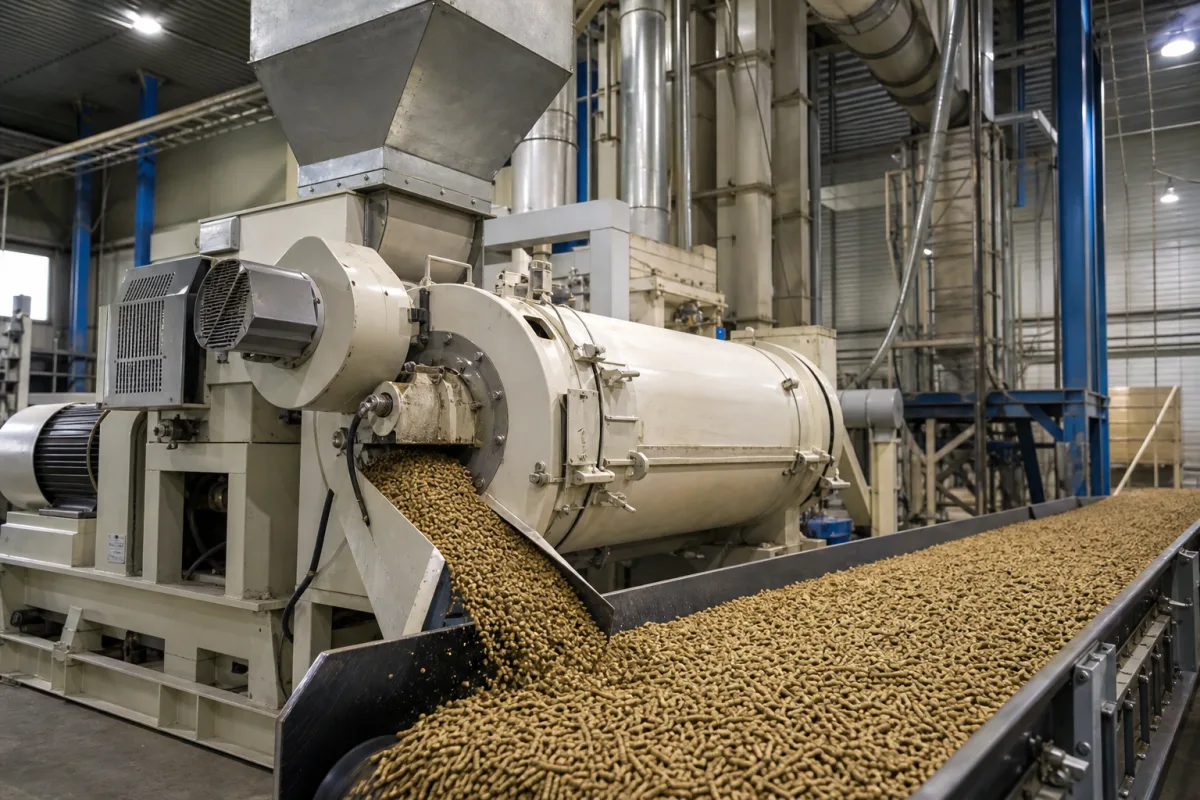
A pellet mill for animal feed presses steam-conditioned mash through the holes of a rotating ring die with rollers, forming pellets that are then cooled and screened. Ask three things first: what capacity and motor power the ring-die size gives for your formula, what die L:D and conditioning the mill uses to reach your pellet durability target, and how much energy per tonne it will draw.
Ring-die pellet mills for livestock, poultry and aquatic feed with feeders and steam conditioners. Flat-die mills for small farms, biomass and wood pellet mills, extruders and complete feed mill lines are outside this page.
CNFX editorial research · Sources checked October 12, 2026 · 4 sources
Liyang Yuda Machinery lists its SZLH ring-die pellet mills by die diameter: SZLH400 with a 400 mm die and 75/90 kW motor for 7–10 t/h; SZLH420 with 420 mm and 90/110 kW for 9–12 t/h; and SZLH508 with 508 mm and 132/160 kW for 13–17 t/h, each with a 2.2 kW feeder, a 5.5–7.5 kW conditioner and 2–10 mm pellets, weighing 3,000–4,465 kg. [2]
The US Grains Council's DDGS handbook explains that pellet mill electricity is quoted as kWh per tonne, that up to 72% of pelleting energy goes to steam conditioning, and that 15 kWh per tonne has been suggested as a reasonable goal for swine diets. Raising throughput from 545 to 1,646 kg/h increased mill efficiency from 73.3 to 112.4 kg per horsepower-hour but linearly reduced pellet durability index (PDI) from 55.4% to 30.2%. [1]
Editorial calculation: a 110 kW main motor making 9–12 t/h draws about 9.2–12.2 kWh/t at full load, before feeder, conditioner, cooler and steam; the 508 mm model at 160 kW and 13 t/h is about 12.3 kWh/t. Compare quoted capacities on the same formula and pellet size. [2][1]
Give the supplier the feed type and formula (with fat, DDGS and fibre levels), pellet diameter, target capacity in t/h, durability target and test method, steam supply and pressure, conditioner retention time wanted, die material and L:D options, cooler and crumbler needs, power supply and feed mill layout.
02
Balance pellet durability against throughput
The handbook states that almost any change made to increase pellet durability decreases throughput and increases energy cost. The key die factor is the ratio of die thickness to hole diameter (L:D): a thicker die raises durability through friction and retention time but reduces throughput and increases energy; die metal, hole design (straight or relief), hole pattern and number of holes also matter, as does the roller-to-die gap. [1]
It names steam conditioning as the leading factor for durability: higher conditioning temperature raises PDI and cuts energy by reducing friction, and changing conditioner paddle pitch can increase retention time, whereas steam pressure has inconsistent effects — 207–345 kPa appears sufficient. Pellets leave the die at 80–90 °C and 15–17% moisture and are cooled to within 8 °C of ambient and 10–12% moisture; particle size has weak evidence of effect on PDI. [1]
Editorial calculation: at an L:D of 8, a 4 mm hole needs an effective die thickness of 32 mm; at L:D 10 it is 40 mm. The L:D values and hole size are assumed examples; agree them with the die maker for your formula. [1]
03
Compare die width, working area and power, not die diameter alone
CPM's 7900 Series ring-die pellet mill table lists die inside diameter, width, working area and power. The 7930-4 has a 762 mm die, 94 mm wide, with 2,251 cm² of working area and 250 kW; the 7930-8 shares the 762 mm diameter but is 209 mm wide with 5,012 cm² and 250 kW; the 7936-14 has a 914 mm die, 356 mm wide, 10,352 cm² and 450 kW. Die speed is 180/150 rpm at 60/50 Hz, and CPM gives peripheral speeds of 1,696, 1,824 and 1,989 ft/min for its 30, 32.5 and 36 in dies, calculated with a 3 in thick die and 1,800 rpm motor; power may change with application. [4]
Editorial calculation: working area per kilowatt is about 9 cm²/kW for the 7930-4 (2,251 ÷ 250), 20 cm²/kW for the 7930-8 and 23 cm²/kW for the 7936-14 (10,352 ÷ 450), so dies of one diameter can differ more than twofold in area per kilowatt. The 1,696 ft/min of the 30 in die is about 8.6 m/s, against 1,064 ft/min at full motor frequency on the 100 HP mill in the Kansas State trial. Ask for die width and working area alongside die diameter. [4][3]
Model
Die ID × width; working area
Power
7930-4
762 × 94 mm; 2,251 cm²
250 kW
7930-8
762 × 209 mm; 5,012 cm²
250 kW
7932-9
826 × 240 mm; 6,218 cm²
315 kW
7936-14
914 × 356 mm; 10,352 cm²
450 kW
04
Treat die speed and conditioning temperature as settings to specify
A Kansas State University Animal Feed and Pet Food Research report (2021) pelleted a swine finishing diet on a 100 HP CPM 3016-4 mill with a 3/16 in × 1 3/4 in effective-length die at a target of 5 ton/h, after about 30 s of conditioning at 165 °F or 185 °F with 22 psi steam. Die speed was set by a variable frequency drive at 100, 75 and 50% of motor frequency, giving peripheral die speeds of 254, 190 and 127 rpm (1,064, 796 and 532 ft/min). [3]
The authors state there is no standard operating die speed across pellet mills, that die speed is measured at the outside diameter of the die, and that mill models may run at different die speeds, so settings should be checked when enzymes are added. PDI was measured with a tumble box to ASAE S269.5 and with a Holmen NHP 100 tester. [3]
Editorial calculation: the die's L:D is 1.75 / 0.1875 ≈ 9.3; 165 °F ≈ 74 °C, 185 °F = 85 °C; 5 short tons/h ≈ 4.5 t/h; 22 psi ≈ 1.5 bar.
Finding in the K-State trial
Result
165 °F, die speed lowered 254 → 127 rpm
PDI rose (linear); specific energy consumption rose (quadratic)
185 °F vs 165 °F at 190–254 rpm
Higher PDI regardless of die speed
185 °F at 127 rpm
Not possible to pellet: die choking from feed pad build-up and roll slip
185 °F, die speed raised 190 → 254 rpm
Lower phytase stability
Xylanase (heat-tolerant enzyme)
Less affected; higher die speed gave greater stability
Ask whether the main drive has a variable frequency drive, the die's peripheral speed range, and capacity and PDI at your conditioning temperature, especially if the diet contains heat-sensitive enzymes.
05
400–508 mm ring-die mills and complete feed pellet lines
Listings include ring-die feed pellet mills from 400 to 508 mm dies and complete animal feed pellet lines with hammer mills and mixers; ask each for capacity on your formula and the die specification.
06
Feeder, steam conditioner, ring die, rollers, main drive and cooler
The USGC handbook names steam conditioning, not the die, as the leading factor for pellet durability, so the conditioner row deserves as much detail in the order as the die itself. [1]
Capacity, motor power, die size and speed, conditioning temperature and steam for a pellet mill quotation
The capacity row is only meaningful with a formula and a durability target attached: the handbook reports PDI falling from 55.4% to 30.2% as throughput rose from 545 to 1,646 kg/h. [1]
2 companies list this product among what they make. Company figures are quoted from each
company's own website; every card states where the relationship came from.
Liyang Yuda Machinery Co.,Ltd
Manufacturing site to be confirmed for the order
Lists SZLH ring-die feed pellet mills from 400 to 508 mm dies, 7–17 t/h.
Explore company information and manufacturing capabilities, then discuss the scope of your project with a relevant supplier.
Share this page
Compiled and source-reviewed by the CNFX editorial team.
Each manufacturer above links to the page on that company's own website where the product is listed, with the date we checked it. How we source and review
· Page last updated 13 October 2026
Buyer questions
How much capacity does a 420 mm ring-die pellet mill have?
Liyang Yuda lists 9–12 t/h for its SZLH420 with a 90/110 kW motor. [2]
Does higher throughput reduce pellet quality?
Yes; the USGC handbook cites throughput rising from 545 to 1,646 kg/h cutting PDI from 55.4% to 30.2%. [1]
What does die L:D do?
A thicker die (higher L:D) increases durability but reduces throughput and raises energy use. [1]
How much energy does pelleting use?
Up to 72% goes to steam conditioning; 15 kWh per tonne has been suggested as a goal for swine diets. [1]
Does pellet mill die speed affect pellet quality?
In a 2021 Kansas State trial, lowering die speed from 254 to 127 rpm at 165 °F conditioning raised pellet durability but also specific energy; at 185 °F durability was higher regardless of speed. [3]
How large are the ring dies on large feed pellet mills?
CPM's 7900 Series table lists dies of 762 to 914 mm inside diameter with 2,251 to 10,352 cm² of working area and 250 to 450 kW. [4]
Sources and what still needs a direct check
Sources checked 2026-10-12. The US Grains Council handbook chapter reviews published feed-pelleting research and the Kansas State University report gives one pelleting trial; Liyang Yuda and CPM are makers publishing their own model data, and Liyang Yuda is also a linked supplier.