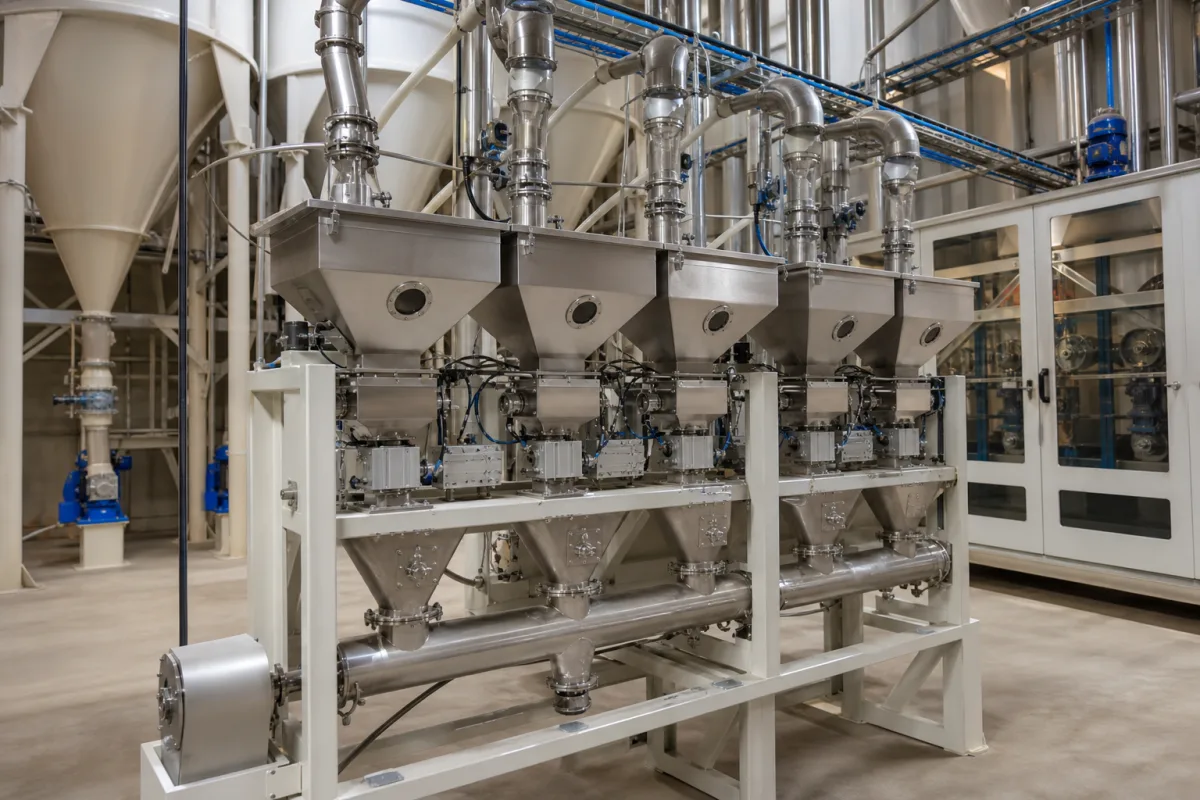
Micro-ingredient dosing and weighing module for feed mills: bin block, dosing screws and small scales weighing additives to within grams
Bin block of small stainless bins over dosing screws and small weigh hoppers · vitamins, minerals, premixes and additives weighed in grams per batch and dropped into a collecting conveyor to the mixer
Macro ingredients in a feed mill are weighed in hundreds of kilograms; vitamins, trace minerals, enzymes, amino acids and medicated premixes may be needed in a few kilograms or less per batch. A micro-ingredient module handles that end of the formula: small bins, each with a dosing screw sized for low flows, discharge into scales that are much smaller than the main batch scale, and a collecting conveyor delivers the weighed doses to the mixer. Two published numbers decide whether a module fits a formula: the accuracy of each scale in grams and the smallest dose it is meant to weigh.
Micro- and small-ingredient dosing and weighing modules for compound feed, premix, pet food and aqua feed plants: bin blocks of small bins, dosing screws with shut-off valves, small and intermediate weigh hoppers on load cells, main micro scales and collecting conveyors to the mixer, with their accuracy, scale ranges and cleanout. Single screw feeders, the design of the screw and the choice between volumetric and loss-in-weight feeding are covered on the Screw feeder page; continuous loss-in-weight powder feeders on the Powder feeder with loss-in-weight control page; whole recipe batching lines with the mixer and blend-uniformity test on the Automated ingredient batching and blending system page; the premixes themselves on the High-stability vitamin premix concentrate page; macro-ingredient batch scales, mixers and liquid addition systems are outside this page.
CNFX editorial research · Sources checked October 12, 2026 · 4 sources
Bins, scales and accuracy in grams: what three makers publish
Makers describe these modules by the number of bins, the capacity of each scale and an accuracy in grams; the figures below are each maker's own statements for its own system.
Editorial calculation: Ottevanger's 2% rule puts the smallest recommended dose on its main weigher at 0.02 × 50 = 1 kg for a 50 kg scale and 0.02 × 380 = 7.6 kg at the top of the range, which is why smaller doses go to the super scales above it. [1] Van Aarsen's 10 g on a batch of up to 50 kg is 10 / 50,000 = 0.02% of the batch; its 1 g on a 1 kg batch is 0.1%; AGI's 73 g on a 250 kg scale is 0.029% of capacity. [2][3] These are ratios of the published figures, not tested results, and the makers do not state the conditions behind them.
Ottevanger states that its unit can use four super scales at the same time to cut cycle time, and lists feed, premix and concentrates, pet food and aqua feed among its applications. [1] Van Aarsen states that its dosing slides close automatically on power loss and that the dosing unit consumes 1.2 kW. [2]
Published item
Ottevanger MDU
Van Aarsen dosing units
AGI microdosing system
Bins
Up to 8 stainless steel bins per unit, variable in size; larger bin blocks need an external structure [1]
Not stated on the page reviewed
8 to 24 stainless steel bins; 74° bin wall slope [3]
Dosing devices
8 dosing screw feeders, 8 pneumatic shut-off valves, up to 6 agitators optional [1]
Sequential slide openings for coarse and fine dosing; optional extra dosing screws and stirring devices [2]
43.5 in variable-pitch screw; 0.37 kW motor; feeder capacity 1.33 m³/h for densities of 488–1,442 kg/m³ [3]
Scales
1–4 small super scales of up to 15 dm³ and 1–2 large super scales of up to 20 dm³, over a main weigher of 50–380 kg [1]
SID: batches of 75–300 kg; MID: batches up to 50 kg; PID: batches as small as 1 kg [2]
Gravimetric scale capacity 250 kg (dimension table) [3]
Give the supplier each micro ingredient with its dose per batch and bulk density, and ask which scale weighs it, that scale's capacity, and the accuracy in grams measured at that dose.
02
How fast a dosing screw delivers compared with a tolerance of a few tens of grams
AGI's specification gives a feeder capacity of 1.33 m³/h and a density range of 488 to 1,442 kg/m³ for the ingredients it handles. [3]
Editorial calculation: at 1.33 m³/h a screw delivers 1.33 × 488 ≈ 649 kg/h of the lightest material and 1.33 × 1,442 ≈ 1,918 kg/h of the densest, which is about 180 g/s and 533 g/s. [3] Against a 73 g tolerance, that is roughly 0.4 s of full-speed running for the light material and about 0.14 s for the dense one, so the screw has to slow down or switch to fine feeding before the target weight, and the shut-off has to stop the flow quickly. [3]
Van Aarsen's coarse and fine dosing through sequential slide openings and Ottevanger's pneumatic shut-off valve under each screw are the two published ways of making that transition in the systems reviewed. [2][1] AGI lists standard and loss-in-weight bins integrated in a single frame, explosion-proof motor options rated Class II Div 2 Group G, and NTEP certification. [3]
Ask how the controller changes from coarse to fine feed, how it learns the in-flight material after shut-off, and what the scale reading is compared with to show the dose was within tolerance.
03
Scale testing and cleanout when the module doses medicated premixes
Where drugs are dosed into feed in the United States, the current good manufacturing practice rules for medicated feeds in 21 CFR Part 225 set requirements that fall on the dosing module. [4]
Editorial note: in a module where two or more bins discharge into shared scales and one collecting conveyor, each of those shared parts is equipment that comes into contact with the drug component, so the cleanout or sequencing plan has to cover them as well as the bin and screw of the drug itself. [4]
Requirement
21 CFR Part 225
Size and accuracy
Equipment, including scales and liquid metering devices, of suitable size, design, construction, precision and accuracy for its intended purpose [4]
Scale testing
Scales and metering devices tested for accuracy on installation and at least once a year thereafter [4]
Lubricants
Equipment built and maintained so that lubricants and coolants do not become unsafe additives [4]
Cleanout
Equipment designed to allow inspection and cleanout; procedures by physical means (vacuuming, sweeping, washing), flushing or sequential production on a predetermined basis [4]
Flush material
If flushing is used, the flush material is identified, stored and used so that it does not contaminate other feeds [4]
04
What to send for a micro-dosing module quote
Paste it into your enquiry below or into an email to a maker, then replace every bracket.
Ingredients: [name; dose per batch; bulk density; flow behaviour; medicated or not]
Batch: [batch size; batches per hour; mixer cycle]
Bins: [number; volume; agitators]
Scales: [capacities; accuracy in grams at dose; smallest dose per scale]
Dosing: [screw size; coarse/fine control; shut-off]
Compliance: [scale test certificate; cleanout or sequencing plan; hazardous-area rating]
Explore company information and manufacturing capabilities, then discuss the scope of your project with a relevant supplier.
Share this page
Compiled and source-reviewed by the CNFX editorial team.
Each manufacturer above links to the page on that company's own website where the product is listed, with the date we checked it. How we source and review
· Page last updated 13 October 2026
Buyer questions
How accurate are feed-mill micro-dosing scales?
Published figures include down to 10 g on Van Aarsen's MID and 1 g on its PID for 1 kg batches, and within 73 g for AGI's system. [2][3]
What is the smallest dose a scale should weigh?
Ottevanger recommends at least 2% of the scale capacity, about 1 kg on a 50 kg scale by editorial calculation. [1]
How often must the scales be tested for medicated feed?
21 CFR 225.30 requires testing on installation and at least once a year thereafter. [4]
Sources and what still needs a direct check
Sources checked 2026-10-12. Bin, scale and accuracy figures come from three makers' own leaflets and pages; the medicated-feed requirements from the US Code of Federal Regulations.