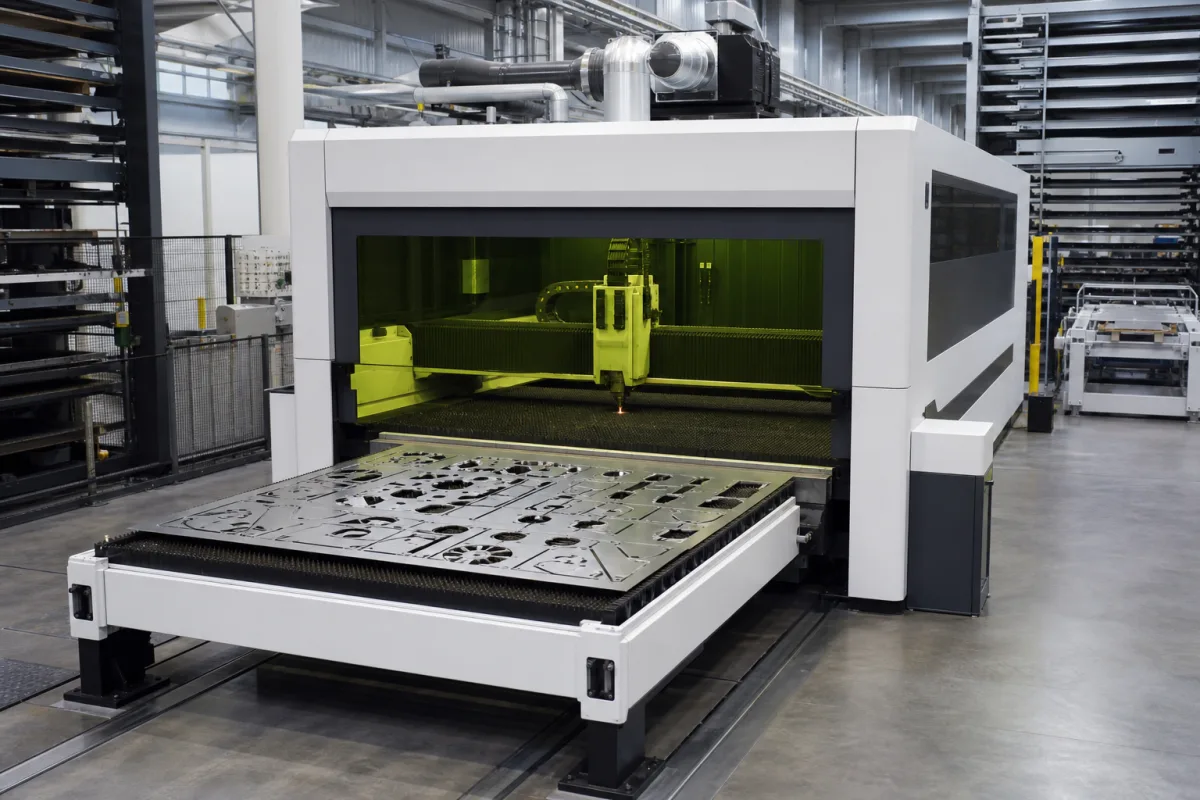
Sheet metal fibre laser cutting machine · Assist gas choice, pressure and purity, enclosure and laser safety controls, machine specification
A CNC fibre laser cutting machine moves a cutting head over a sheet on a gantry, focusing a fibre laser beam with an assist gas jet that blows molten metal from the kerf. The laser source and cutting head have their own CNFX guides; this page covers what the machine as a whole must be specified for. Ask three things first: which assist gas (nitrogen, oxygen or air) at what pressure and purity your parts need, how the enclosure and interlocks keep operators out of the beam, and what bed size, accuracy and automation the machine must deliver.
CNC fibre laser cutting machines for flat sheet and plate, enclosed or open, with or without exchange tables. Laser sources, cutting heads, tube lasers, CO2 lasers and laser marking or welding machines are outside this page.
CNFX editorial research · Sources checked October 12, 2026 · 4 sources
Atlas Copco, which sells nitrogen generators for laser cutting, says “Fiber lasers typically require 8–20 bar of nitrogen depending on material and thickness”, that nitrogen gives inert, oxidation-free edges suited to stainless steel and aluminium, and that “Delivered gas is typically supplied at a fixed, high purity level (99.999%)”, whereas an on-site generator can be specified for the purity a shop actually needs. [2]
StyleCNC's assist-gas guide for its fibre lasers gives starting windows: oxygen at 0.3–2 bar for carbon steel, falling as thickness rises, because oxygen reacts with hot iron and contributes roughly 30–40% of the cutting energy, leaving an oxide layer on the edge; nitrogen at about 12–20 bar for stainless steel and aluminium; and dried, oil-free compressed air at 8–12 bar, sometimes boosted toward 17 bar, for thin-to-medium mild steel. It gives running costs of about USD 0.20–0.40 per cutting minute for nitrogen against 0.05–0.15 for oxygen and 0.01–0.03 for air. [3]
Editorial calculation with StyleCNC's cost ranges: a part needing 2 minutes of cutting adds about USD 0.40–0.80 in nitrogen, 0.10–0.30 in oxygen or 0.02–0.06 in compressed-air electricity, so the oxide clean-up time saved by nitrogen decides which is cheaper overall. [3] Editorial note: these are a seller's starting values; take the gas pressures and nozzle sizes from the cut charts of the machine you buy.
Give the supplier the materials and thickness range, edge requirement (oxide-free, weld-ready or paint-ready), sheet size, annual cutting hours, assist gases available on site (bulk nitrogen, generator, oxygen, compressed air and dryer), required parts accuracy, loading and unloading automation, fume extraction, the laser safety rules that apply, power supply and floor space.
02
Check the enclosure and laser safety controls
US Federal rule 21 CFR 1040.10 defines a Class I laser product as one that does not allow human access during operation to radiation above the Class I limits, and a Class IV laser product as one that permits access above the Class IIIb limits. Each laser product must have a protective housing that prevents access above Class I wherever access is not needed for its function, and a safety interlock on each part of the housing designed to be removed or displaced during operation or maintenance. [1]
Laser systems in Class IIIb or IV must also have a remote interlock connector (no more than 130 V rms across its terminals) that blocks emission when opened, a removable key-actuated master control without which the laser cannot operate, and a permanently attached beam attenuator. [1]
Editorial note: an enclosed machine with interlocked doors is one way to keep operators out of the beam; ask the supplier for the laser product classification of the complete machine, the interlock design and certificates for your market, and the window material and rating for viewing panels.
03
Fix bed size, accuracy and automation
The reviewed sources do not give machine accuracy values; the fields below are those a buyer should obtain in writing from the supplier.
Editorial note: ask for positioning accuracy and repeatability with the test method and length they refer to, maximum acceleration and positioning speed, the usable sheet size and exchange table time, the cutting thickness for each gas at the offered laser power, and an acceptance cut on your material with the edge and dimensional checks you will use.
A maker's specification shows the machine-level figures to collect. Bystronic lists its ByStar Fiber with laser power up to 30 kW and sheet thicknesses up to 50 mm, in a 6225 model for 6,200 × 2,500 mm sheets and an 8025 model for 8,000 × 2,500 mm sheets, both with a maximum simultaneous positioning speed of 170 m/min and maximum workpiece weights of 3,650 kg and 4,710 kg; its HP Shop Air option cuts 3–30 mm sheet with compressed air instead of nitrogen to lower cost per part. [4] Editorial calculation: a full 6,200 × 2,500 × 30 mm steel sheet weighs about 3,650 kg (at 7,850 kg/m³), matching the 6225 table limit, and 8,000 × 2,500 × 30 mm about 4,710 kg for the 8025, so these tables are sized for full 30 mm steel sheets; 170 m/min is about 2.8 m/s. The page does not state positioning accuracy, so ask for it with the test method as noted above. [4]
04
Compare what suppliers offer
Suppliers linked to this page list CNC fibre laser cutting machines; each card links to the page reviewed.
Listings range from open-bed sheet cutters to enclosed high-power machines with exchange tables; ask each for laser power options, enclosure and safety design, gas circuits and cut charts.
05
Trace the machine components
This is a functional reference built from the sources cited; it is not one maker's design.
Fill the specification fields with values for your parts
A laser cutting machine quotation needs values for your parts and plant. The table explains each field, gives published values where a reviewed source states them, and says what to obtain from the supplier.
Explore company information and manufacturing capabilities, then discuss the scope of your project with a relevant supplier.
Share this page
Compiled and source-reviewed by the CNFX editorial team.
Published product pages show what a company offers, not tested performance. Confirm the legal seller, factory and scope for your order. How we source and review
· Page last updated 13 October 2026
Buyer questions
What nitrogen pressure does a fibre laser cutter use?
Atlas Copco says “Fiber lasers typically require 8–20 bar of nitrogen depending on material and thickness”. [2]
Why use oxygen for thick carbon steel?
StyleCNC notes oxygen reacts with hot iron, supplying roughly 30–40% of the cutting energy at only 0.3–2 bar, but leaves an oxide edge. [3]
What safety controls does a high-power laser need under US rules?
21 CFR 1040.10 requires protective housing with interlocks, and for Class IIIb and IV a remote interlock connector, key control and beam attenuator. [1]
What sheet size and thickness can a high-power fibre laser cutter handle?
One maker lists 6,200 × 2,500 mm and 8,000 × 2,500 mm sheets, laser power up to 30 kW, thickness up to 50 mm and 170 m/min positioning speed. [4]
Sources and what still needs a direct check
Sources checked 2026-10-12. 21 CFR 1040.10 is a US regulation; Atlas Copco sells nitrogen generators and StyleCNC sells laser cutters, so both describe gas use from their own commercial angle.