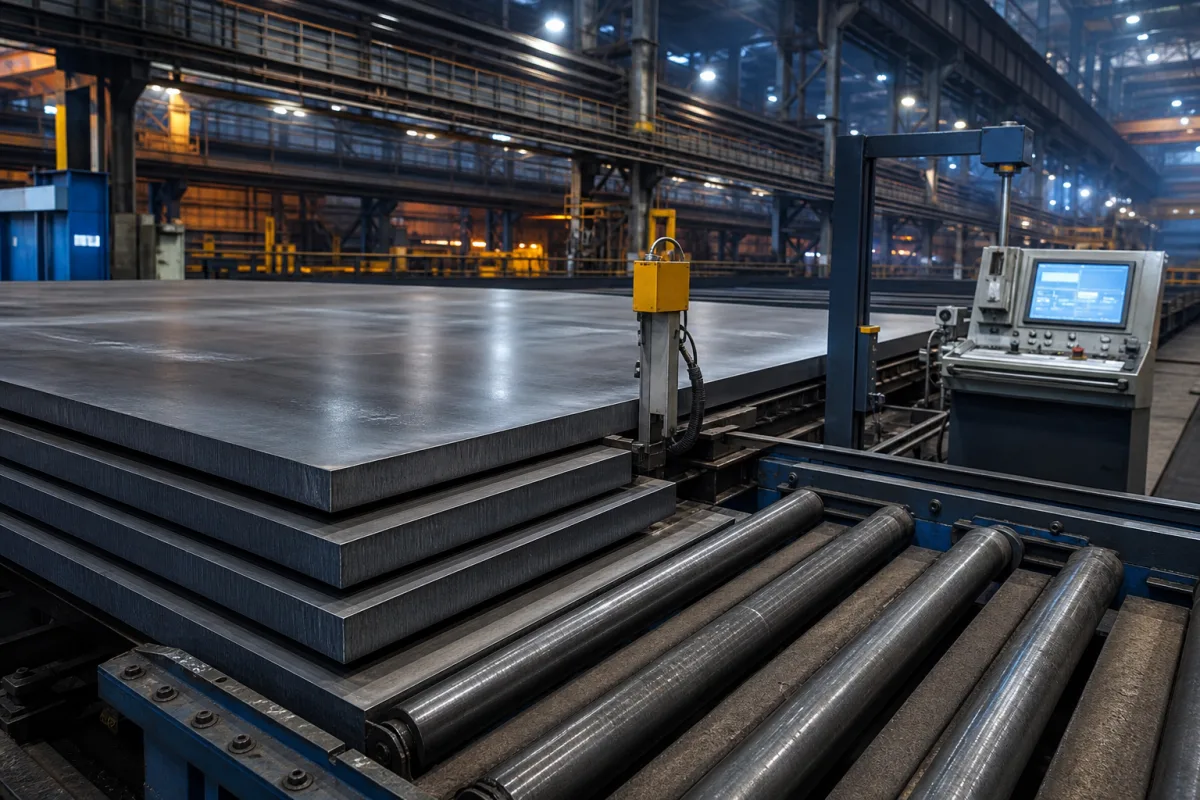
Wear plate · Hardness grades, carbon equivalent, preheat and interpass by thickness, hydrogen control, no post-weld heat treatment
High-strength abrasion-resistant (AR) steel plate is quenched, low-alloy steel made to a high surface hardness, such as the 450 HBW of SSAB's Hardox 450, for buckets, dump bodies, chutes and liners that must resist wear while carrying structural loads. Ask three things first: the guaranteed hardness range and toughness for your thickness, the carbon equivalent on the mill certificate, and the preheat, interpass and consumable rules for welding it.
Quenched abrasion-resistant steel plate and sheet for wear parts and structures. Cast wear liners and high-chromium castings, overlay (hardfaced) clad plate, grinding media and wear-resistant coatings are outside this page.
CNFX editorial research · Sources checked October 11, 2026 · 4 sources
SSAB describes its Hardox 450 plate as having a nominal hardness of 450 HBW with good bendability and weldability, 50 HBW harder than its 400 grade for better dent and abrasion resistance and longer wear life, or the option of a thinner plate for lighter equipment, with similar toughness to AR 400 steels. [1]
SSAB's welding guide says all Hardox grades resist hydrogen cracking better than other wear-resistant steels because of their relatively low carbon equivalent, gives the CEV and CET formulas, and states that alloy contents are on the mill certificate and "The typical carbon equivalent for all Hardox® grades is guaranteed in SSAB's product data sheets", and that "A higher carbon equivalent usually requires a higher preheating and interpass temperature". [2]
Editorial note: suppliers on this page list grades such as NM360 to NM550 and AR550; compare them on the guaranteed hardness range, impact toughness at temperature and carbon equivalent for the thickness you buy, not on the name.
Give the supplier the grade or hardness range, thickness, width and length, flatness, impact toughness requirement and test temperature, carbon equivalent limit, cutting and bending plans, welding processes, quantity, and mill certificate type.
02
Preheat, control hydrogen and avoid post-weld heat treatment
SSAB's preheat table for Hardox 450 plate gives no preheat up to 25.0 mm, 125 °C minimum for 25.1–40.0 mm and 150 °C minimum for 40.1–160.0 mm, with a maximum interpass temperature of 225 °C throughout; sheet of 2.0–8.0 mm needs no preheat and at most 100 °C interpass. [3]
The welding guide applies these values to tack welds and root runs, uses the thicker plate's requirement when thicknesses differ, and adds 25 °C at heat inputs of 1.0–1.69 kJ/mm or when humidity is high or the temperature is below 5 °C. It recommends consumables giving at most 5 ml of hydrogen per 100 g of weld metal, clean joints, weld starts and stops 50–100 mm from corners, root openings and gaps no more than 3 mm, and shifting the root pass about 5 mm off the plate centreline above 25 mm. [2]
SSAB says post-weld heat treatment can stress-relieve its HiTuf and HiTemp grades but should not be used on other Hardox steels because it may impair mechanical properties. [2] Editorial calculation: a 30 mm Hardox 450 plate welded at 1.2 kJ/mm would need 125 + 25 = 150 °C minimum preheat under these rules, below the 225 °C interpass limit.
03
NM360–NM550 and AR-type plate on the listed mills' pages
Listings include NM360 to NM550 and AR-type wear-resistant plates alongside carbon and structural steels.
04
Check a second mill's guaranteed values before comparing grades
voestalpine's technical terms of delivery for its durostat wear-resistant steels (January 2024) guarantee 410–490 HB as delivered for durostat 450 and apply to plate from 5 to 70 mm. Maximum carbon equivalent is CEV 0.57 and CET 0.37 up to 15 mm, and CEV 0.59 and CET 0.39 above 15 up to 70 mm. Charpy-V impact energy at −40 °C is guaranteed only on request and surcharge: 20 J minimum for 5–50 mm, against a standard value of 30 J at 20 mm. [4]
The same document gives standard values at 20 mm of 1,100 MPa yield strength, 1,400 MPa tensile strength and 9% elongation; minimum bending radii of 5 × plate thickness longitudinal and 4 × transverse; no preheat for thermal cutting up to 20 mm and at least 60 to 80 °C above that; and a ban on heating the plate above 250 °C if it is to keep its hardness. Hardness is measured per heat and every 40 t, about 1–2 mm below the surface, and the impact test and the EN 10204 certificate type must be agreed at ordering. [4]
Editorial calculation: a 20 mm durostat 450 plate needs an inside bending radius of at least 5 × 20 = 100 mm for the longitudinal value and 4 × 20 = 80 mm for the transverse value. Ask each supplier for guaranteed values, not standard values, for the thickness you buy.
Property (durostat 450)
Published value
Status in the document
Hardness as delivered
410–490 HB
Guaranteed range
Plate thickness
5–70 mm
Scope of the delivery terms
CEV / CET, 5–15 mm
0.57 / 0.37
Maximum
CEV / CET, over 15–70 mm
0.59 / 0.39
Maximum
Charpy-V at −40 °C, 5–50 mm
20 J
Guaranteed minimum, on request and surcharge
Charpy-V at −40 °C, 20 mm
30 J
Standard value
Yield / tensile strength, 20 mm
1,100 / 1,400 MPa
Standard values
Minimum bending radius
5 × t longitudinal, 4 × t transverse
Recommended
Maximum heating temperature
250 °C
To keep hardness
05
Hardness, toughness, carbon equivalent, thickness and primer
Thickness and carbon equivalent are the rows that change the welding procedure: SSAB's Hardox 450 preheat steps up at 25 and 40 mm, and its welding guide ties preheat to carbon equivalent. [3][2]
Hardness, strength, toughness, carbon equivalent and plate size for an AR plate order
SSAB's figures fill the hardness, thickness and carbon-equivalent rows. For yield, tensile and impact values, voestalpine's durostat terms above separate standard values from guaranteed ones, so ask which kind each quoted figure is. [1][4]
3 companies list this product among what they make. Company figures are quoted from each
company's own website; every card states where the relationship came from.
Shandong Huitong Steel Co., Ltd.
Manufacturing site to be confirmed for the order
Lists wear-resistant steel plate in grades up to NM550 and AR550.
Explore company information and manufacturing capabilities, then discuss the scope of your project with a relevant supplier.
Share this page
Compiled and source-reviewed by the CNFX editorial team.
Each manufacturer above links to the page on that company's own website where the product is listed, with the date we checked it. How we source and review
· Page last updated 13 October 2026
Buyer questions
Does abrasion-resistant plate need preheating?
For SSAB's Hardox 450, not up to 25 mm; 125 °C at 25.1–40 mm and 150 °C at 40.1–160 mm, with 225 °C maximum interpass. [3]
What consumables should be used?
SSAB recommends processes and consumables giving at most 5 ml hydrogen per 100 g of weld metal. [2]
Can AR plate be stress relieved after welding?
SSAB says only its HiTuf and HiTemp grades; other Hardox grades should not be post-weld heat treated. [2]
What hardness range does a 450-grade wear plate guarantee?
voestalpine's delivery terms for durostat 450 guarantee 410–490 HB as delivered, for plate 5–70 mm thick. [4]
Sources and what still needs a direct check
Sources checked 2026-10-11. SSAB is a steel maker describing its own Hardox grades; other mills' AR plates have their own data sheets and welding rules.