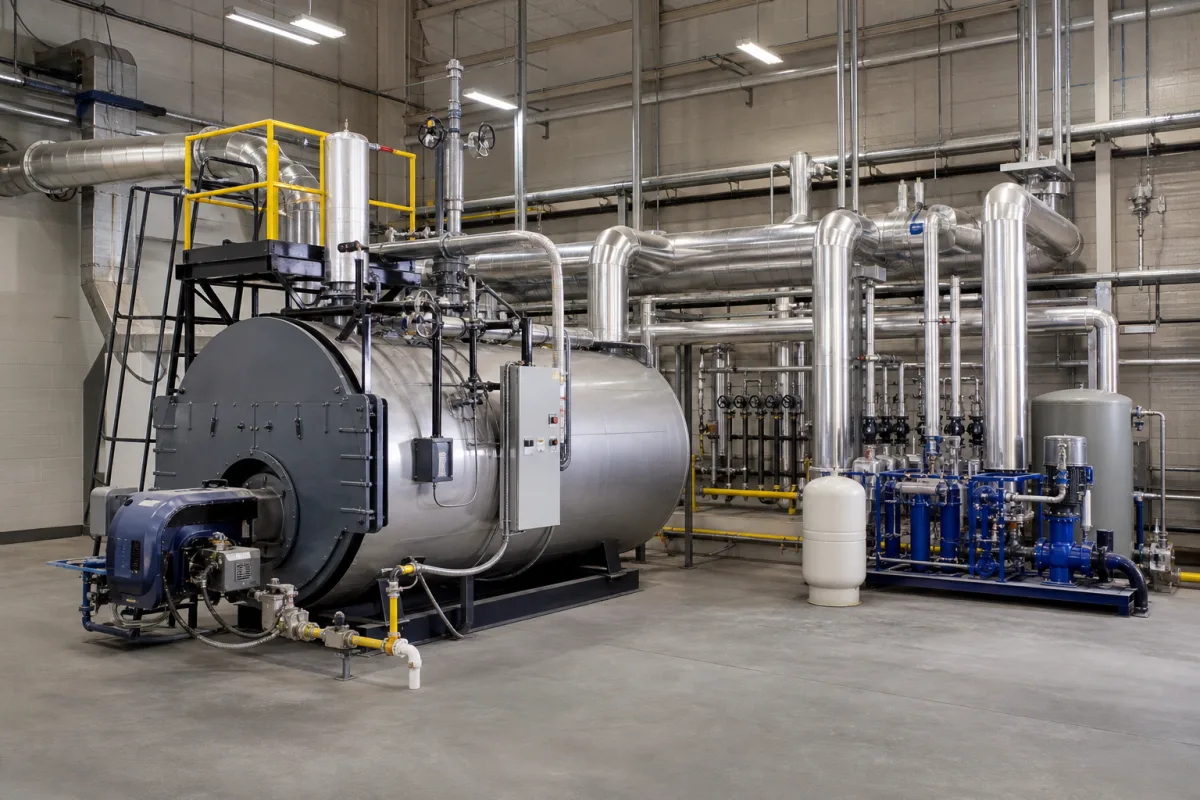
Industrial steam generation system for process heating
Packaged steam boiler plants for process heat · Firetube or watertube boiler, burner and combustion air, feedwater tank, softener, deaerator and feed pumps, blowdown and heat recovery, economizer, and US air rules for small steam generating units
An industrial steam generation system for process heating is a boiler plant that turns treated feedwater into steam for heating, drying, sterilising or reacting, and takes back condensate. Beyond the boiler and burner it needs feedwater storage, softening, deaeration, feed pumps, blowdown, controls and, where fitted, heat recovery. Ask three things first: what steam flow, pressure and quality the processes need, which boiler type fits that duty, and how feedwater, blowdown and emissions will be handled.
Fuel-fired packaged and field-erected steam boiler plants for process heating, with their burners, feedwater and condensate systems, water treatment, deaerators, blowdown, economizers and controls. Biomass-fired plant (see industrial boilers), waste heat boilers, steam distribution headers and traps, and power-generation boilers are outside this page except where compared.
CNFX editorial research · Sources checked October 12, 2026 · 4 sources
The US Department of Energy's sourcebook Improving Steam System Performance describes generation as a boiler adding energy from fuel combustion or process waste heat to feedwater, with the boiler, fuel supply, combustion air, feedwater and exhaust venting systems all affecting each other. It names two basic boiler types. In firetube boilers the combustion gases pass inside the tubes; Scotch marine boilers, the principal industrial firetube type, are valued for low initial cost, efficiency and durability, and generate steam on the large shell side; the biggest firetube boilers are over 1,500 boiler horsepower (about 50,000 lb/h). Turnaround zones between passes are dryback (refractory-lined) or waterback (water-cooled). [1]
In watertube boilers the water passes through the tubes; because tubes withstand higher internal pressure than a large shell, watertube boilers are used for high pressures (3,000 psi, sometimes higher), can produce saturated or superheated steam, and are favoured in chemical manufacturing, pulp and paper and refining. The sourcebook notes that firetube boilers account for the larger share of boiler sales by units, but watertube boilers for the larger share of capacity. [1]
Editorial calculation: using the sourcebook's definition of 1 boiler horsepower = 33,475 Btu/h, a 1,500 bhp firetube boiler delivers about 50.2 million Btu/h, or about 14.7 MW of steam output; fuel heat input will be higher by the boiler's losses. [1]
Give the supplier the steam demand profile (normal, peak and minimum flow), pressure and whether saturated or superheated steam is needed, steam quality needs (for example sterilisation), condensate return share and temperature, make-up water analysis, fuel(s) and supply pressure, emission limits, building space and flue route, redundancy, controls and remote monitoring, and local boiler code and inspection requirements.
02
Plan feedwater, deaeration, blowdown and heat recovery
The sourcebook explains that feedwater comes from returned condensate and make-up water, stored in a collecting tank; a modulating feedwater valve follows the water level transmitter. Softeners remove hardness minerals such as calcium, magnesium and iron by ion exchange, because hardness causes scale and foaming that lower efficiency and can cause tube failure. Deaerators and deaerating heaters use steam to heat water to saturation and break it into droplets or sheets, reducing oxygen to 7 to 40 ppb depending on design, while atmospheric deaerators in smaller, lower-pressure systems reach about 0.5 to 1 ppm, with oxygen scavengers used where lower levels are needed. [1]
Continuous blowdown removes a set share of boiler water to hold total dissolved solids, set with the water treatment programme; bottom blowdown removes sludge periodically and should never be done unless the boiler maker recommends it, because in higher-pressure boilers, especially above 700 psig, it can starve parts of the circuit of water. Blowdown heat exchangers and flash tanks recover heat to preheat make-up water or supply low-pressure steam. Economizers transfer flue gas heat to feedwater; non-condensing types must stay above the flue gas dew point (for natural gas, the source gives above 250°F), while condensing types recover latent heat and can need special stainless steels. [1]
DOE's Steam Tip Sheet #10 (Recover Heat from Boiler Blowdown, 2012) says any boiler with continuous blowdown above 5% of the steam rate is a good candidate for blowdown heat recovery, with larger savings at higher pressure. Its table, based on 100,000 lb/h of steam, 60 °F make-up water and 90% recovery, gives 1.7 MMBtu/h recoverable at 6% blowdown and 150 psig, rising to 2.7 MMBtu/h at 8% and 300 psig. Its worked example, a 50,000 lb/h, 150 psig, 80%-efficient boiler with 3,200 lb/h of blowdown (6.0%) running 8,000 h a year, saves 8,500 MMBtu a year, or $68,000 at $8.00/MMBtu. [3]
The tip sheet adds that heat can be recovered with a heat exchanger, a flash tank, or both; flash steam is used in the deaerator, and cooling the drain helps meet local limits on hot discharges to sewer. [3]
US EPA's New Source Performance Standards Subpart Dc (40 CFR 60.40c) apply to steam generating units built or modified after 9 June 1989 with a maximum design heat input of 2.9 MW (10 MMBtu/h) to 29 MW (100 MMBtu/h). [2] Editorial note: ask the supplier to state the design heat input, not only steam output, so the applicable air rules can be checked.
03
Check shell boiler pressure and output limits before choosing
Spirax Sarco's tutorial on shell boilers explains that furnace tube walls must resist pressure yet pass heat from flames of up to 1 800°C; the compromise of 18 to 20 mm wall thickness translates to a practical pressure limit of around 27 bar,. Higher pressures need a water-tube boiler. Combustion gases should be cooled to at least 420°C in plain steel boilers and 470°C in alloy steel boilers before the reversal chamber; check this if other fuels are considered. [4]
Output is capped by transport: the largest packaged shell boiler that can be moved by road in the UK produces around 27 000 kg/h, so larger demands use multi-boiler installations, which Spirax says give better security of supply and plant turndown. Of operating pressure it writes that "the majority operate at 17 bar or less". [4]
Editorial calculation: 27 bar is about 392 psi (27 × 14.5) and 27,000 kg/h about 59,500 lb/h (27,000 × 2.205), above DOE's figure for today's biggest firetube boilers of over 1,500 boiler horsepower (about 50,000 lb/h). [1] Ask the supplier for the design pressure and maximum continuous output, and above these limits compare a multi-boiler installation with a water-tube unit.
04
Boiler, burner, water treatment and heat recovery in one steam plant
Output, pressure, fuel and NOx: the boiler house data sheet
Output and pressure here draw on the DOE sourcebook and the blowdown case on Tip Sheet #10; efficiency, start-up time, dimensions and weight have no published value in these sources and have to come from the supplier with their basis stated.
Field
What it means and published values
Ask the supplier for
Steam Output Capacity
E.g. firetube over 1,500 bhp (about 50,000 lb/h). [1]
Find industrial steam generation system for process heating manufacturers
3 companies list this product among what they make. Company figures are quoted from each
company's own website; every card states where the relationship came from.
Hunan Xinhang Thermal Energy Technology Co., Ltd.
Manufacturing site to be confirmed for the order
Its website has a product page for industrial steam generation system for process heating.
Product scope checked 2026-10-12
Product page on own website · profile compiled by CNFX from public sources
Explore company information and manufacturing capabilities, then discuss the scope of your project with a relevant supplier.
Share this page
Compiled and source-reviewed by the CNFX editorial team.
Each manufacturer above links to the page on that company's own website where the product is listed, with the date we checked it. How we source and review
· Page last updated 13 October 2026
Buyer questions
Firetube or watertube boiler for process steam?
DOE's sourcebook says Scotch marine firetube boilers are seldom used above 300 psig, while watertube boilers handle high pressures and superheated steam. [1]
How much oxygen does a deaerator leave in feedwater?
Deaerators reach 7–40 ppb depending on design; atmospheric deaerators about 0.5–1 ppm (DOE sourcebook). [1]
Which US air rule covers small industrial boilers?
NSPS Subpart Dc applies to steam generating units of 2.9 to 29 MW design heat input built or modified after 9 June 1989. [2]
When is blowdown heat recovery worth adding?
DOE's Steam Tip Sheet #10 says a boiler with continuous blowdown above 5% of the steam rate is a good candidate. [3]
What pressure and output can a shell (firetube) boiler reach?
Spirax Sarco's shell boiler tutorial gives a practical pressure limit of around 27 bar and, for UK road transport, a largest packaged output of around 27 000 kg/h; beyond that it points to multi-boiler installations or a water-tube boiler. [4]
Sources and what still needs a direct check
Sources checked 2026-10-12. The DOE sourcebook is US government technical guidance (second edition); 40 CFR 60.40c is a US federal air regulation. Local boiler codes also apply.