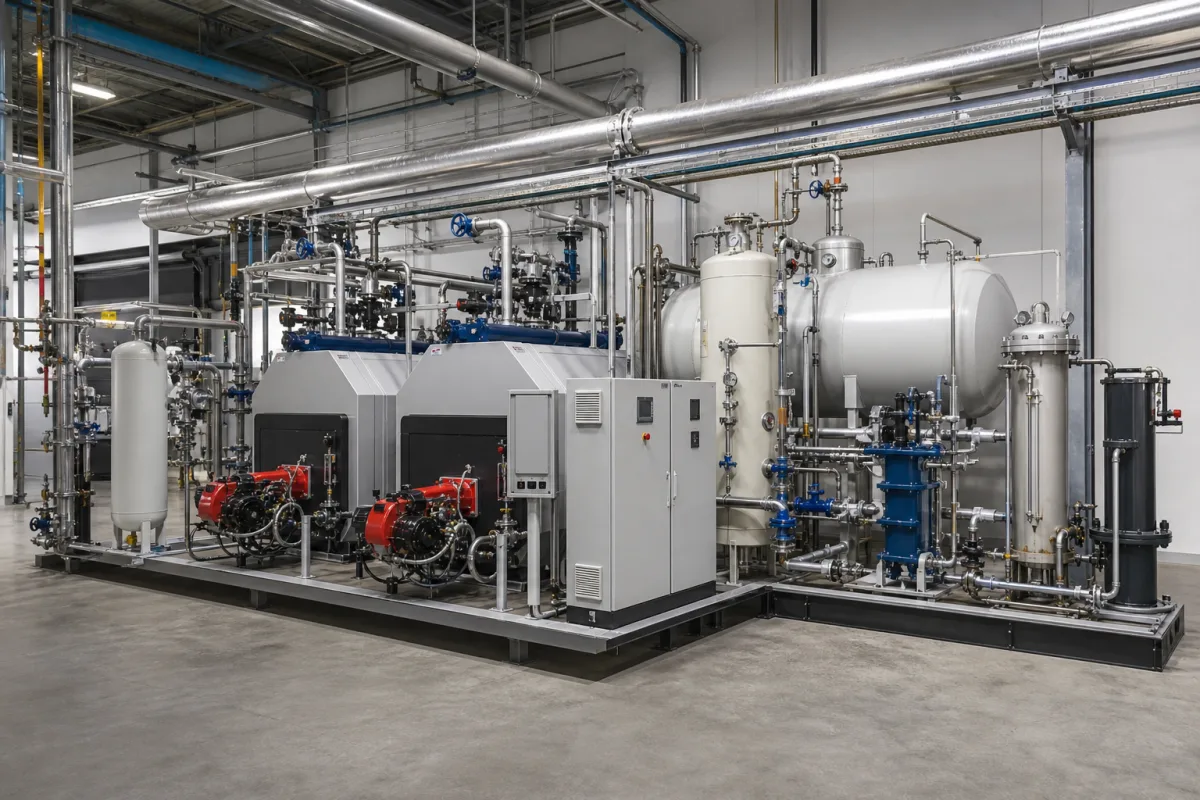
Modular multi-unit steam plant of small once-through generators: staging, N+1 spare and a shared feedwater header
Two or more small once-through steam generators run as one plant · units of 25 to 300 boiler horsepower staged on and off with load, one spare, one shared feedwater and condensate system
Instead of one large boiler sized for peak demand, a modular plant uses two or more small generators that start, fire and stop as the load changes. The small units are once-through designs: water is pumped through tubes or a single coil and leaves as steam through a separator, so the pressure part holds little water and can be brought up from cold within minutes. What makes the group behave as one plant is outside the units: the sequencing controls, a feedwater supply sized for all of them at full fire, a receiver they share, and pressure control on each separator outlet so a unit started by the sequencer does not overheat its coil.
Process steam plants made of two or more small once-through watertube or coil-tube steam generators (from about 25 to 300 boiler horsepower each) operated as one plant: unit staging and lead-lag sequencing, N+1 redundancy, shared feedwater pumps, headers and receivers, water treatment and back-pressure regulation for the group. Single packaged or field-erected shell and watertube boiler plants, with boiler-type selection by pressure and capacity and shell-boiler limits, are covered on the Industrial steam generation system for process heating page; burners, fuel trains and combustion-air systems on the Industrial furnace combustion system page; skid-mounted multi-pump packages on the Pumping system page; waste heat boilers, biomass boilers and steam distribution are outside this page.
CNFX editorial research · Sources checked October 12, 2026 · 3 sources
How many units, of what size: staging against load and the spare unit
DOE's steam tip sheet on short cycling explains the loss a modular plant is meant to avoid: fixed losses grow as a share of input when a boiler is lightly loaded. Its example puts radiation loss at 1% of input at full load, 2% at half load and 4% at one-quarter load, with pre- and post-purge air also carrying heat out of the boiler on every cycle. [3]
The tip sheet names re-engineering a boiler plant as multiple small boilers as one route to fuel savings, saying they give operators reliability and flexibility to follow load swings without over-firing and short cycling, and it advises bringing units on line in order of efficiency as load rises and taking the least efficient off first as it falls. [3]
Miura's LX brochure shows this arrangement with its own units: a Multiple Installation system of five 300 HP boilers for 1,500 HP, units that fire low, high or stay off according to demand, and an N+1 comparison in which 1,200 HP is met by two 600 HP boilers or by three 300 HP boilers plus one more 300 HP unit as the spare. [1] Editorial calculation: in the five-unit example each unit is 300 / 1,500 = 20% of plant capacity, so a 300 HP load can run on one unit at full fire instead of one 1,500 HP boiler at one-fifth load, the region where the DOE example shows radiation loss rising as a share of input. [1][3]
Miura states a five-minute start-up and attributes it to low water content, and claims that firetube inspection and maintenance cost 2 to 3 days of downtime against unit-by-unit service in a modular plant; both are the maker's statements, not test results. [1]
80% on gas, 81–82% on oil at 100% firing, higher heating value, nominal [2]
Firing
Low fire, high fire or off per unit in the staging diagram; blower VFD on LX 250/300 only [1]
—
SF-25/35 step-fired only; SF-50 to SF-200 step-fired standard, modulating on gas to order [2]
Give the supplier the hourly steam demand profile, not only the peak, and ask how many units at what size cover the lowest and highest loads, which unit is the spare, and how the sequencer decides lead and lag.
02
One feedwater system for a group of coil generators: flow, suction velocity, receiver and back-pressure regulators
Clayton's SigmaFire installation manual gives rules that apply as soon as more than one generator draws from the same feedwater supply. [2]
Editorial calculation from the manual's ratios: feedwater is supplied at 44 / 34.5 ≈ 1.28 times the rated steam output by mass, so the shared pumps and header have to be sized on the water figure, not the steam figure. For the manual's three 150 BHP units the receiver comes to 3 × 150 × 1.5 = 675 gallons. [2]
The coil of a SigmaFire unit is made from ASME SA178 or SA192 tube and hydrostatically tested to 1.5 times design pressure or 750 psig, whichever is greater; the manual asks for 60 in (1.5 m) of service clearance in front, 36 in (1 m) at each side and 18 in (0.5 m) behind, plus overhead room in case the coil has to be lifted out, and requires the plant room to stay above 45 °F (7 °C). [2]
Item
Published rule
Water supply per unit
44 lb/h per boiler horsepower; gross steam output is 34.5 lb/h per boiler horsepower [2]
Feedwater supply line
All flow velocities kept under 1 ft/s; with pumps in parallel on one suction line, sized as if all pumps act as one large pump [2]
Worked example
Three 150 BHP generators: 19,800 lb/h, 0.0881 ft³/s; a 3-inch line gives 1.8 ft/s, so at least a 4-inch manifold is needed [2]
Receiver
Sized at 1.5 gallons per boiler horsepower in total; two or more generators may share one receiver if they operate at the same pressure; receiver built to ASME Section VIII [2]
Back-pressure regulator
Required on units sold with auxiliary pressure control, master lead-lag or automated start-up, to protect the heating coil from drying out and overheating during large steam pressure changes [2]
Feedwater quality
Hardness 0 ppm (4 ppm max); pH 10.5–11.5 (12.5 max); sulfite residual 50–100 ppm in operation; TDS 8,550 ppm max (3,000–6,000 normal); iron 5 ppm max; silica 120 ppm max [2]
Ask for the feedwater line size calculation at all units on full fire, the receiver volume, the back-pressure regulator on each separator outlet, and the water analysis the treatment plant must deliver.
03
What to send for a modular steam plant quote
Paste it into your enquiry below or into an email to a maker, then replace every bracket.
Demand: [steam lb/h or kg/h by hour of day; peak; minimum; pressure at use point]
Units: [number and size; N+1 or N; fuel; NOx limit]
Controls: [lead-lag sequencing; rotation of lead unit; remote monitoring]
Feedwater: [raw water analysis; softener or RO; receiver; condensate return %]
Piping: [shared feed header; back-pressure regulators; separator traps]
Room: [floor area; clearances; minimum room temperature]
Explore company information and manufacturing capabilities, then discuss the scope of your project with a relevant supplier.
Share this page
Compiled and source-reviewed by the CNFX editorial team.
Each manufacturer above links to the page on that company's own website where the product is listed, with the date we checked it. How we source and review
· Page last updated 13 October 2026
Buyer questions
Why use a group of small steam generators instead of one large boiler?
DOE notes that fixed losses rise as a share of input at low load (radiation loss 1% at full, 4% at quarter load in its example) and names multiple small boilers as a way to follow load swings without short cycling. [3]
How is the shared feedwater line sized for a group of Clayton generators?
Clayton requires under 1 ft/s in the supply line at 44 lb/h per boiler horsepower; its example of three 150 BHP units needs at least a 4-inch manifold. [2]
What does the N+1 spare look like?
Miura's example meets 1,200 HP with three 300 HP units plus a fourth 300 HP unit as the extra unit. [1]
Sources and what still needs a direct check
Sources checked 2026-10-12. Two makers of small once-through steam generators publish the unit data and installation rules used here; the part-load loss example is from the US Department of Energy.