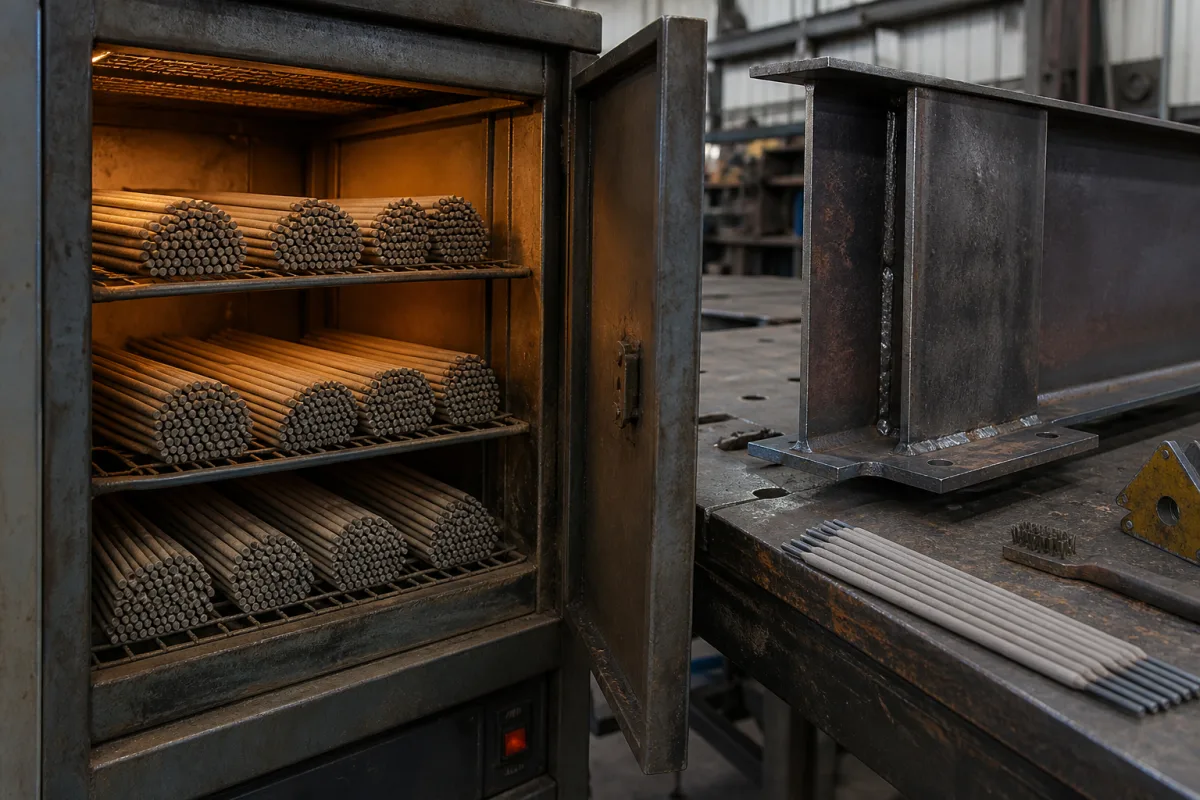
Stick welding · AWS A5.1 classification and E7018 H4R test minimums, current and diameter, low-hydrogen storage and holding ovens, exposure limits and redrying
A structural steel welding electrode is a flux-coated stick electrode for shielded metal arc welding of beams, columns and frames, classified by strength and coating type, for example E7018 low-hydrogen. Ask three things first: the classification and diameter for your steel and joints, how the electrodes are packed and kept dry, and the redrying and exposure rules your code requires.
Covered (stick) electrodes for carbon and low-alloy structural steel, including low-hydrogen and rutile types. Plastic welding rods, carbide hardfacing rods, brazing rods, solid wires and electrode ovens themselves are outside this page.
CNFX editorial research · Sources checked October 12, 2026 · 6 sources
AWS describes A5.1/A5.1M:2012 as establishing the requirements for classification of carbon steel electrodes for shielded metal arc welding: mechanical properties of weld metal, weld metal soundness and usability, plus weld metal composition, moisture content of low-hydrogen electrode coverings, standard sizes and lengths, marking, manufacturing and packaging, with optional supplemental requirements for improved toughness and ductility, lower moisture contents and diffusible hydrogen limits. The AWS store now lists that 2012 edition as historical. Low-alloy steel covered electrodes fall under A5.5/A5.5M:2022, which adds chemical composition and moisture tests of the low-hydrogen covering, with optional tests for absorbed moisture and diffusible hydrogen. Both use U.S. Customary and SI units independently of each other. [2][3]
Hobart's 418 data sheet shows how one product carries a set of designations: AWS A5.1 E7018 H4R and E7018-1 H4R, AWS A5.1M E4918, ASME SFA5.1 F-4, A-1, and approvals ABS 3Y H5, CWB E4918-1-H4, Lloyd's Register BF3, 3YM, 3M and DNV GL 3Y H5. [4]
The AWS minimums listed on that sheet are 70,000 psi (490 MPa) tensile strength, 58,000 psi (400 MPa) yield strength, 22% elongation in 2 in (50 mm), 20 ft·lbs (27 J) Charpy V-notch at -20 °F (-30 °C) and, for the -1 classification, at -50 °F (-45 °C), and 4.0 mL/100g diffusible hydrogen. Hobart's typical as-welded results are 75,000 psi (518 MPa) tensile, 60,000 psi (413 MPa) yield, 29% elongation, 94 ft·lbs (127 J) at -20 °F, 84 ft·lbs (114 J) at -50 °F and 2.9 mL/100g, and the sheet states these are typical values without guarantee. [4]
Lincoln's Excalibur brochure lists the same E7018 H4R requirements (400 MPa yield, 490 MPa tensile, 22% elongation, 27 J at -29 °C, 4.0 mL/100g maximum) with test results of 430–510 MPa yield, 510–605 MPa tensile and 2–3 mL/100g diffusible hydrogen, and places the E7018-1 H4R Charpy requirement at -46 °C. Its disclaimer says test results should not be assumed to be the results in a particular weldment. [5]
Editorial calculation: Hobart's typical tensile strength of 518 MPa is 28 MPa, or about 6%, above the 490 MPa minimum; the certificate for the delivered lot, not the typical value, is what a structural code inspector will check.
Ask for the classification printed on the electrode and packaging, the diffusible hydrogen designator (for example H4), the 'R' moisture-resistant suffix where exposure is long, and lot test certificates rather than typical values.
02
Set diameter, current and length
Hobart 418 runs on DCEP or AC. Its amperage ranges are 75–100 A for 3/32 in (2.4 mm), 90–150 A for 1/8 in (3.2 mm), 110–230 A for 5/32 in (4.0 mm), 150–300 A for 3/16 in (4.8 mm) and 270–380 A for 1/4 in (6.4 mm), with optimum settings of 90 A and 22.0 V, 130 A and 26.5 V, 170 A and 28.0 V, 220 A and 28.5 V, and 340 A and 32.0 V respectively. It advises reducing optimum amperage by 15% out of position, an arc length of less than half the electrode diameter, and does not recommend vertical-down. [4]
At those optimum settings Hobart calculates deposition rates from 1.8 lbs/hr (0.8 kg/hr) for 2.4 mm to 8.0 lbs/hr (3.6 kg/hr) for 6.4 mm, with deposition efficiencies between 62.5% and 73.1%. Electrodes are 14 in (355 mm) long up to 3/16 in and 18 in (457 mm) for 1/4 in. [4]
Lincoln's Excalibur 7018 MR covers 3/32 to 1/4 in (2.4–6.4 mm) in 14 in (350 mm) and 18 in (450 mm) lengths, with DC+ ranges of 70–110 A, 90–160 A and 130–210 A and AC ranges of 80–120 A, 100–160 A and 140–210 A for 2.4, 3.2 and 4.0 mm. Packages include a 1 lb (0.5 kg) tube, a 10 lb (4.5 kg) easy open can and a 50 lb (22.7 kg) easy open can. [5]
Editorial calculation: a 15% reduction from the 130 A optimum for 3.2 mm gives about 110 A for vertical or overhead work, still inside the 90–150 A range. [4]
03
Store low-hydrogen electrodes and limit exposure
Lincoln Electric says stick electrodes that absorb moisture can cause cracking or porosity and poorer arc performance. Unopened hermetically sealed containers protect low-hydrogen electrodes; opened cans should be held in a cabinet at 250–300 °F (120–150 °C). Moisture in low-hydrogen coatings can cause hydrogen-induced cracking, particularly in steels of 80,000 psi (550 MPa) yield and above. Standard EXX18 electrodes should be issued to welders twice per shift, while moisture-resistant types with an 'R' suffix may be exposed for up to 9 hours; codes may set different limits. [1]
Lincoln describes rising effects of moisture: internal porosity found only by x-ray or destructive testing, then visible porosity, fluid slag, rough surfaces and difficult slag removal, and with severe pickup weld and under-bead cracking. Non-low-hydrogen electrodes from opened containers can be held at 100–120 °F (40–50 °C) if moisture is a problem. [1]
Makers' figures differ. Hobart recommends storing its 418 electrodes in an oven at 220 °F to 350 °F and reconditioning electrodes exposed for extended periods for one hour at 575 °F (302 °C). Editorial calculation: 350 °F is about 177 °C, while the sheet prints the Celsius range as 104–117 °C, so confirm the oven setting with the supplier. [4]
Magmaweld says that unless supplied in a vacuum package, electrodes with basic coverings, referred to by the E7018 designation, must be redried at the maker's time and temperature before first use, because the calcium oxide based covering absorbs moisture; after redrying they should be kept in a temperature-controlled electrode thermos. [6]
Editorial calculation: issuing EXX18 electrodes twice in an 8-hour shift limits each batch's exposure to about 4 hours, against up to 9 hours for 'R' types. [1] Specify the code's limits and the holding ovens at the point of use.
Give the supplier the steel grades and strength, code (e.g. AWS D1.1 or EN equivalents), classification and diameters, packaging (hermetically sealed or vacuum packed), moisture-resistant 'R' requirement, quantities, certificates and test reports, and storage conditions on site.
04
Redry correctly and know when to discard
Lincoln states that one hour at the listed final temperature is satisfactory, higher temperatures must not be used, and longer drying at a lower temperature is not equivalent. E7018 and E7028 electrodes exposed to air for less than a week are redried at 650–750 °F (340–400 °C); those wetted or exposed to high humidity are first pre-dried at 180–220 °F (80–105 °C) for 1–2 hours. E8018 and stronger classes are redried at 700–800 °F (370–430 °C), no more than three times. Electrodes must be spread out in the oven, and discarded if the coating becomes fragile or the arc changes noticeably. [1]
For non-low-hydrogen types Lincoln does not recommend re-baking E6010/E6011 'fast freeze' electrodes, and gives 400–500 °F (200–260 °C) for 30–45 minutes for E7024 and E6027 types. [1]
Magmaweld adds that electrodes should be placed in the furnace at 100 °C and brought up gradually to the redrying temperature to avoid thermal shock to the covering, and that redrying above the maker's temperature degrades the covering and weldability. [6]
Editorial note: Hobart's one hour at 302 °C and Lincoln's one hour at 340–400 °C for E7018 are different instructions for different products; write the redrying procedure from the data sheet of the brand and classification actually delivered.
05
Compare what suppliers offer
Suppliers linked to this page list covered electrodes for structural steel; each card links to the page reviewed.
Xiang Welding lists AWS E6013, E7016 and E7018 electrodes with MIG and submerged-arc wires.
06
Trace the electrode components
This is a functional reference built from the sources cited; it is not one maker's specification.
Part
Role
Fix in the order
Core wire
Carbon steel electrodes under A5.1; low-alloy under A5.5. [2][3]
Wire grade and diameter.
Flux coating
Shields the arc; basic coverings absorb moisture and must stay dry. [1][6]
Coating type and moisture limit.
Classification
E.g. E7018 H4R, metric E4918; 'R' suffix for moisture resistance. [1][4]
Classification, H designator and suffix.
Packaging
Hermetically sealed or vacuum packs protect from moisture. [1][6]
Fill the specification fields with values for your welds
An electrode quotation needs values for your steel and code. The table explains each field, gives published values where a reviewed source states them, and says what to obtain from the supplier.
Explore company information and manufacturing capabilities, then discuss the scope of your project with a relevant supplier.
Share this page
Compiled and source-reviewed by the CNFX editorial team.
Published product pages show what a company offers, not tested performance. Confirm the legal seller, factory and scope for your order. How we source and review
· Page last updated 13 October 2026
Buyer questions
How should opened low-hydrogen electrodes be stored?
Lincoln Electric says in a cabinet at 250–300 °F (120–150 °C). [1]
How long can E7018 electrodes be out of the oven?
Lincoln says standard EXX18 electrodes should be issued twice per shift; moisture-resistant 'R' types up to 9 hours. Codes may differ. [1]
How are E7018 electrodes redried?
One hour at 650–750 °F (340–400 °C), with a 1–2 hour pre-dry at 80–105 °C if wet; never at higher temperatures. [1]
What do H4 and R mean in E7018 H4R?
The data sheets list a 4.0 mL/100g diffusible hydrogen maximum for H4; Lincoln describes 'R' electrodes as having high resistance to moisture pickup. [4][1]
Sources and what still needs a direct check
Sources checked 2026-10-12. Lincoln Electric, Hobart and Magmaweld are welding consumables makers; their storage, redrying and operating figures are for their own products, and codes may set different limits. AWS store abstracts describe what the A5.1 and A5.5 specifications cover; the specifications themselves were not reviewed.