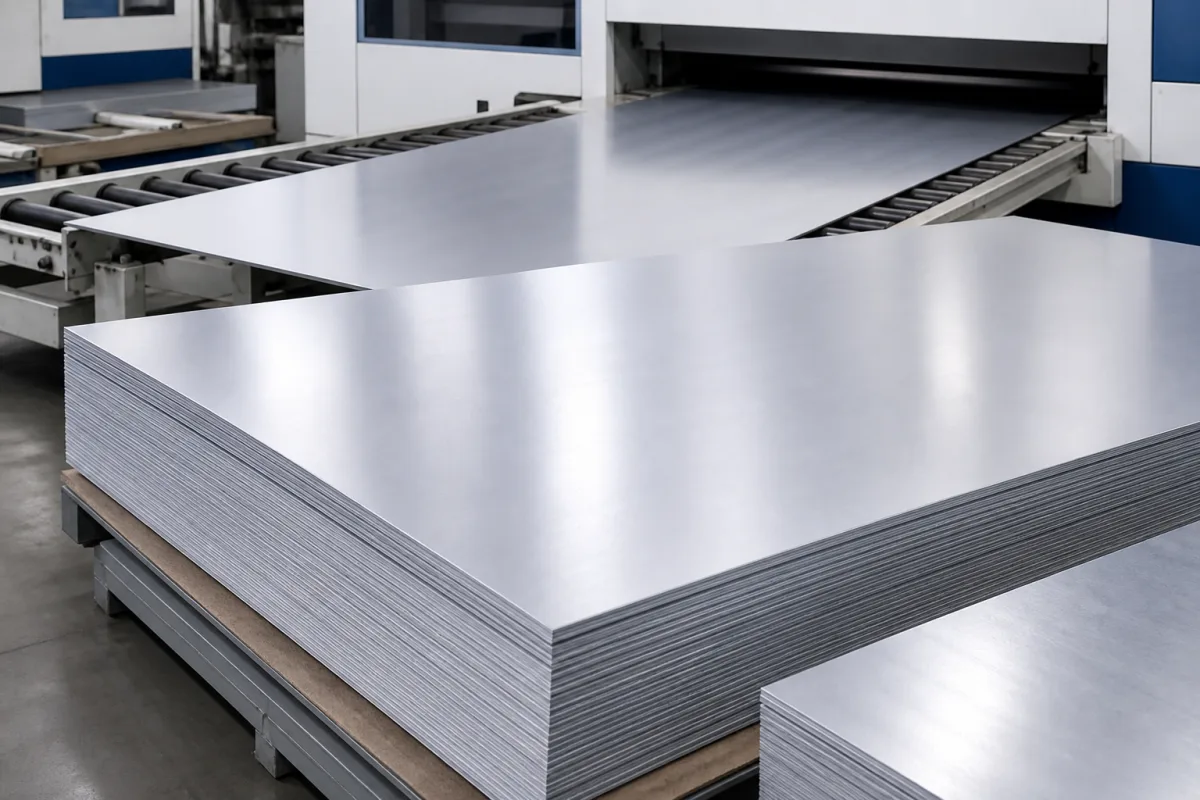
Corrosion-resistant aluminium sheet for tanks (weldable Al-Mg sheet, including 5454 for service above 65 °C)
Weldable Al-Mg sheet for tanks · EN 14286 scope, 5454 for service above 65 °C, Mg content and intergranular corrosion, strength against 5083
Corrosion-resistant aluminium sheet for tanks is weldable aluminium-magnesium sheet and plate used for the shells of storage tanks, road tankers and pressure vessels. Ask three things first: what the highest service temperature of the tank is, because higher-magnesium alloys can become susceptible to intergranular corrosion, which alloy and temper give the strength the design needs at that temperature, and which product standard and inspection the sheet must meet.
Weldable 5xxx (Al-Mg) aluminium sheet and plate for tank shells, road tankers, chemical storage tanks and pressure vessels. Marine plate for ship and boat structures (5083 and 5383 in H116 and H321) is covered on the Marine grade aluminium alloy plate page; extrusions, castings and filler wire are outside this page.
CNFX editorial research · Sources checked October 12, 2026 · 3 sources
Choose the alloy by service temperature as well as strength
A Corus Aluminium patent on wrought Al-Mg products whose applications include pressure vessels (US 7,727,346 B2) gives the nominal composition of AA5454 as 2.4-3.0% Mg, 0.50-1.0% Mn and 0.05-0.20% Cr, and states that with its fairly low Mg level the alloy is not susceptible to intergranular corrosion (IGC), while standard AA5083 with 4.0-4.9% Mg is known to be susceptible to IGC, so that a product with low IGC resistance cannot be used reliably, in particular at service temperatures above 65 °C. [1]
The patent's laboratory sheets put numbers on the trade-off: in the parallel direction the AA5454 sheet gave 237 MPa tensile and 108 MPa proof strength and the AA5083 sheet 299 MPa and 149 MPa, both with 19% elongation. It tested corrosion by ASTM G67 weight loss after sensitising at 100 °C for 100 hours, and the higher-strength alloys it claims gave less than 15 mg/cm² in that test. [1]
Righton Blackburns' data sheet for 5454 O/H111 sheet and plate describes the alloy as used for chemical storage tanks and in particular applications that may be subject to temperatures above 65 °C, with good strength from 65 to 170 °C, and gives for sheet of 0.2 to 6.0 mm to BS EN 485-2 a minimum proof stress of 85 MPa and tensile strength of 215 to 275 MPa, with a density of 2.69 g/cm³. [2]
Editorial calculation: in the patent's tests 5083 was 299 ÷ 237 ≈ 1.26 times as strong in tension and 149 ÷ 108 ≈ 1.38 times in proof strength as 5454, which is the strength a designer gives up when choosing 5454 for a hotter tank. At 2.69 g/cm³, one square metre of 4 mm 5454 sheet weighs 2.69 × 4 = 10.76 kg. [1][2]
Give the supplier the tank type and contents, highest service temperature, alloy and temper, thickness, width and length, product standard and its edition, mechanical properties at temperature if needed, corrosion test requirements such as ASTM G67 after sensitising, inspection certificate type, flatness and surface, and quantity.
02
Order to the tank product standard and the regulations
EN 14286 (SS-EN 14286:2008), as summarised by the Swedish Institute for Standards, specifies the inspection and delivery conditions, mechanical properties and dimensional and form tolerances of rolled aluminium alloy products intended for tanks for the storage and transportation of dangerous goods, in particular gasoline and other liquid hydrocarbons, and applies to hot- or cold-rolled strip, sheet and plate from 3.0 mm up to and including 12.0 mm used as wall material. [3]
The same summary notes that compliance with the standard does not ensure compliance with national or international regulations, that the user must check the material against all applicable regulations, and that depending on the goods carried or stored it can be necessary to agree on additional properties or inspection conditions. [3] Editorial note: name the regulation that governs the tank as well as EN 14286 in the order, and ask which alloys and tempers the mill supplies under it.
03
CHAL 5754, 5052 and 5083 sheet and plate
CHAL lists 5754 aluminium sheet described for corrosion resistance, 5052 coil and 5083 alloy plate among its products. Ask for the alloy, temper, standard and certificates for tank use.
04
Magnesium content, temper and IGC resistance the sheet must prove
Magnesium content decides both strength and intergranular-corrosion risk: the Corus patent describes 5454's lower Mg as not susceptible to IGC, while 5083 is, in particular in service above 65 °C.
Property
Why it matters
Fix in the order
Mg content
Higher Mg raises strength but IGC susceptibility. [1]
Alloy and composition limits.
Temper
O or H111 tempers named for these products. [1][2]
Explore company information and manufacturing capabilities, then discuss the scope of your project with a relevant supplier.
Share this page
Compiled and source-reviewed by the CNFX editorial team.
Each manufacturer above links to the page on that company's own website where the product is listed, with the date we checked it. How we source and review
· Page last updated 13 October 2026
Buyer questions
Why is 5454 used for hotter tanks instead of 5083?
A Corus patent states 5454's lower Mg (2.4-3.0%) avoids IGC susceptibility, while 5083 (4.0-4.9% Mg) is susceptible, a concern above 65 °C. [1]
How much strength does 5454 give up against 5083?
In the patent's tests 5454 sheet gave 237 MPa tensile and 108 MPa proof against 299 and 149 MPa for 5083. [1]
What does EN 14286 cover?
Rolled aluminium strip, sheet and plate from 3.0 to 12.0 mm used as wall material for dangerous-goods tanks. [3]
What strength does 5454 O/H111 sheet have?
Righton Blackburns gives a minimum proof stress of 85 MPa and tensile strength of 215-275 MPa for 0.2-6.0 mm sheet. [2]
Sources and what still needs a direct check
Sources checked 2026-10-12. The Corus Aluminium patent reports laboratory tests on standard and new Al-Mg alloys; Righton Blackburns is a UK metals stockholder publishing alloy data; the Swedish Institute for Standards publishes the scope of EN 14286.