Industry-Verified Manufacturing Data (2026)

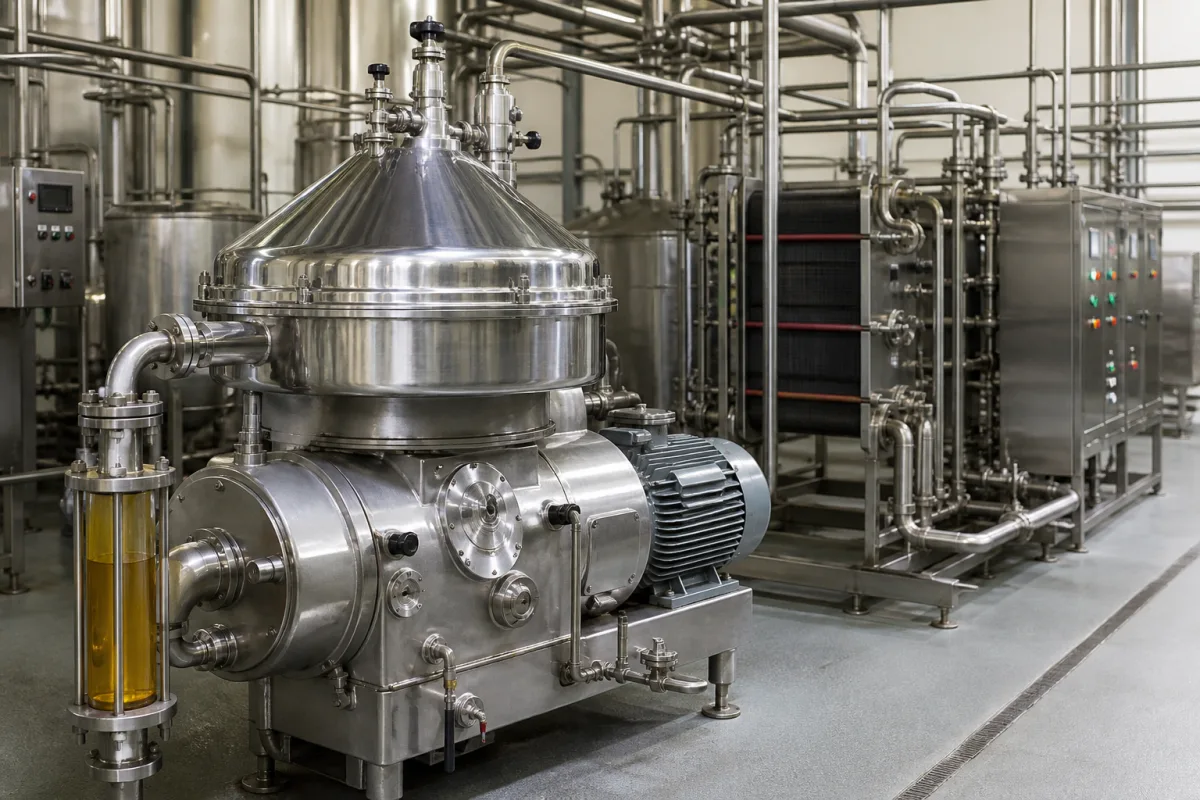
Industrial Oil Degumming Centrifuge

Based on aggregated insights from multiple verified factory profiles within the CNFX directory, the standard Industrial Oil Degumming Centrifuge used in the Manufacture of Vegetable and Animal Oils and Fats sector typically supports operational capacities ranging from standard industrial configurations to heavy-duty production requirements.

Technical Definition & Core Assembly

A canonical Industrial Oil Degumming Centrifuge is characterized by the integration of Separation Bowl and Main Drive Motor. In industrial production environments, manufacturers listed on CNFX commonly emphasize Stainless Steel 316L construction to support stable, high-cycle operation across diverse manufacturing scenarios.

Continuous centrifugal separator for removing phospholipids and gums from crude vegetable oils.

Product Specifications

Technical details and manufacturing context for Industrial Oil Degumming Centrifuge

Definition
An industrial centrifugal separator specifically designed for the degumming stage in vegetable oil refining. It operates continuously to separate phospholipids, gums, and other impurities from crude oils through high-speed centrifugal force. This machine is essential in edible oil processing plants to improve oil quality and prevent downstream processing issues. It plays a critical role in B2B supply chains by enabling refineries to produce higher-grade oils for food manufacturers and industrial applications.
Working Principle
Crude oil is fed into a high-speed rotating bowl where centrifugal force separates heavier phospholipid and gum particles from lighter oil, with continuous discharge of separated phases.
Common Materials
Stainless Steel 316L, Food-Grade Elastomers, High-Strength Alloy Steel
Technical Parameters
  • Maximum crude oil throughput rate (tons/hour) Standard Spec
  • Phospholipid removal efficiency from crude oil (%) Standard Spec
Components / BOM
  • Separation Bowl
    Creates centrifugal force field for phase separation
    Material: Stainless Steel 316L
  • Main Drive Motor
    Provides rotational power to bowl assembly
    Material: Copper Windings, Steel Housing
  • Feed Distribution System
    Evenly distributes crude oil into rotating bowl
    Material: Stainless Steel 304
  • Discharge Nozzles Optional
    Controls separated phase outlet flow
    Material: Hardened Steel
  • Vibration Dampers Optional
    Reduces mechanical vibration during operation
    Material: Rubber Composite
Engineering Reasoning
0.5-3.0 m³/h feed rate, 55-85°C operating temperature, 6000-10000 rpm bowl speed, 0.2-0.8 MPa feed pressure
Bowl speed exceeding 11000 rpm causes bearing seizure, feed temperature above 95°C degrades mechanical seals, phospholipid concentration >2.5% causes bowl imbalance
Design Rationale: Centrifugal force imbalance from uneven solids distribution (F = mω²r), thermal expansion mismatch between stainless steel bowl (α=17.3×10⁻⁶/K) and ceramic seals (α=5.5×10⁻⁶/K), hydrodynamic instability at Reynolds number >4000 in feed zone
Risk Mitigation (FMEA)
Trigger Phospholipid polymerization at 90°C forming adhesive deposits
Mode: Bowl imbalance causing 0.5 mm vibration amplitude at 100 Hz
Strategy: Install inline viscometer with PID control maintaining feed at 75±2°C
Trigger Water hammer pressure surge of 1.2 MPa during pump startup
Mode: Ceramic seal fracture at 0.9 MPa differential pressure
Strategy: Integrate accumulator with 0.6 MPa precharge and 10 ms response check valve

Industry Taxonomies & Aliases

Commonly used trade names and technical identifiers for Industrial Oil Degumming Centrifuge.

Industrial Ecosystem & Supply Chain DNA

Complementary Systems
Downstream Applications
Specialized Tooling

Application Fit & Sizing Matrix

Operational Limits
pressure: Max 6 bar (87 psi) inlet pressure
flow rate: 5-50 m³/h (22-220 gpm) depending on model
temperature: 20-90°C (68-194°F)
slurry concentration: Up to 30% solids by weight
separation efficiency: >95% phospholipid removal at optimal conditions
Media Compatibility
✓ Crude soybean oil ✓ Crude canola/rapeseed oil ✓ Crude sunflower oil
Unsuitable: Highly abrasive slurries with silica content >5%
Sizing Data Required
  • Required throughput (kg/h or m³/h)
  • Incoming phospholipid concentration (%)
  • Required final gum content specification (%)

Reliability & Engineering Risk Analysis

Failure Mode & Root Cause
Bearing failure due to imbalance or contamination
Cause: Imbalance from uneven bowl loading or sediment buildup, or contamination from degraded oil particles and moisture ingress leading to lubrication breakdown and overheating.
Bowl or scroll wear from abrasive particles
Cause: Presence of hard, abrasive impurities (e.g., silica, metal fines) in the feedstock, causing accelerated erosion of critical components, especially in high-speed zones, leading to reduced separation efficiency and potential structural failure.
Maintenance Indicators
  • Excessive vibration or unusual noise (e.g., grinding, knocking) during operation, indicating imbalance, bearing issues, or internal component contact.
  • Visible oil leakage around seals or housing, or a sudden drop in separation efficiency (e.g., increased oil turbidity or sediment in output), suggesting seal failure, bowl damage, or clogging.
Engineering Tips
  • Implement strict feedstock pre-filtration and quality control to minimize abrasive particles and moisture, reducing wear and corrosion risks.
  • Establish a condition-based maintenance program using vibration analysis and oil analysis to monitor bearing health, imbalance, and contamination, enabling proactive interventions before catastrophic failures.

Compliance & Manufacturing Standards

Reference Standards
ISO 1940-1:2003 (Mechanical vibration - Balance quality requirements for rotors in a constant (rigid) state) ANSI/ASME B73.1-2012 (Specification for Horizontal End Suction Centrifugal Pumps for Chemical Process) DIN 2448-1:2016 (Seamless steel tubes - Dimensions, masses, permissible deviations)
Manufacturing Precision
  • Bowl concentricity: +/-0.05mm
  • Shaft alignment: 0.02mm/m
Quality Inspection
  • Hydrostatic Pressure Test (1.5x operating pressure)
  • Non-Destructive Testing (Ultrasonic or Magnetic Particle Inspection for welds)

Factories Producing Industrial Oil Degumming Centrifuge

Verified manufacturers with capability to produce this product in China

✓ 96% Supplier Capability Match Found

S Sourcing Manager from Australia Feb 25, 2026
★★★★★
"Impressive build quality. Especially the Bowl Speed (rpm) is very stable during long-term operation."
Technical Specifications Verified
P Procurement Specialist from Singapore Feb 22, 2026
★★★★☆
"As a professional in the Manufacture of Vegetable and Animal Oils and Fats sector, I confirm this Industrial Oil Degumming Centrifuge meets all ISO standards. (Delivery took slightly longer than expected, but technical support was excellent.)"
Technical Specifications Verified
T Technical Director from Germany Feb 19, 2026
★★★★★
"Standard OEM quality for Manufacture of Vegetable and Animal Oils and Fats applications. The Industrial Oil Degumming Centrifuge arrived with full certification."
Technical Specifications Verified
Verification Protocol

“Feedback is collected from verified sourcing managers during RFQ (Request for Quote) and factory evaluation processes on CNFX. These reports represent historical performance data and technical audit summaries from our B2B manufacturing network.”

12 sourcing managers are analyzing this specification now. Last inquiry for Industrial Oil Degumming Centrifuge from India (13m ago).

Frequently Asked Questions

What materials are used in the construction of this degumming centrifuge?

The centrifuge is constructed with Stainless Steel 316L for corrosion resistance, food-grade elastomers for safe oil contact, and high-strength alloy steel for structural components.

How does this centrifuge remove phospholipids from crude vegetable oils?

The centrifuge uses continuous centrifugal force to separate phospholipids and gums from crude oil through high-speed rotation of the separation bowl, with discharge nozzles removing the separated impurities.

What are the key specifications for operating this industrial centrifuge?

Key specifications include bowl diameter (mm), bowl speed (rpm), feed pressure (bar), motor power (kW), noise level (dB(A)), and operating temperature (°C), all designed for continuous industrial operation.

Can I contact factories directly on CNFX?

CNFX is an open directory, not a transaction platform. Each factory profile provides direct contact information and production details to help you initiate direct inquiries with Chinese suppliers.

Get Quote for Industrial Oil Degumming Centrifuge

Request technical pricing, lead times, or customized specifications for Industrial Oil Degumming Centrifuge directly from verified manufacturing units.

Your business information is encrypted and only shared with verified Industrial Oil Degumming Centrifuge suppliers.

Thank you! Your message has been sent. We'll respond within 1–3 business days.

Need to Manufacture Industrial Oil Degumming Centrifuge?

Connect with verified factories specializing in this product category

Add Your Factory Contact Us
Previous Product
High-Pressure Oil Filter Cartridge
Next Product
Industrial Oilseed Flaking Mill