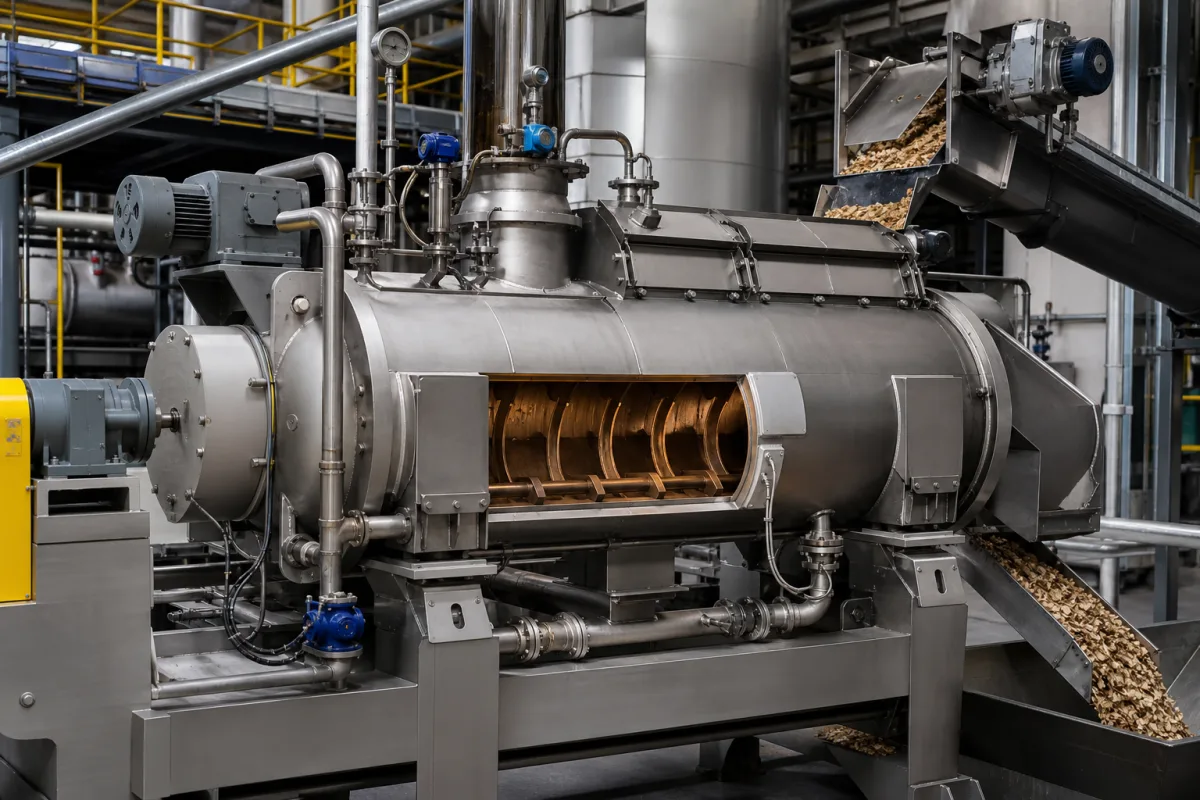
Oilseed pre-conditioning steam jacket: the heated shell of a horizontal seed conditioner
The steam-heated shell of a horizontal seed conditioner ahead of the flakers · jacket space, steam and condensate handling, air venting and the heating duty the seed needs
Before cracked soybeans, rapeseed or sunflower seed are flaked, they are heated and softened in a conditioner so they flake without shattering. In the horizontal type the product is turned by paddles inside a drum or trough whose outer wall is a steam jacket: low-pressure steam condenses in the annular space and the heat passes through the wall into the seed. The jacket only works if steam reaches every part of it and condensate and air leave it, so its piping, traps and vents matter as much as its shell.
Steam jackets on horizontal oilseed conditioners and cookers — the jacket shell, steam inlet, condensate outlet, air venting, insulation and their control — together with the heating duty they must deliver before flaking. Vertical tube-bank seed conditioners are described for comparison. Two-roll flaking mills, their feeders and roll gap are covered on the Industrial oilseed flaking mill page.
CNFX editorial research · Sources checked October 12, 2026 · 3 sources
The jacket shell and the duty it serves: cracks heated to about 70 °C over 25–35 minutes
Spirax Sarco describes the steam jacket as an outer cylinder around the vessel in which steam circulates and condenses on the vessel wall; Crown Iron Works' conditioner data give the seed-side duty that wall must deliver. [1][3]
Spirax Sarco notes that jacketed vessels may be lagged or have an air space around the jacket so that little steam condenses on the outer wall, that jackets lose more to radiation than submerged coils but leave room for agitation, which promotes heat transfer, and that the jacket space is between 50 mm and 300 mm wide depending on vessel size. [1] Its tabulated jacket heat-transfer coefficients are for liquids, so they do not apply to a bed of seed; ask the conditioner maker for test data on your seed.
For the duty, Crown Iron Works lists its Vertical Seed Conditioner for final conditioning of soybean cracks before flaking in conventional dehulling systems and for canola pre-heating. It heats beans with low-pressure steam at 1 bar (15 psi) to approximately 70 °C, with a residence time of approximately 25 to 35 minutes depending on bean moisture; with aspiration it removes up to 3% moisture, so beans received at 14% leave at approximately 11%. Five models cover 25 to 3,500 tonnes a day. [3] Editorial calculation: drying 1,000 t of beans from 14% to 11% moisture keeps 860 t of dry matter and removes about 34 t of water (1,000 − 860/0.89).
Design point
Horizontal jacketed conditioner (this page)
Vertical tube conditioner (Crown VSC, for comparison)
Heating surface
Vessel wall inside an outer steam jacket, 50–300 mm space. [1]
Oval 304L stainless tubes welded into tube sheets, with steam and condensate headers per section. [3]
Give the conditioner maker the seed, throughput, inlet and target temperature and moisture, required residence time and available steam pressure, and ask for heating area and test data on that seed.
02
Keeping the jacket working: traps sized for stall load, air vents at about 22 °C below steam temperature
A jacket that floods with condensate or fills with air heats only part of its wall; Spirax Sarco and TLV describe the drainage and venting rules that prevent it. [1][2]
Spirax Sarco advises sizing the steam control valve for the maximum start-up load so that steam pressure is kept up to push condensate out, and sizing the condensate removal device to pass both the full-load condensate and the stall load — when the control valve throttles and steam pressure falls to the condensate back-pressure. If the trap is sized only for full load, condensate backs up, water hammer occurs and heating becomes erratic. [1]
TLV explains that air and non-condensable gases build up in steam-using equipment and recommends thermostatic air vents for batch processes and equipment prone to air locking; its X-element vents discharge air at approximately 22 °C (40 °F) below the steam saturation temperature, at start-up and during operation. On rotating equipment that lifts condensate with a siphon pipe or internal scoops, steam mixed into the condensate can lock the trap, and TLV suggests a trap with a lock-release or needle valve to bleed a small amount of steam downstream. [2]
Ask the supplier for the jacket design pressure and hydrostatic test pressure, the number and position of condensate outlets and air vents, and the trap and vent models matched to the stall load.
03
What to send for a conditioner steam jacket
Paste it into your enquiry below or into an email to a maker, then replace every bracket.
Seed: [soybean cracks; rapeseed; sunflower; throughput t/day]
Duty: [inlet and target temperature; moisture in and out; residence time]
Steam: [available pressure; quality]
Jacket: [shell material; jacket space; design and test pressure; insulation]
Drainage: [condensate outlets; trap type; stall load; back-pressure]
Venting: [air vent positions; product-side aspiration]
Drum: [fixed trough or rotating drum; siphon or scoops]
Explore company information and manufacturing capabilities, then discuss the scope of your project with a relevant supplier.
Share this page
Compiled and source-reviewed by the CNFX editorial team.
Each manufacturer above links to the page on that company's own website where the product is listed, with the date we checked it. How we source and review
· Page last updated 13 October 2026
Buyer questions
How hot are soybean cracks conditioned before flaking?
Crown Iron Works reports heating beans to approximately 70 °C with 1 bar steam over about 25 to 35 minutes in its seed conditioner. [3]
How should the steam trap on a jacket be sized?
Spirax Sarco says it must pass both the full-load condensate and the stall load, when steam pressure in the jacket falls to the condensate back-pressure. [1]
Why does a steam jacket need an air vent?
Air in the steam space blocks heating; TLV's thermostatic vents discharge air at about 22 °C below steam saturation temperature. [2]
Sources and what still needs a direct check
Sources checked 2026-10-12. Spirax Sarco and TLV are steam-system equipment makers writing on jackets, traps and vents; Crown Iron Works is an oilseed equipment maker describing its own conditioner.