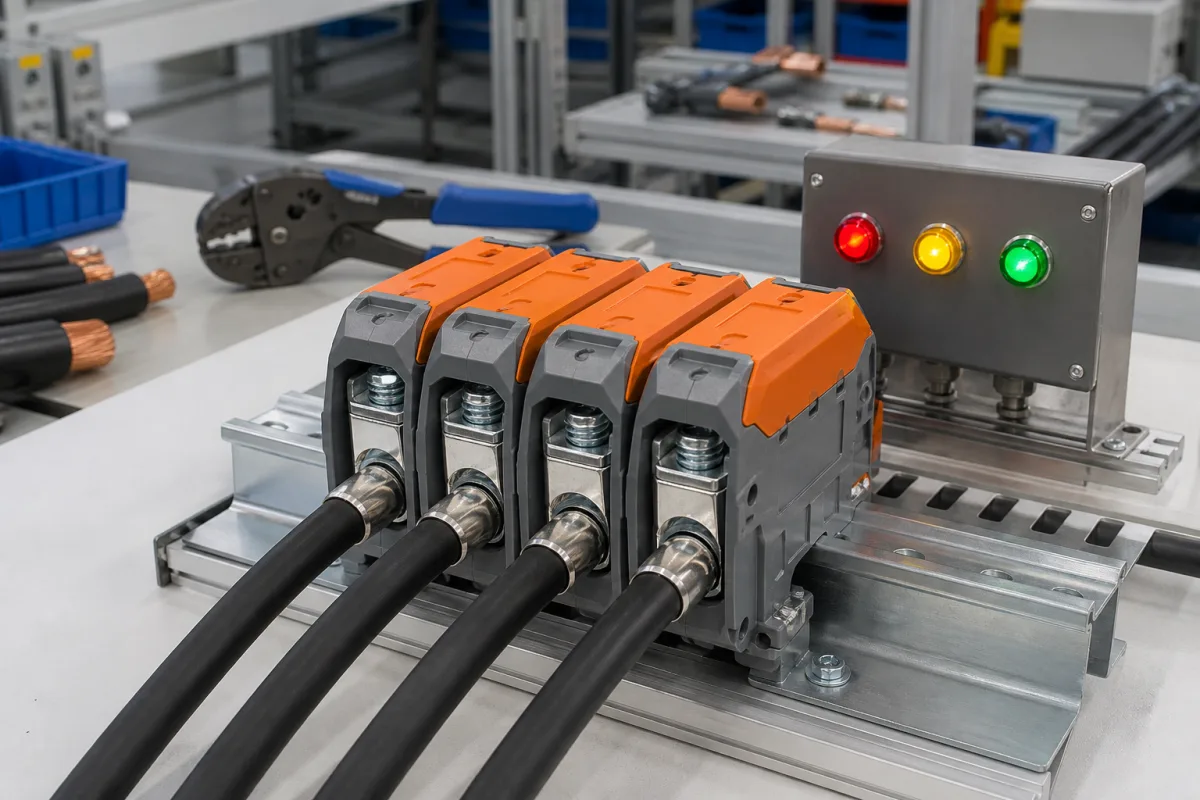
High-current power terminal block for large cables (DIN-rail, 50–240 mm²)
High-current DIN-rail power terminal blocks for 50–240 mm² cables · rated current by standard, clamping, torque, rail and derating
A high-current power terminal block is a rail-mounted feed-through or ground terminal built for main feeder and power cables from about 50 mm² to 240 mm², clamped by a large screw or a spring clamp and rated for hundreds of amperes. Ask three things first: which standard's current rating applies to your installation, what conductor range, stripping length and tightening torque or tool the clamp needs, and what derating applies at the temperature inside your enclosure.
Rail-mounted feed-through and ground terminal blocks for large power conductors, roughly 50 mm² to 240 mm², with screw or spring clamping. Terminal blocks for control and signal wiring are covered on the Terminal block page; cable lugs, busbars, plug connectors and appliance terminal boxes are outside this page.
CNFX editorial research · Sources checked October 12, 2026 · 3 sources
Read the current rating for the standard you build to
Weidmüller's data sheet for its WDU 240 feed-through terminal (order no. 1802780000) gives a 240 mm² rated cross-section, 1,000 V AC and DC, and a rated current of 415 A to IEC 60947-7-1, with a volume resistance of 0.08 mΩ, a power loss of 13.28 W, a rated impulse withstand voltage of 8 kV and pollution severity 3. The same sheet lists 380 A and 600 V under its UL recognition (conductors up to 500 kcmil) and 350 A and 1,100 V under ATEX. [1]
WAGO's data sheet for its 285-1169 three-phase set of 185 mm² POWER CAGE CLAMP through terminal blocks with a 120 mm² ground block gives 353 A, 1,000 V and 12 kV rated surge voltage under IEC/EN 60947-7-1 (overvoltage category III, pollution degree 3), and 310 A under both UL 1059 (600 V) and CSA 22.2 No. 158 (1,000 V). [2]
Editorial calculation: the WDU 240's listed loss and resistance agree, since 13.28 W ÷ 415² ≈ 0.077 mΩ, about the 0.08 mΩ stated. Per square millimetre of rated cross-section, 415 A on 240 mm² is about 1.7 A/mm² and 353 A on 185 mm² about 1.9 A/mm². The UL figure for the WDU 240 is 380 ÷ 415 ≈ 92% of its IEC figure, so quote the rating for the standard your panel is certified to. [1][2]
Give the supplier the standard and approvals needed (IEC 60947-7-1, UL, CSA, ATEX), voltage, current and short-circuit level, conductor material, type and cross-section range, number of poles and ground terminals, rail type, clamping preference (screw or spring), enclosure ambient temperature, marking and covers, and quantity.
02
Match clamping, torque, rail and derating to the installation
The WDU 240 takes conductors from 70 mm² to 240 mm² with an M10 clamping screw, a stripping length of 40 mm and a tightening torque of 25 to 30 Nm; it mounts on TS 32 or TS 35 rail, is 36 mm wide, 100 mm high and weighs 472.5 g, and its Wemid insulation is rated UL 94 V-0 for continuous operation from -60 °C to 120 °C. [1] WAGO's 185 mm² blocks take 50 to 185 mm² conductors (50 to 150 mm² fine-stranded with insulated ferrules), need a 45 to 47 mm strip length, are actuated with an 8 mm T-wrench, and are only suitable for a 35 × 15 copper DIN rail 2.3 mm thick; their PA66 housing is UL 94 V0 for continuous operation from -60 °C to +105 °C. [2]
Siemens' ALPHA FIX catalogue (2008) shows how a maker derates terminals for temperature: its 8WA1 terminals carry their full uninterrupted current up to an ambient of +55 °C, above which the current is multiplied by a factor of 0.94 at 60 °C, 0.82 at 70 °C, 0.67 at 80 °C and 0.33 at 95 °C, and it states that the 45 K clamping-point temperature rise allowed by IEC 60947-7-1 is not exceeded up to 100 °C ambient. Its 240 mm² terminals use M10 screws at 30 to 35 Nm, and it notes that standard mounting rails used as PEN rails must be copper. [3]
Editorial note: these factors belong to the Siemens terminals named; ask each maker for its own derating curve and torque for the part quoted, and set torque with a calibrated tool to the stated range.
03
VIOX terminal and distribution block range
VIOX lists terminal blocks including CM1, JF5, MRK and ceramic types and power distribution blocks. Ask any supplier for the rated current under the standard you need, the conductor range and the tightening torque of the exact part.
04
Current bar, clamp, housing and covers of a 240 mm² terminal
On the 240 mm² block the clamp and current bar carry 350 to 415 A depending on the standard; the sources give the tightening torque and derating next to that rating.
Part
Role
Fix in the order
Current bar
Carries the current between clamps; resistance sets loss. [1]
Explore company information and manufacturing capabilities, then discuss the scope of your project with a relevant supplier.
Share this page
Compiled and source-reviewed by the CNFX editorial team.
Each manufacturer above links to the page on that company's own website where the product is listed, with the date we checked it. How we source and review
· Page last updated 13 October 2026
Buyer questions
Why does a power terminal block list more than one current rating?
Each standard rates them differently: Weidmüller lists 415 A to IEC 60947-7-1, 380 A under UL and 350 A under ATEX for its WDU 240. [1]
What tightening torque does a 240 mm² terminal need?
Weidmüller gives 25 to 30 Nm for the WDU 240's M10 screw; Siemens gives 30 to 35 Nm for its 240 mm² terminals. [1][3]
Does a power terminal block need a special rail?
Some do: WAGO's 185 mm² blocks are only suitable for a 35 × 15 copper rail 2.3 mm thick. [2]
How is terminal current derated for temperature?
Siemens' 8WA1 example keeps full current to +55 °C and then applies factors from 0.94 at 60 °C to 0.33 at 95 °C. [3]
Sources and what still needs a direct check
Sources checked 2026-10-12. Weidmüller, WAGO and Siemens are terminal block makers; their data sheets and catalogue were reviewed from copies hosted by MISUMI, Farnell and Electrika. Figures apply to the parts named.