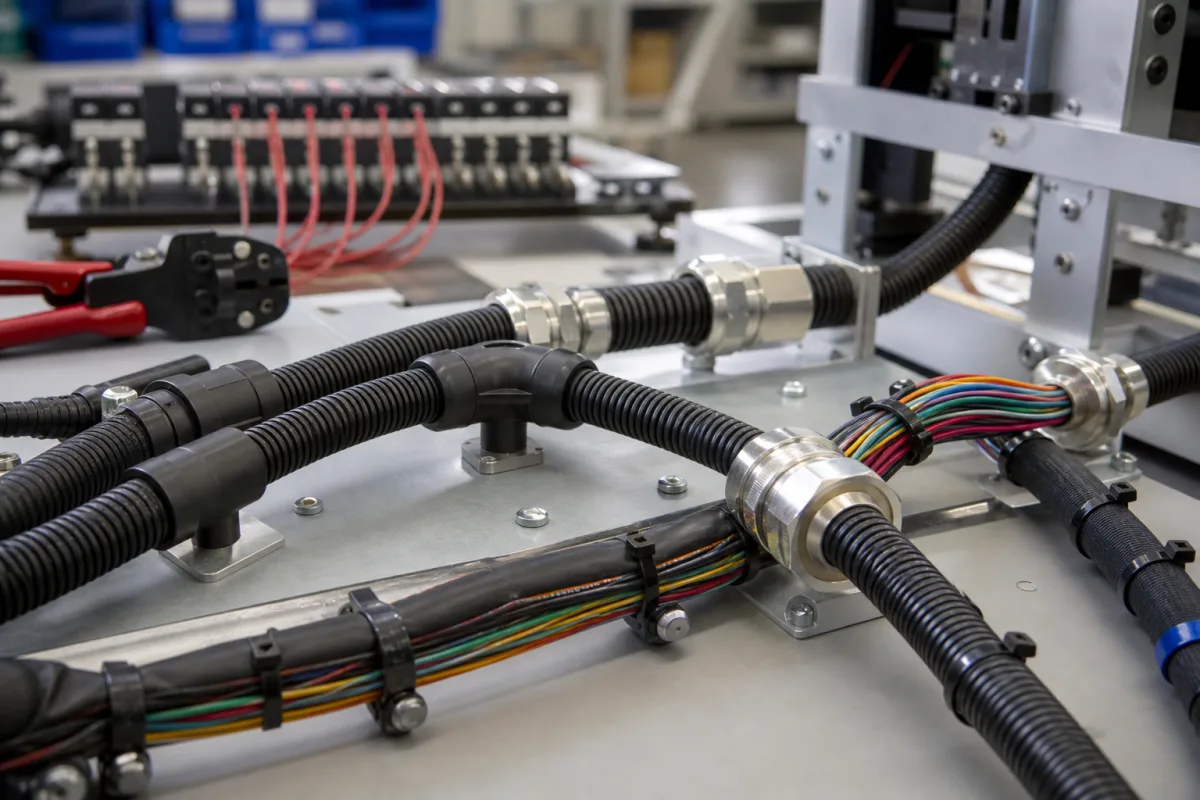
Conduit fittings · Conduit nominal size and connection thread, bore, tightening torque, IP rating, material and temperature, approvals
A wire harness conduit fitting connects flexible corrugated conduit, or metal tubing, to an enclosure, junction box or another conduit, gripping the conduit, sealing the joint and screwing into the enclosure wall with a threaded nozzle and locknut. Ask three things first: which conduit nominal size and enclosure thread it must join, what bore it leaves for the wires, and what sealing rating, material, temperature range and approvals the environment demands.
Straight, angled and swivel fittings for flexible corrugated conduit, and connectors and couplings for metal conduit and tubing, in plastic, brass or steel. Cable glands without conduit, the conduit itself, and conduit clamps and holders are outside this page.
CNFX editorial research · Sources checked October 12, 2026 · 4 sources
WISKA's datasheet for its EMBMFS-C-16-20 metal conduit fitting (nickel-plated brass, PA sealing gasket) pairs conduit nominal size NW 16 with an M20 × 1.5 connection thread of 9 mm screw-in length, a 15.5 mm inside diameter, 27 and 29 mm key widths and 33.5 mm overall length, for corrugated conduit. It specifies 5 N·m tightening torque for both the nozzle and the cap nut. [1]
Its EMBFS-48-63-BK fitting pairs NW 48 conduit with an M63 × 1.5 thread of 14 mm screw-in length and a 42.5 mm inside diameter. [2] Editorial note: the conduit nominal size and the enclosure thread are separate choices; check the fitting's bore against the harness, the thread against the enclosure hole, and the screw-in length against the wall and locknut.
Editorial calculation: a 15.5 mm bore has a cross-section of about 189 mm²; if you limit wires to 40% of it (an assumption, not a value from the datasheet), about 75 mm² of cable cross-section can pass. Check your harness against the bore of every fitting on the run. [1]
Give the supplier the conduit type and nominal size, enclosure thread and wall thickness, fitting shape (straight, 90°, swivel), harness diameter, IP rating, temperature range, material, fire and railway or UL requirements, quantity, and tightening instructions.
02
Choose sealing, material and approvals for the environment
WISKA rates the nickel-plated brass EMBMFS-C fitting IP67 for −45 to +145 °C, for railway technology. [1] Its EMBFS-48-63-BK has a UL94-V0 polyamide body, nickel-plated brass connection thread and TPU sealing gasket, is rated IP68 and IP66 for −40 to +100 °C, is listed for EN 45545 railway use, and carries UL 1696 approval only in conjunction with UL-approved corrugated conduits. [2]
Editorial note: the two datasheets show the trade-off: the all-metal fitting has the wider temperature range, the plastic-bodied one the higher IP rating. An IP or UL rating applies to the tested fitting-and-conduit combination, so order fittings and conduit from one system or ask for test evidence of the pair. [1][2]
For metal conduit, connectors are made in other styles: one supplier lists electro-galvanised steel raintight compression connectors for EMT in 1/2 to 4 inch sizes. [3]
03
Read the sealing test behind an IP68 claim
HUMMEL's product page for its SNAPCLIC Duo-PA M20 fitting (article 1542201250), a polyamide part that works as both a cable gland and a conduit fitting for HUMMEL polyamide hose 1510110114, lists an NBR seal and protection classes of IP54 as supplied, IP68 with an additional O-ring tested at 10 bar for 30 minutes, and IP69K. It is rated for −40 to +100 °C and has an M20 metric external thread of 10 mm length, a cable clamping range of 6–12 mm, an outside diameter of 25 mm, a height of 44 mm and a 24 mm wrench size, in black RAL 9005, and it can be taken apart without tools. [4]
Editorial calculation: 10 bar is 1.0 MPa, so the IP68 claim here rests on a stated test pressure and time, while the IP rating without the O-ring is IP54; a quotation that lists IP68 should name the test depth or pressure, duration and the parts fitted during the test. A 12 mm cable or harness bundle has a cross-section of about 113 mm², and the 10 mm thread length compares with the 9 mm screw-in length WISKA gives for its M20 metal fitting, so check wall thickness and locknut space for both. [4][1]
Field
SNAPCLIC Duo-PA M20 value
What to confirm
Protection class
IP54; IP68 (10 bar, 30 min) with extra O-ring; IP69K [4]
EMT and rigid conduit connectors, PVC fittings and flexible-conduit connectors
Listings include steel compression connectors and couplings for EMT and rigid conduit, PVC conduit fittings, and connectors for flexible conduit alongside cable glands.
05
Body, connection thread, cap nut, sealing gasket, locknut and bore
The cap nut and gasket carry the sealing claim and the bore limits the harness: WISKA's NW16/M20 brass fitting closes at 5 N·m and leaves a 15.5 mm bore. [1]
Conduit size, enclosure thread, IP rating, material and temperature for a conduit fitting order
An IP rating belongs to the tested combination: HUMMEL's polyamide M20 fitting reaches IP68 at 10 bar for 30 minutes only with an extra O-ring and is IP54 without it. [4]
Field
What it means and published values
Ask the supplier for
Conduit nominal size
Nominal size, e.g. NW 16 or NW 48; EMT 1/2–4 in. [1][3]
Size system.
Mounting thread size
M20 × 1.5 or M63 × 1.5 in the cited fittings. [1][2]
2 companies list this product among what they make. Company figures are quoted from each
company's own website; every card states where the relationship came from.
Ningbo Xiatao Plastic Industry Co.,Ltd
Manufacturing site to be confirmed for the order
Lists steel compression connectors for EMT, rigid couplings and PVC conduit fittings.
Explore company information and manufacturing capabilities, then discuss the scope of your project with a relevant supplier.
Share this page
Compiled and source-reviewed by the CNFX editorial team.
Each manufacturer above links to the page on that company's own website where the product is listed, with the date we checked it. How we source and review
· Page last updated 13 October 2026
Buyer questions
What is the difference between NW and the M thread on a conduit fitting?
NW is the conduit nominal size and M the enclosure thread; WISKA pairs NW 16 with M20 and NW 48 with M63. [1][2]
Are metal conduit fittings rated higher than plastic ones?
Not always: WISKA's brass fitting is IP67 to +145 °C, its plastic-bodied fitting IP68/IP66 to +100 °C. [1][2]
How tight should a conduit fitting be?
Follow the datasheet; WISKA gives 5 N·m for the nozzle and cap nut of its NW16/M20 metal fitting. [1]
What test pressure lies behind an IP68 rating on a conduit fitting?
One maker rates its polyamide M20 conduit fitting IP68 at 10 bar for 30 minutes, but only with an additional O-ring; without it the rating is IP54. [4]
Sources and what still needs a direct check
Sources checked 2026-10-12. WISKA is a German maker of cable glands and conduit fittings and HUMMEL publishes data for its SNAPCLIC fitting; values are for the fittings cited. Xiatao is also listed below as a supplier.