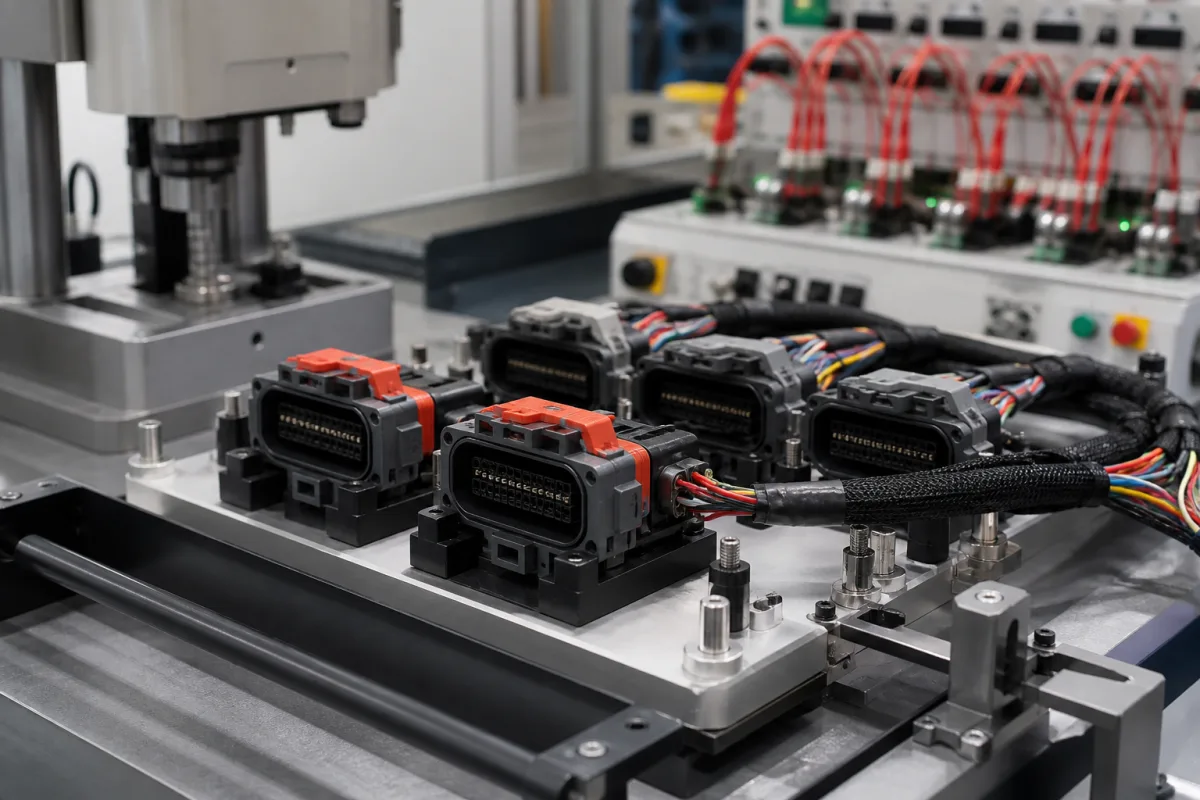
Wire harness connector housings for wire-to-wire and wire-to-board connectors, unsealed and sealed · positions and pitch, rated current and voltage, terminal fit and wire range, housing resin and UL 94 flame class, ingress rating, secondary locks (retainer, wedge, CPA), temperature range
A connector housing is the moulded plastic body that holds crimped terminals in fixed cavities, keys and latches the two connector halves together, and — in sealed versions — carries the seals that keep water out of a wire harness joint. The housing is bought as part of a connector system: it only works with the maker's matching terminals, seals and locks. Ask three things first: positions, pitch and the terminal and wire size it must accept; the current, voltage and temperature it must carry; and whether it must be sealed, and with what secondary locking.
Plug and receptacle housings for wire harness connectors — wire-to-wire and wire-to-board, unsealed and sealed (including automotive and heavy-equipment sealed connectors) — with their terminals, seals, retainers, wedges and CPA parts, as used across wiring harness connectors. Wire seals and grommets that pass a harness through a panel are covered on the industrial wire harness sealing grommet page, and twist-on and lever wire connectors for building wiring on the wire connectors page; PCB headers on their own, circular metal-shell connectors and terminals sold alone are outside this page except where compared.
CNFX editorial research · Sources checked October 11, 2026 · 5 sources
JST's PH series is an unsealed 2.0 mm pitch wire-to-board connector: housings run from 2 to 16 circuits (PHR-2 to PHR-16), the top-entry version is 8 mm high and 4.5 mm wide, and the ratings are 2 A AC/DC with AWG #24 wire, 100 V AC/DC and −40 to +105 °C including temperature rise under current. Contact resistance is 10 mΩ maximum initially and 20 mΩ after test, insulation resistance 1,000 MΩ minimum, and the connector must withstand 800 VAC for one minute; it takes AWG #32 to #24 conductors with insulation of 0.5 to 1.5 mm diameter, on crimp contacts of tin-plated copper alloy. [1] For larger wire, Amphenol Sine's AT series uses size 16 contacts rated 13 A maximum for 14 to 20 AWG wire, in plug and receptacle housings of 2, 3, 4, 6, 8 and 12 positions with key positions A to D, at −55 to +125 °C, with a dielectric rating of at least 1,500 V and a maximum 100 mV drop at 13 A on a 16 AWG conductor. [4]
The housing does not set the current rating on its own: JST states the PH's 2 A with AWG #24 wire and the JWPF's 3 A with AWG #22 wire, so the rating belongs to the housing, terminal and wire combination. [1][2] Each housing also accepts only its maker's terminals — the PH housing takes SPH-series contacts, the WMC takes 0.50 terminals at 1.8 mm pitch (2 and 8 circuits) or 2.0 mm pitch (4 circuits) — and JST names the crimp applicators for each terminal, stating it cannot guarantee terminal performance with other tooling. [1][3]
Editorial calculation: the AT catalog's connector-retention test pulls the wire bundle with 111 N per contact up to a maximum of 444 N, so the cap is reached at 4 contacts (111 × 4 = 444 N), and 6-, 8- and 12-position housings are tested at the same 444 N. [4]
Give the supplier the positions, pitch, wire-to-wire or wire-to-board type, mating header or counterpart, terminal series and plating, wire size and insulation diameter, current per circuit and ambient temperature, voltage, sealing requirement, locking parts required, keying, flame class, colour, test standard, and annual quantity.
02
Choose housing resin, flame class, sealing and secondary locks
JST's JWPF is a 2.0 mm waterproof wire-to-wire connector rated grade 7 ingress protection of JIS C 0920 (IPX7 of IEC 60529), with a contained seal ring, solid rubber seal, housing-to-terminal locks and an inner-housing lock, in 2-, 3-, 4-, 6- and 8-circuit housings of PBT rated UL94V-0; it carries 3 A at 100 V over −55 to +85 °C. [2] JST's WMC automotive wire-to-wire connector adds a mat seal and a connector position assurance (CPA) part that prevents incomplete mating; its housing, retainer, CPA and seal cover are all glass-filled PBT rated UL94 V-0, and it is rated 3 A, 1,000 V AC for one minute and −40 to +105 °C. [3] Amphenol Sine's AT series uses front and rear silicone seals, a wedge that retains the front seal, thermoplastic secondary locks and housings, and nickel-plated copper-alloy contacts — the 2011 catalog marks the wedge as required — and is tested by heating a mated connector to +125 °C for 1 hour and then immersing it in 1 m of water for 4 hours. [4][5]
Flame class must be read from the current document for the exact part: the 2009 AT catalog states all dielectric materials are UL94 V-0 or better, while the 2011 AT catalog states UL94 HB or better. [4][5] JST's PH datasheet gives the housing resin only as PA and refers to a separate technical document for its flame grade. [1]
The AT catalog also lists the mechanical tests a sealed housing has to pass: a 750 mm drop to concrete eight times, 50 g shock in three axes, vibration up to 20 g over 10–2000 Hz, 110 N minimum contact pull-out, 100 mating cycles, 1,000 hours of UV exposure, and insulation resistance above 20 megohms at 1,000 VDC; the catalog states all testing meets SAE J2030. [4]
03
Full system datasheet, resin UL file, ingress report and crimp tooling to ask each supplier for
When requesting quotations, ask each supplier for the full connector-system datasheet (housing, terminals, seals, secondary lock), the resin grade and UL file, the ingress-test report, the crimp specification and tooling, and samples.
04
Housing body, terminals, seals, secondary lock, CPA and keying
Only the first row is the housing itself; terminals, seals, wedge or retainer and CPA come from the same connector system, and the AT catalog's 2011 edition marks the wedge as required. [5]
Element
Role
Fix in the order
Housing body
Cavities, keying and latch; PA or glass-filled PBT. [1][3]
Positions, resin.
Terminals
Crimped copper-alloy contacts, tin- or nickel-plated. [1][4]
Series, plating.
Seals
Seal ring and rubber seal; mat seal; silicone front and rear seals. [2][3][4]
Positions, pitch, temperature, ingress, flame class, current and dielectric ratings for a housing order
Read the flame-class row against the current document for the exact part: the AT catalog states UL94 V-0 or better in its 2009 edition and HB or better in 2011. [4][5]
2 companies list this product among what they make. Company figures are quoted from each
company's own website; every card states where the relationship came from.
Nantong Suhe Auto Lamp Parts Co., Ltd.
Manufacturing site to be confirmed for the order
Its website has a product page for wire harness connector housings.
Product scope checked 2026-10-12
Product page on own website · profile compiled by CNFX from public sources
Explore company information and manufacturing capabilities, then discuss the scope of your project with a relevant supplier.
Share this page
Compiled and source-reviewed by the CNFX editorial team.
Each manufacturer above links to the page on that company's own website where the product is listed, with the date we checked it. How we source and review
· Page last updated 13 October 2026
Buyer questions
What does a sealed harness connector housing add?
Seals and locks: JST's JWPF has a seal ring and rubber seal for IPX7; the WMC adds a mat seal and CPA. [2][3]
Is the current rating a property of the housing?
It belongs to the system: JST rates the PH at 2 A with AWG #24 wire and the JWPF at 3 A with AWG #22. [1][2]
What is the wedge in an AT-style connector?
A thermoplastic part listed with the secondary locks that also retains the front seal; the 2011 catalog marks it as required. [4][5]
Sources and what still needs a direct check
Sources checked 2026-10-11. Three JST datasheets cover an unsealed wire-to-board housing and two sealed wire-to-wire housings; two Amphenol Sine catalogs, hosted by distributors, cover the AT sealed series.