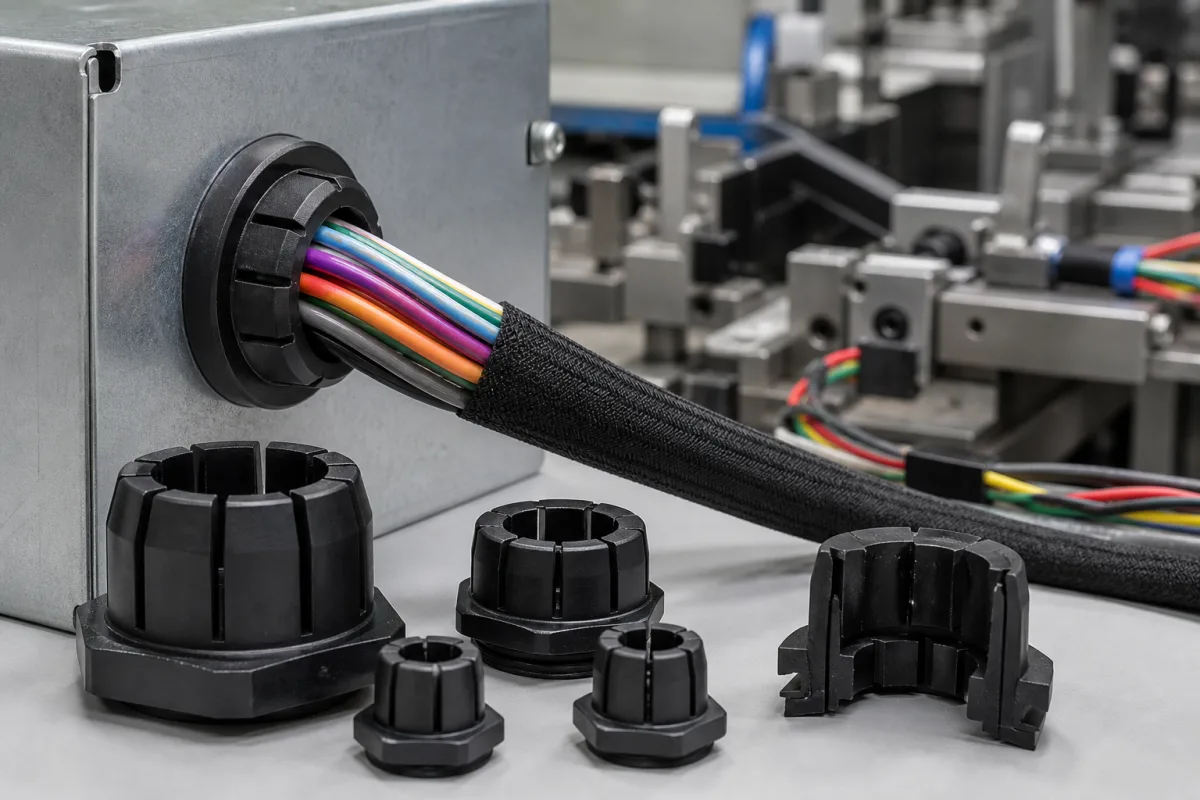
Snap-in strain relief bushing for wire harness and cord panel entries (nylon)
Nylon snap-in panel entries · cord anchorage pull and torque tests, hole and panel-thickness matching, UL 94V-2 nylon 6/6
A snap-in strain relief bushing is a moulded nylon part that clamps a flexible cord or harness and snaps into a punched hole in a sheet-metal panel, so that pulling, pushing or twisting the cord does not load the terminals inside. Snap-in cordgrips do the same with a ratchet sealing nut for round cables. Ask three things first: what pull and torque test the anchorage must pass, which hole shape, size and panel thickness the part fits, and what material, flammability and temperature ratings it carries.
Nylon snap-in strain relief bushings and snap-in cordgrips that lock into a punched panel hole without a locknut and anchor a cord or wire harness. Threaded metal cable glands in aluminium, brass or stainless steel, classified under IEC 62444, are covered on the Aluminium cable gland page. Rubber grommets and liquid-tight threaded cordgrips are outside this page.
CNFX editorial research · Sources checked October 12, 2026 · 3 sources
Set the pull and torque test the anchorage must pass
Pego Electronics, a maker of test apparatus, summarises the cord anchorage test of IEC 60335-1 clause 25.15: mark the cord about 20 mm from the anchorage, apply a steady pull 25 times at about one pull per second, then apply a torque as close as possible to the appliance for 1 minute; afterwards the mark must not have moved more than 2 mm. Its table gives 30 N and 0.1 Nm for appliances up to 1 kg, 60 N and 0.25 Nm for over 1 kg up to 4 kg, and 100 N and 0.35 Nm above 4 kg. [3]
Heyco describes its straight-thru strain relief bushings as absorbing the forces of pull, push and twist on a flexible power cord while anchoring, insulating and protecting the cable at the panel entry, and says its snap-in cordgrips meet UL strain relief requirements without kinking the cable. [1][2]
Editorial calculation: 100 N is about 22.5 lbf (100 ÷ 4.448), and 0.35 Nm is the torque of 17.5 N on a 20 mm lever arm (0.35 ÷ 0.020). Confirm which standard and mass band apply to your product before accepting a supplier's pull rating. [3]
Give the supplier the cord type and outer dimensions (round or flat), conductor count and gauge, the product's mass and applicable standard, panel material and thickness, hole shape, and whether the entry must seal against liquids.
02
Match the hole, anti-rotation flat and panel thickness
Heyco's catalogue fits each straight-thru bushing to one cord type, one mounting hole and one maximum panel thickness: sizes SR 2 to SR 6 cover mounting holes from 0.375 in (9.5 mm) to 0.625 in (15.9 mm). For example, SR 4N-4 takes SPT-1 18/3 or HPN 18/2 flat cord in a 0.500 in (12.7 mm) hole with a 0.465 in (11.8 mm) flat to prevent rotation and a 0.062 in (1.6 mm) maximum panel; SR 4K-4 and SR 4L-4 are the same for 0.100 in (2.5 mm) and 0.156 in (4.0 mm) panels. [1]
Thin-panel versions SR 4A-6 and SR 3A-4 fit 0.040 in (1.0 mm) panels and need a dedicated hand plier for installation. [1]
Heyco's snap-in cordgrips, for round cables, lock into panels from 0.062 in (1.6 mm) to 0.125 in (3.2 mm) thick through fingers on the body, without a locknut, in holes from 0.500 in (12.7 mm) to 2.375 in (60.3 mm) and for cable diameters from 0.210 in (5.3 mm) to 1.560 in (39.6 mm); double-D holes prevent rotation. Heyco notes that they may not be liquid tight at the panel interface. [2]
Editorial note: because each part is matched to a panel thickness band, a change of sheet gauge between prototype and production can leave a bushing loose or impossible to seat; fix the panel thickness and hole tolerance on the drawing.
03
Check material, flammability and temperature ratings
Heyco's straight-thru bushings are nylon 6/6, recognised under the UL Component Program (file E15331) and certified by CSA (file LR8919), with flammability rating 94V-2, a material temperature index of 125 °C and a maximum temperature on the part of 105 °C. [1]
Its snap-in cordgrips are nylon 6/6 with a Buna N sealing gland, UL recognised (file E51579), 94V-2, with a temperature range of −18 °C to 105 °C. [2]
In Heyco's material table, general-use nylon has tensile strength of 76 MPa, heat deflection temperature of 87 °C at 1.8 MPa and electrical RTI of 125 °C, and Heyco also offers flame-retardant (UL 94V-0) and higher-temperature versions. [1]
04
Bushing body, locking steps, anti-rotation flat, gland and ratchet nut
Part
Role
Fix in the order
Bushing body
Clamps the cord and insulates it at the panel edge. [1]
Material, cord type and size.
Locking fingers or steps
Snap into the hole; set the panel thickness range. [2]
Hole size, panel thickness, pull test, UL 94 rating and cord type for a snap-in bushing
Pull-out force is set by the appliance mass in IEC 60335-1 (30, 60 or 100 N) rather than by the bushing, so state the appliance mass and ask for the pull and torque test result. [3]
Field
What it means and published values
Ask the supplier for
Mounting hole diameter (mm)
9.5–15.9 mm for one bushing range; 12.7–60.3 mm for one cordgrip range. [1][2]
Hole size, shape and tolerance.
Minimum bending radius (mm)
Set by the cord; some parts add a curved exit to avoid kinking. [2]
Exit design.
Pull-out force rating (N)
Test pull of 30, 60 or 100 N by appliance mass under IEC 60335-1. [3]
Pull and torque test results.
Operating temperature range (°C)
−18 to 105 °C for one cordgrip range; 105 °C maximum on part for one bushing range. [2][1]
Range.
Ingress protection rating (IP code)
Snap-in cordgrips may not be liquid tight at the panel. [2]
Explore company information and manufacturing capabilities, then discuss the scope of your project with a relevant supplier.
Share this page
Compiled and source-reviewed by the CNFX editorial team.
Each manufacturer above links to the page on that company's own website where the product is listed, with the date we checked it. How we source and review
· Page last updated 13 October 2026
Buyer questions
What pull test does a cord strain relief have to pass?
Under IEC 60335-1 clause 25.15, as summarised by a test-equipment maker, 25 pulls of 30, 60 or 100 N and a torque of 0.1, 0.25 or 0.35 Nm by appliance mass, with no more than 2 mm cord displacement. [3]
Does panel thickness matter for snap-in bushings?
Yes. Heyco matches each bushing to a maximum panel thickness, for example 1.6 mm, 2.5 mm or 4.0 mm for the same 12.7 mm hole. [1]
Are snap-in cordgrips waterproof?
Heyco notes they may not be liquid tight at the panel interface; it offers separate liquid-tight cordgrips. [2]
Sources and what still needs a direct check
Sources checked 2026-10-12. Heyco is a maker publishing catalogue data for its own strain relief bushings and cordgrips; Pego Electronics is a test-equipment maker summarising the IEC 60335-1 cord anchorage test its apparatus performs.