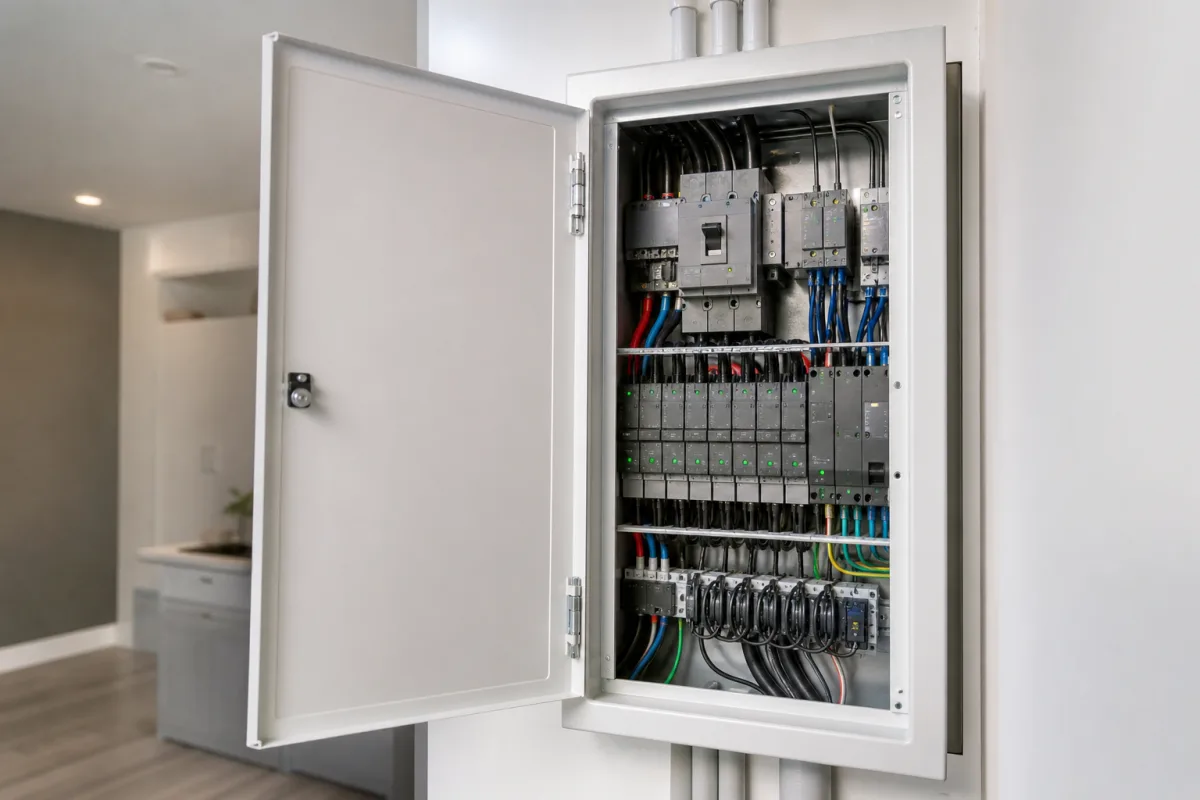
Smart home circuit breaker panel: load-managing residential panel for service-upgrade avoidance
Residential smart panels for electrification on an existing service · circuit-level metering and switching that sheds load before the main breaker trips, so heat pumps and EV chargers fit on 100–125 A
A smart home circuit breaker panel replaces or supplements the house's load centre with breakers or relays that the panel itself can switch, current sensing on each circuit, and software that keeps the total below the service rating. Its main job in electrification projects is to let a home add a heat pump, induction range or EV charger without a new utility service. The questions are how fast it sheds load, how it brings loads back, how accurate its circuit metering is, and whether the local inspector will accept its control in the load calculation.
Residential load centres with integrated circuit-level metering and remotely switched circuits, smart subpanels added downstream of an existing panel, and retrofit smart breakers or circuit pausers used to manage household demand within the service rating. General low-voltage distribution boards, panelboards and consumer units, their fault ratings and IEC 61439-3 status, are covered on the Power distribution panel (distribution board, panelboard) page; busbar systems and distribution blocks inside industrial control cabinets are covered on the Control-cabinet power distribution unit page.
CNFX editorial research · Sources checked October 12, 2026 · 3 sources
Shedding circuits before the main breaker trips: overloads 5–100% above the limit in the UC Davis tests
A California Emerging Technologies programme project tested three commercially available architectures at UC Davis by pushing loads from 5% to 100% above the configured limit and watching how each system responded. [1]
The report's background puts the constraint at legacy 100–125 A service panels that cannot run heat pumps, EV chargers and electric dryers at the same time, and concludes that smart panels can technically defer service upgrades today. [1]
A simpler device in the same family is the circuit pauser described at the 2023 ENERGY STAR partner meeting: a control relay on one circuit communicates with current sensors on the mains or feeder and switches its load off at 80% of rated capacity, so the load may be treated as zero in the NEC load calculation. It saves panel load but not breaker space, and installation is more complex because of the current transformers and communication hardware. [3] Editorial calculation: on a 100 A service, 80% of rated capacity is 80 A.
Architecture tested
How it shed and restored load
Result
Full smart-panel replacement
Recovery intervals of 1–6 min, adaptive and dependent on the overload. [1]
Prevented sustained overloads below the main breaker's thermal-trip curve. [1]
Smart subpanel downstream of the existing panel
Started shedding within about 4 s; re-enabled loads on a fixed 1-min timer, so loads cycled on and off under sustained overload. [1]
Prevented sustained overloads below the trip curve. [1]
Retrofit smart breakers
Relied on user-defined scenes rather than automatic sensing. [1]
Limited autonomous protection; depends on correct configuration. [1]
Ask the maker for the shedding delay, the restore logic (fixed timer or adaptive), the circuits that can never be shed, and how the panel behaves if its software or network fails.
02
Replacement panel, subpanel, smart breakers or circuit pausing: what each costs and saves
The 2023 ENERGY STAR presentation, given by EPA, Lawrence Berkeley National Laboratory and the smart-panel maker SPAN, ranks the alternatives to a panel upgrade by cost and complexity. [3]
The same presentation reports that, in one Bay Area checklist, 31% of 100 A panels and 48% of 200 A panels had free breaker space, and notes that some local code authorities will not allow circuit sharing or smart panel controls. [3] The UC Davis interviews likewise found low installation experience, inconsistent inspector familiarity and high upfront cost as the main barriers, and found demand-response, time-of-use and carbon-signal features minimally implemented or dependent on third-party smart-home platforms. [1]
Option
Cost given (2023)
Complexity and notes
Smart electrical panel
$3,000–5,000 plus installation
Ranked highest for both complexity and flexibility; the SPAN panel shown offers control of 32 circuits. [3]
Circuit pausing
$400–900 plus installation
Medium complexity; requires current transformers. [3]
Circuit sharing
$300–600 plus installation when hard-wired
Least complicated; a plug-in version can sometimes be DIY, e.g. a dryer outlet shared with an EV charger. [3]
Conventional upgrade, for comparison
Circuits $250–750 each; panel $1,000–5,000; service $1,000–25,000 to the homeowner
A similar amount again for the utility, plus 3–6 months of project delay. [3]
03
Circuit metering within ±5 W, and how a managed panel enters the NEC load calculation
Circuit-level metering is what makes the panel's decisions and its usage reports possible, so its accuracy and its role in sizing the service both need checking.
All three products tested at UC Davis metered circuits within ±5 W of laboratory reference equipment, which the authors judge sufficient for consumer feedback but not revenue-grade. [1]
For sizing, the ENERGY STAR presentation points to existing NEC paths: under 220.87 existing load can be taken from 15-minute metering data, with total load equal to metered load × 1.25 plus new load; under 220.83 existing loads are summed as 100% of the first 8,000 W plus 40% of the remainder, adding the larger of heating or cooling when new HVAC is installed. [3]
NREL and LBNL, who led a subgroup submitting 17 public inputs and 7 public comments to the 2026 NEC revision, report first-revision changes that include treating power control systems and non-coincident load controllers for dwellings (120.6 and 120.7), cutting the heat pump demand factor for existing dwellings from 100% to 50%, setting EVSE and resistance heating at 80%, and lowering lighting and receptacle loads from 3 to 2 W/ft². [2] These were first-draft revisions at the time of the poster; check the edition adopted locally.
Before ordering, confirm with the inspecting authority whether the panel's load control will be accepted in the load calculation for the edition of the NEC they enforce.
04
Data for a smart panel quotation
Paste it into your enquiry below or into an email to a maker, then replace every bracket.
Service: [rating in A; voltage; utility]
Existing panel: [rating; free spaces; replace or add subpanel]
Loads to add: [heat pump; EV charger; range; dryer; ratings]
Control: [circuits to be managed; circuits never shed; restore logic]
Metering: [per-circuit accuracy; data access]
Integration: [batteries; PV; EV charger; app or local control]
Approval: [NEC edition; local inspector requirements; listing]
Explore company information and manufacturing capabilities, then discuss the scope of your project with a relevant supplier.
Share this page
Compiled and source-reviewed by the CNFX editorial team.
Each manufacturer above links to the page on that company's own website where the product is listed, with the date we checked it. How we source and review
· Page last updated 13 October 2026
Buyer questions
Can a smart panel avoid a service upgrade?
In UC Davis lab tests all three smart-panel types kept sustained overloads below the main breaker's thermal-trip curve, which the report treats as technical feasibility for deferring upgrades. [1]
How accurate is circuit metering in a smart panel?
The tested products were within ±5 W of laboratory reference equipment, adequate for household feedback but not revenue-grade. [1]
How much does a smart electrical panel cost compared with alternatives?
A 2023 ENERGY STAR presentation gave $3,000–5,000 plus installation for a smart panel, $400–900 for circuit pausing and $300–600 for hard-wired circuit sharing. [3]
Sources and what still needs a direct check
Sources checked 2026-10-12. The test results come from a California Emerging Technologies programme report on laboratory work at UC Davis; housing-stock and NEC revision figures from an NREL/LBNL poster for the DOE Building Technologies Office; costs and code paths from a 2023 ENERGY STAR partner presentation by EPA, LBNL and SPAN.