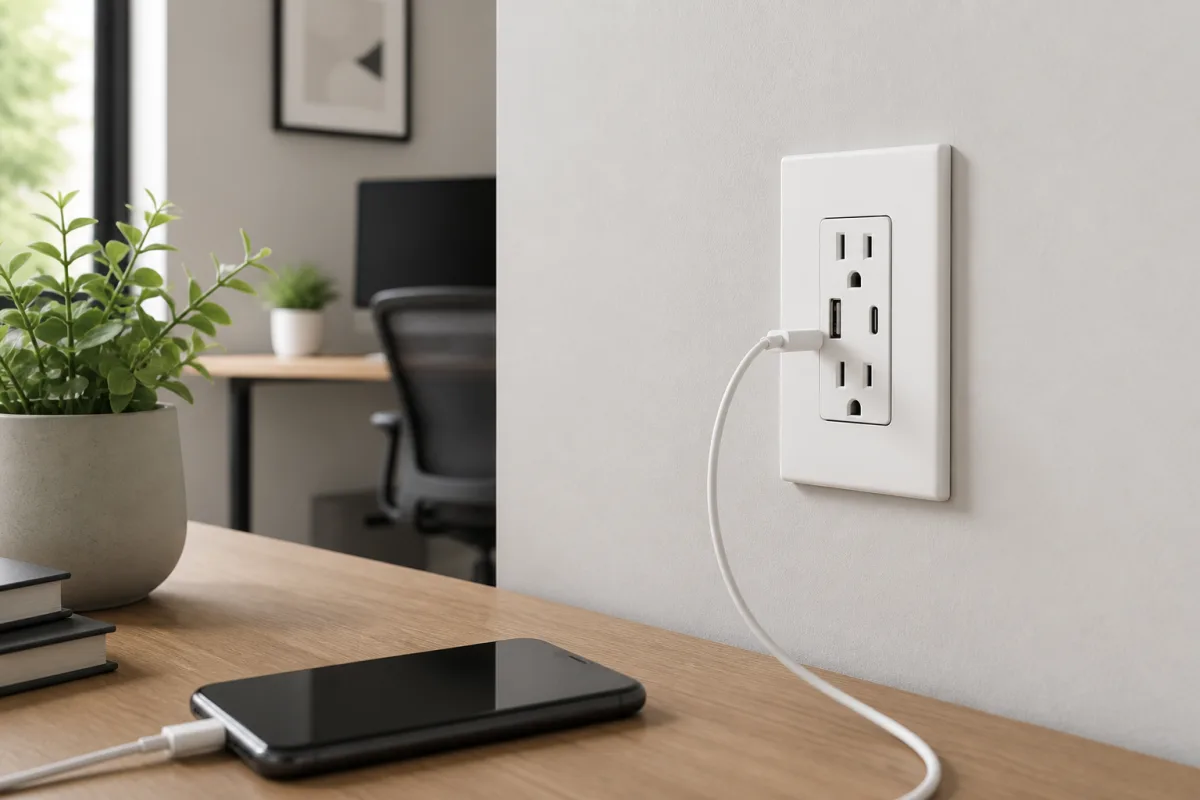
USB wall sockets · Socket and USB ratings, shared versus per-port output, USB-C Power Delivery, standby power, applicable standards
A wall outlet with USB charging is a fixed socket-outlet or receptacle that also contains a small mains-to-USB power supply, giving USB-A and/or USB-C charging ports alongside the plug socket; smart versions add Wi-Fi or other connectivity. Ask three things first: what the socket and the USB supply are rated for and whether USB power is shared between ports, whether USB-C ports support Power Delivery, and how much power the unit draws when nothing is charging.
Flush-mounted socket-outlets and receptacles with built-in USB chargers, and USB charging modules for wall plate systems, for homes, offices and hotels. Power strips (covered on a separate page), plug-in USB adapters and industrial sockets are outside this page.
CNFX editorial research · Sources checked October 11, 2026 · 4 sources
Legrand's Living Now catalogue page lists USB-C Power Delivery charger modules of 3 A / 20 W, 3 A / 30 W and 3 A / 45 W, and Type-A, Type-C and mixed double chargers rated 3 A / 15 W in total, conforming to IEC 62368-1. Its socket-outlets with a built-in USB-C charger are rated 1.5 A, 5 V, 7.5 W, and its Euro-US and American socket-outlets with two USB ports are rated 3 A, 5 V, 15 W. [1]
Hager's datasheet for its 260219 230 V double USB charging socket gives 5 V and 3,000 mA output, 15 W, for two USB-A sockets, short-circuit and overload protected by an electronic fuse. [2] Leviton's spec sheet for a US combination receptacle gives 2.1 A at 5 V DC combined across two USB-A ports, with a smart chip that recognises the device's charging requirement. [3]
Editorial calculation: 2.1 A at 5 V is 10.5 W shared between two ports, and Hager's 15 W is likewise a total for two ports; check whether a quoted figure is per port or shared, and whether USB-C ports support Power Delivery at higher voltages. [3][2]
Give the supplier the market and socket standard (NEMA, Schuko, French, British), current and voltage rating, USB port types and output per port and total, Power Delivery profiles, standby and (for smart models) networked standby targets, connectivity, wiring terminals, box depth, plate system and colours, and certifications required.
02
Check socket ratings, standards and standby draw
Leviton's receptacle is rated 15 A, 125 V AC (NEMA 5-15R), tamper-resistant with a shutter described as compliant with the 2011 NEC, operating from −10 to 60 °C, with a UL94 V-2 rating, 12–14 in·lb terminal torque for 14–12 AWG wire, cULus listing and FCC Part 15 Class B compliance. [3] Legrand describes its socket-outlets with USB chargers as conforming to IEC 60884-3-1 and ETSI EN 301 489-34, with shutters for child safety; its US-style versions cite NEMA WD-6. [1]
Standby draw is published: Hager gives 0.15 W for the 260219 socket, and Legrand gives below 0.07 W for its Power Delivery modules and below 0.1 W for its other USB chargers. [2][1] Hager's socket needs 32 mm built-in depth (34 mm in flush-mounted boxes). [2]
Editorial calculation: 0.15 W drawn all year is about 1.3 kWh per socket (0.15 × 8,760 h); across 100 sockets in a hotel that is about 130 kWh a year with nothing charging. Ask suppliers of smart sockets for networked standby power as well. [2]
03
Check the outlet sits inside the USB-socket standard's scope
The GCC Standardization Organization's store page for GSO IEC 60884-3-1:2024 reproduces the scope of IEC 60884-3-1:2021, the standard Legrand cites for its socket-outlets with USB chargers. It applies to fixed or portable socket-outlets for AC only, with or without earthing contact, with a rated voltage greater than 50 V but not exceeding 440 V and a rated current not exceeding 32 A, for household and similar purposes, indoors or outdoors, that incorporate a USB power supply. [4][1]
The scope states that the document defines safety and EMC requirements only; the specifications, performance and dimensional requirements of the USB technologies themselves are defined in the relevant parts of IEC 62680. A test report to IEC 60884-3-1 therefore shows the socket and its built-in supply are safe, not what charging profile the USB port delivers, so ask for the USB-side data separately. [4]
Editorial calculation: Hager's 230 V double USB socket and Legrand's 16 A socket-outlets sit inside the 50–440 V and 32 A limits; a 16 A socket uses half the 32 A ceiling. [4][2][1]
Explore company information and manufacturing capabilities, then discuss the scope of your project with a relevant supplier.
Share this page
Compiled and source-reviewed by the CNFX editorial team.
Each manufacturer above links to the page on that company's own website where the product is listed, with the date we checked it. How we source and review
· Page last updated 13 October 2026
Buyer questions
Is USB power shared between ports on a USB outlet?
In the cited units the rating is a total: Hager's double socket gives 15 W across two ports and Leviton's receptacle 2.1 A across two. [2][3]
Which standard covers sockets with built-in USB chargers?
Legrand cites IEC 60884-3-1, with ETSI EN 301 489-34 for EMC, for its socket-outlets with USB chargers. [1]
How much power does a USB outlet use when idle?
Published standby values in the cited units are 0.15 W (Hager) and below 0.07–0.1 W (Legrand modules). [2][1]
What does IEC 60884-3-1 cover for USB socket-outlets?
Its scope covers AC socket-outlets rated above 50 V up to 440 V and up to 32 A that incorporate a USB power supply, and sets safety and EMC requirements; USB performance and dimensions are left to IEC 62680. [4]
Sources and what still needs a direct check
Sources checked 2026-10-11. Leviton, Hager and Legrand are wiring device makers describing their own products; the Leviton sheet dates from 2012. The scope of IEC 60884-3-1 was read from the GCC Standardization Organization's adoption page; the full text of the standards cited by the makers was not read for this page.