Beverage lines · Rinsing and sanitizing containers, sanitizer strength and contact time, final rinse and container swab tests
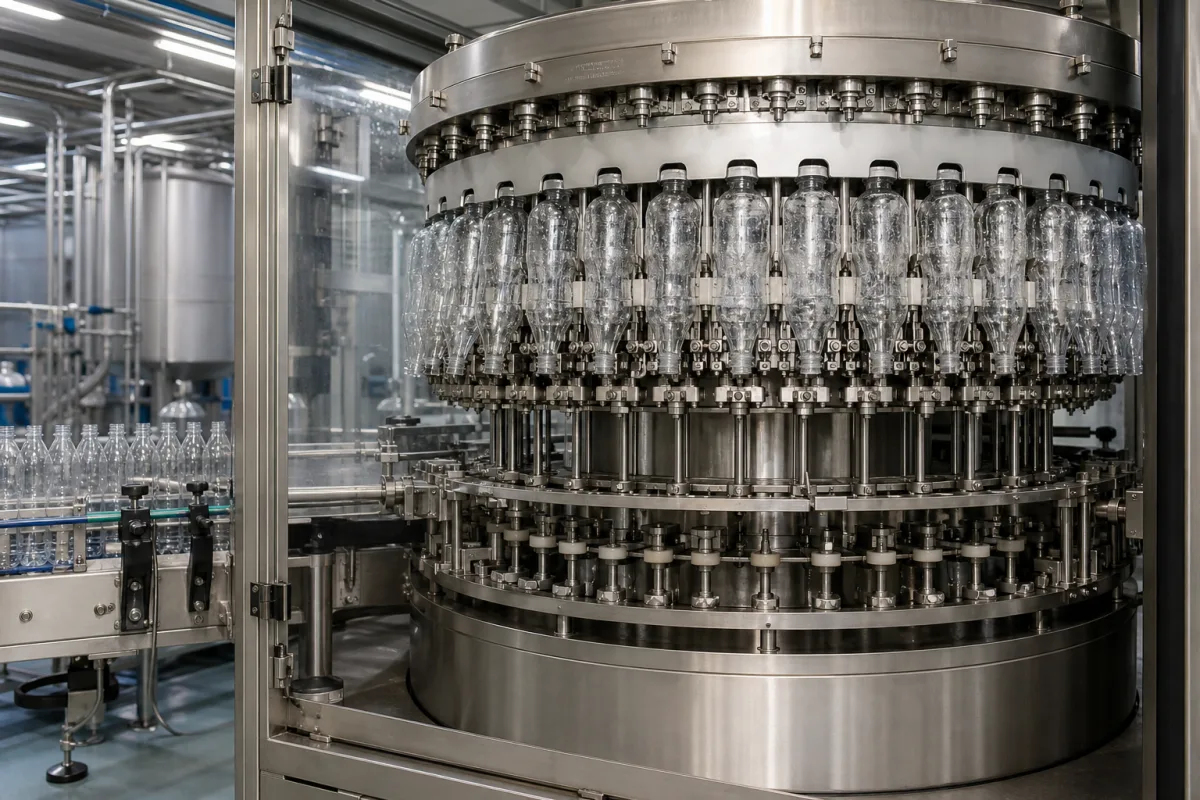
A rotary bottle rinsing machine grips empty bottles, inverts them over spray nozzles and rinses or sanitizes the inside before filling; it can also be built into a rinser-filler-capper monoblock. Ask three things first: the bottles and output, the rinse or sanitizing medium with its strength and contact time, and how the final rinse water and container cleanliness are verified.
Rotary and linear bottle rinsers and washers for beverage, food and pharmaceutical containers, including air rinsers and rinser-filler-capper monoblocks. Household baby-bottle washers, laboratory glassware washers and commercial dishwashers are outside this page.
CNFX editorial research · Sources checked October 11, 2026 · 4 sources
Set the sanitizing medium, strength and contact time
US rules for bottled drinking water (21 CFR 129.80) require multi-service containers to be cleaned, sanitized and inspected just before filling, washed, rinsed and sanitized by mechanical washers or another adequate method, with records of the washer's maintenance and performance and testing of cleaning and sanitizing solutions. Minimum sanitizing treatments include steam or hot water in an enclosed system at 170 °F for 15 minutes or 200 °F for 5 minutes; chemical sanitizers equivalent to a 2-minute immersion in 50 ppm available chlorine at 57 °F, or at least 100 ppm when applied as a spray or fog; or 0.1 ppm ozone for at least 5 minutes in an enclosed system. [1]
If a sanitizer other than those permitted for food-contact use is used, it must be rinsed off, and the final rinse before filling must use disinfected water free of pathogens or an equivalent sanitizing step. [1]
Editorial calculation: 170 °F ≈ 77 °C, 200 °F ≈ 93 °C and 57 °F ≈ 14 °C. A spray rinser for sanitizing therefore needs at least 100 ppm available chlorine or an equivalent, double the immersion figure. [1]
Give the supplier the bottle types and sizes, output, rinse medium (water, ionized air, sanitizer), sanitizer type and concentration, contact time, water consumption and recovery, final rinse water treatment, CIP, and the regulations the line must meet.
02
Verify container cleanliness
The same rules call for filled containers to be inspected and require at least once every 3 months a bacteriological swab or rinse count from at least four containers and closures taken just before filling; no more than one of the four may exceed one bacterium per millilitre of capacity or one colony per square centimetre, and all must be free of coliforms. [1]
Editorial calculation: for a 500 mL bottle, one bacterium per millilitre of capacity is a limit of 500 per container rinse sample. [1] Ask the supplier how the rinser's nozzle coverage and drain time support these results on your bottles.
03
Choose water rinsing or ionized-air rinsing
Published machine descriptions show two rinsing methods. In a water rinser, neck or body grippers take the bottle from the infeed, turn it upside down over a spray nozzle that directs rinse water into it, let it drain and turn it upright; one rotary rinser-filler-capper builder lists 316 stainless steel contact parts and a 304 stainless frame. [4] In an air rinser, the containers turn upside down and pass over nozzles of pressurised ionized air, with the dislodged particles collected in the machine. [3]
Edelstein describes a non-slip gripper, adjustable rinsing pressure and time, a 'no bottle, no rinsing' option, a stop when the water tank runs low and a guard against crushing glass bottles. [2] Traktech states that its air rinsers clean glass, plastic or metal containers and that ionized air removes particles held by static electricity. [3]
Editorial calculation: 3,600 bottles per hour on 12 heads is 3,600 / 12 = 300 bottles per head per hour, or one bottle every 12 seconds per head, which is the time budget for gripping, inverting, spraying, draining and righting; 66 to 400 bottles per minute equals 3,960 to 24,000 bottles per hour. [2][4]
Editorial note: an air rinser does not apply a sanitizer, so if your bottles must be sanitized before filling under the rules above, a liquid rinse or sanitizing step is still needed; state the medium per station in the order. [1]
Published configuration
Medium
Stated output
Format change
12-head rotary water rinser (ED-RR12)
Water, adjustable pressure and time
3,600 bottles/h
Adjustable rinsing head height
Rotary rinser-filler-capper (RFC-6000 series)
Rinse water via neck grippers
66 to 400 bottles/min; up to 800 bottles/min in larger plant systems
Not stated
Rotary air rinser, vertical carousel
Ionized air, 4 or 5 nozzles
3,000–4,000 bottles/h lines
Replace guides and plastic holders
Side-grip air rinser SG-10
Ionized air, blowing and suction
Up to 10,000 bottles/h, cylindrical bottles
Plastic guide and grip width, no tools
State the medium for each station (water, sanitizer, ionized air), number of heads or grippers, rated output per bottle size, gripper type (neck or side), and the interlocks required (no bottle no rinse, low tank, glass breakage).
04
Compare what suppliers offer
Suppliers linked to this page list bottle rinsers or washers; each card links to the page reviewed.
Best Crown lists rinser-filler-capper monoblocks and bottle washers for beverage lines; Sunter lists bottle washers with unscramblers and fillers; Cassman lists glass bottle washers for beer filling lines; Honsimba lists bottle rinsing and washing machines, including ultrasonic types; Sinobiz lists air rinsing and bottle washing machines for pharmaceutical packaging.
05
Trace the machine components
This is a functional reference built from the sources cited; it is not one maker's parts list.
Part
Role
Fix in the order
Grippers and carousel
Invert and carry bottles through the rinse; neck or side grip. [4][3]
Change parts per bottle.
Spray nozzles
Deliver rinse or sanitizer; spray needs ≥100 ppm Cl or equivalent. [1]
No bottle no rinse, low-tank stop, glass guard. [2]
Interlocks required.
06
Fill the specification fields with values for your line
A rinser quotation needs values for your bottles and sanitation plan. The table explains each field, gives published values where a reviewed source states them, and says what to obtain from the supplier.
Field
What it means and published values
Ask the supplier for
Throughput capacity (bottles/min)
Rated output; published examples 3,600 bottles/h on 12 heads [2], 66 to 400 bottles/min. [4]
Output per bottle size.
Rinse pressure (bar)
Nozzle supply; adjustable pressure and time on one water rinser. [2]
Explore company information and manufacturing capabilities, then discuss the scope of your project with a relevant supplier.
Share this page
Compiled and source-reviewed by the CNFX editorial team.
Published product pages show what a company offers, not tested performance. Confirm the legal seller, factory and scope for your order. How we source and review
· Page last updated 13 October 2026
Buyer questions
What sanitizer strength does a spray rinser need?
Under 21 CFR 129.80, chemical sanitizers applied as a spray need at least 100 ppm available chlorine at 57 °F or an equivalent. [1]
How hot must hot-water sanitizing be?
At least 170 °F (about 77 °C) for 15 minutes or 200 °F (about 93 °C) for 5 minutes in an enclosed system. [1]
How are rinsed containers verified?
At least every 3 months, swab or rinse counts on four containers and closures: no more than one may exceed 1 bacterium per mL of capacity, and none may contain coliforms. [1]
What is the difference between a water rinser and an air rinser?
A water rinser inverts the bottle over a spray nozzle and drains it; an air rinser blows pressurised ionized air into the inverted container and collects the particles. [4][3]
What output do rotary rinsers reach?
Published examples include 3,600 bottles per hour on a 12-head rinser, 66 to 400 bottles per minute for rinser-filler-capper systems and up to 10,000 bottles per hour for a side-grip air rinser. [2][4][3]
Sources and what still needs a direct check
Sources checked 2026-10-11. 21 CFR 129 is the US Food and Drug Administration's regulation for processing and bottling drinking water; it is used here as a published sanitation standard.