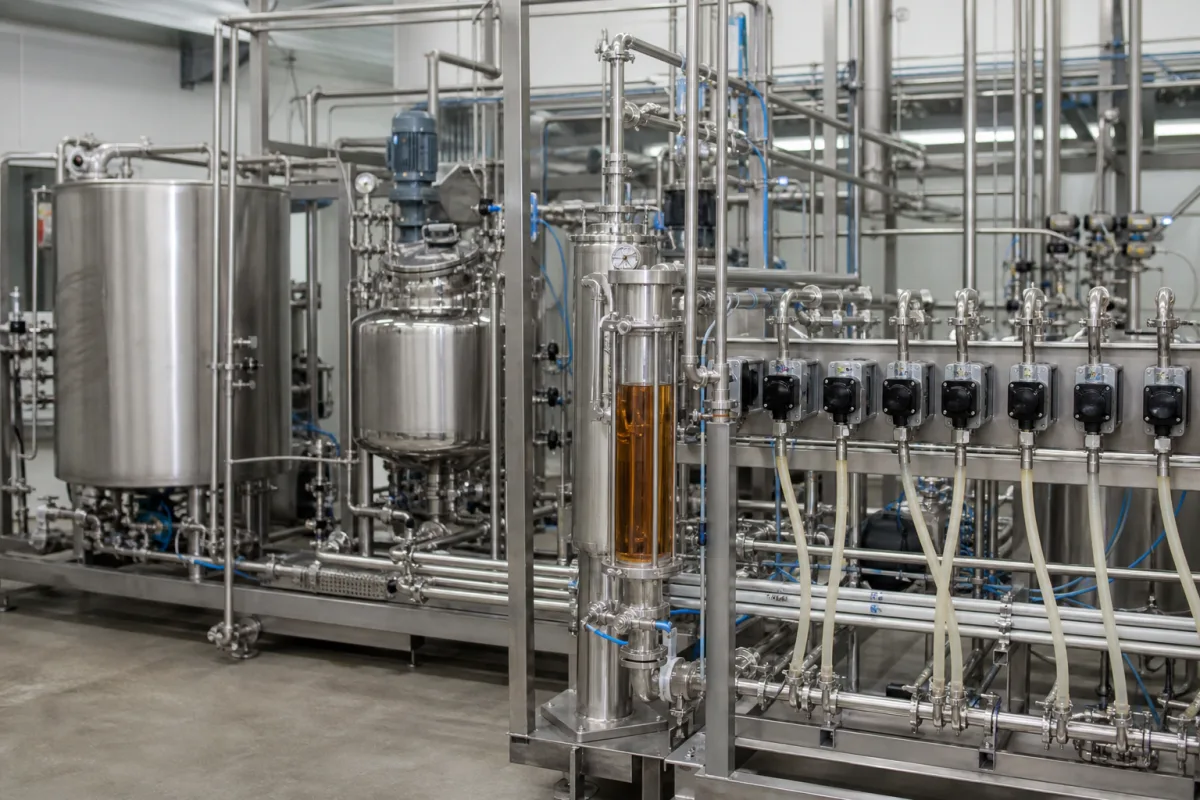
Sugar syrup preparation and dosing station for soft drinks: dissolving, treating and metering simple syrup before it reaches the blending room
The sugar side of a soft-drink syrup room · dissolving crystal sugar to about 65 °Brix, filtering, decolourising and pasteurising the simple syrup, then storing it and dosing it by flowmeter or load cell to the blending tanks
Before a cola or a flavoured soda is blended, someone has to make the sugar syrup it is built on. In a soft-drink plant that is a separate station: crystal sugar is conveyed in, wetted and dissolved in heated water to a set Brix, screened and filtered, sometimes decolourised with carbon, pasteurised and cooled, held in tanks, and then dosed by flowmeter or weight to the blending tanks where flavours and acids are added. The questions that decide the station are how hot to dissolve, how far to treat the syrup, and whether to dissolve on site at all or buy liquid sugar.
Sugar dissolving and simple-syrup preparation stations for beverage plants: sugar intake and conveying to the dissolver, batch and continuous dissolvers, Brix control by refractometer, pre-filters, bag, cartridge and kieselguhr filtration, activated-carbon and ion-exchange syrup treatment, plate pasteurisation and cooling of the syrup, syrup storage tanks, and the in-line dosing of the finished sugar syrup to the blending room by mass or magnetic flowmeter or load cells. Recipe blending of the final syrup and finished drink, with its batch tanks, in-line blenders and finished-drink Brix control, is covered on the Automated beverage batch blending system page; metering of individual flavours, acids and minor ingredients into the batch on the Beverage ingredient dosing station page; agitated tanks with impellers and baffles on the Mixing vessel page; carbonation on the Automated beverage carbonation control system page; flavour emulsion premixing and homogenising on the Beverage emulsion mixing and homogenizing system page; the complete line on the Carbonated soft drink (CSD) production line page; sugar crystallisation in a refinery on the Sugar vacuum pan page.
CNFX editorial research · Sources checked October 12, 2026 · 4 sources
Dissolving crystal sugar to 65 °Brix: injector-and-cartridge continuous dissolvers against jet-mix batch tanks
Tetra Pak's Continuous Sugar Dissolver is built to dissolve crystalline sugar in water continuously up to 65 °Brix, in three sizes rated at 7,000, 15,000 and 25,000 litres per hour, with a guaranteed accuracy of ±0.1 °Brix. [1]
Its working principle starts with hydraulic conveying: granulated sugar is drawn into the vacuum of an injector driven by the main slurry recirculation pump, which wets the sugar and doses it in line. An in-line Brix measurement then sets how much preheated water is admitted to hold the nominal concentration. The recirculation pump keeps the dissolving tank agitated through a radial jet mixer and sends the slurry to a dissolving chamber fitted with gap cartridges, which hold back undissolved crystals and return them to the tank while dissolved syrup passes through the gaps to the plate heat exchanger. [1]
Tetra Pak gives the dissolving temperature for 65 °Brix as 40 °C, noting that lower temperatures can be used for lower Brix, and an outlet temperature of 25 °C. Product-contact parts are AISI 316L with a surface roughness of Ra 1.6 µm and the frame is AISI 304L; the skid stands beside its dissolving tank and is run by a PLC in a cabinet in the base frame. [1] Editorial calculation: going from the 40 °C dissolving temperature to the 25 °C outlet means the plate exchanger's cooling section takes 15 K out of the syrup; in the pasteurising variant the syrup is first heated to pasteurising temperature, so its regenerative and cooling sections cover a wider span.
A DUE's brochure describes the other route. Its plants dissolve refined or raw sugar either cold, from 20 °C, or hot, up to 90 °C, and can be combined with an HTST pasteurising unit and energy recovery. Batch dissolving tanks are mixed either by pump recirculation through a diffuser nozzle (jet-mix) or by vertical eccentric stirrers running at high speed or fitted with high-shear propellers. Its continuous EASY.Dinamix monobloc is quoted at up to 35,000 L/h of sugar syrup, Brix accuracy up to ±0.10 °Bx and concentration up to 82 °Bx. [2] The 82 °Bx figure is the brochure's upper limit for the unit; it is well above the 65 °Brix that Tetra Pak dissolves at 40 °C, so ask what temperature and sugar type that concentration assumes.
Silos with pneumatic or screw conveying, ATEX categories 2GD/3GD [2]
Ask for the Brix the dissolver reaches at your sugar's temperature limit, the hourly output at that Brix, the Brix accuracy and how it is measured, and how undissolved crystals are kept out of the outlet.
02
Filtering, decolourising and pasteurising the simple syrup between the dissolver and the tanks
How much treatment the syrup needs depends on the sugar. Tetra Pak offers one or two 8 mm pre-filters, which it says prevent damage and allow lower-quality sugar to be handled, followed by two or four bag filters with a 50 micron mesh; other sugar treatment is offered on request. [1]
A DUE lists in-line filtration by cartridge filters, bag filters or diatomaceous earth (kieselguhr) filters, and two batch or continuous decolourising and deodorising treatments: activated carbon combined with kieselguhr filtration, or ion-exchange resin (which it says also suits demineralisation) combined with fine filtration through granular activated carbon. [2]
Pasteurisation is a plate heat exchanger stage. In Tetra Pak's pasteurising variant the plate exchanger has a hot-water circuit, heat-regenerating sections and a cooling-media supply, with a centrifugal booster pump; options include pressure surveillance on the plate exchanger, an extra tower-water cooling section, a magnetic flowmeter on the dissolver outlet (required with the plate exchanger), tank sanitisation when the pasteuriser is used and an additional refractometer on the production outlet. The syrup leaves at a constant 25 °C. [1] A DUE's EASY.ThermP pasteuriser uses standard or twin-plate exchangers, with pasteurisation temperature and flow adjustable on the HMI and energy recovery quoted at up to 90%. [2]
Decolourising, deodorising; also demineralisation [2]
Plate pasteuriser and cooler
Regenerative plate exchanger; Tetra Pak outlet 25 °C [1]
Heat treatment of the syrup with heat recovery; A DUE quotes up to 90% recovery [2]
Ask which filters and treatments are included for the sugar you will buy, the pasteurisation temperature and hold the supplier proposes, the regeneration percentage, and the syrup temperature at the tank inlet.
03
What the sugar brings in: bottlers-grade crystal sugar against 66–68 °Bx liquid sugar
A sugar refiner's bottlers-grade specifications show what the station is expected to receive. Sunshine Sugar's Refined Sugar Bottlers Grade, made at the Harwood refinery in New South Wales, is described as designed for colour-sensitive products and specified at a colour of no more than 30 ICUMSA units. [3]
The same refiner sells a Liquid Sugar Bottlers Grade at 66–68 °Bx total dissolved solids. Its standard shelf life is 14 days including the day of packing, extendable to 4 months only under conditions the specification lists: sealed food-grade containers, regularly cleaned equipment, UV-treated air in tank headspaces and regular microbial testing. It is supplied in 292 kg drums, 1,200 kg pallecons and bulk road tankers. [4] That short life is the trade-off a plant weighs when choosing between dissolving crystal sugar on site and receiving syrup ready-made.
Editorial calculation, assuming °Brix is read as grams of sucrose per 100 g of syrup: one 1,000 kg FIBC of crystal sugar dissolved to 65 °Brix gives about 1,000 ÷ 0.65 ≈ 1,540 kg of syrup, so about 540 kg of water must be metered in with it. The refiner lists 25 kg sacks and 1,000 kg and 1,200 kg FIBCs for the crystal grade. [3]
Give the station supplier your sugar specification (colour, ash, insoluble matter, microbial limits) so the pre-filters, carbon or resin stage and pasteuriser can be sized to it.
04
Holding the syrup and dosing it on: mix-proof tank routing, flowmeters or load cells, and UV on syrup and tank air
Once treated, the syrup is held in tanks and metered to the blending room. A DUE's storage tanks and in-line dosing systems are offered for sugar syrup, glucose and fructose (HFCS). [2]
The brochure lists automatic loading and unloading through mix-proof valves or manual swing-bend panels, dosing control by mass or magnetic flowmeters or by load cells, UV treatment of the sugar syrup to control its microbial load, and microfiltration or UV treatment of the air entering the tanks. [2] The liquid-sugar specification's own storage conditions point the same way: its 4-month extended life assumes UV-treated air in the headspace of storage vessels. [4]
On the dissolver side, Tetra Pak's base package includes frequency control of external dosing equipment and an advanced Brix set-point control with refractometer; its touchscreen gives the operator control of the recipe. [1]
Specify the number of syrup tanks and their volume, whether loading and unloading are automatic through mix-proof valves, the dosing method (mass flowmeter, magnetic flowmeter or load cells) and the accuracy expected at the blending tank, and whether UV is fitted on syrup and tank air.
05
Sugar, syrup and dosing data for a syrup station quotation
Paste it into your enquiry below or into an email to a maker, then replace every bracket.
Sugar: [crystal or liquid; refined or raw; colour ICUMSA; ash; microbial limits; sack, FIBC or bulk]
Syrup: [target °Brix and tolerance; L/h or kg/h; batch or continuous]
Dissolving: [cold or hot; maximum temperature; outlet temperature]
Treatment: [pre-filter; bag, cartridge or kieselguhr; activated carbon or ion exchange]
Pasteuriser: [temperature; hold; heat recovery %]
Storage and dosing: [number and volume of tanks; mix-proof valves; mass or magnetic flowmeter or load cells; UV]
Utilities: [steam; cooling water or tower water; compressed air pressure; supply voltage]
Cleaning: [CIP of dissolver, filters and tanks]
Explore company information and manufacturing capabilities, then discuss the scope of your project with a relevant supplier.
Share this page
Compiled and source-reviewed by the CNFX editorial team.
Each manufacturer above links to the page on that company's own website where the product is listed, with the date we checked it. How we source and review
· Page last updated 13 October 2026
Buyer questions
How concentrated is beverage sugar syrup made in a dissolver?
Tetra Pak's continuous dissolver works up to 65 °Brix with ±0.1 °Brix accuracy, dissolving at 40 °C for that Brix; A DUE quotes its continuous unit at up to 82 °Bx. [1][2]
How is sugar syrup decolourised for soft drinks?
A DUE offers activated carbon with kieselguhr filtration, or ion-exchange resin with granular activated carbon, in batch or continuous form. [2]
How long does liquid sugar keep?
Sunshine Sugar gives its bottlers-grade liquid sugar (66–68 °Bx) a standard shelf life of 14 days, extendable to 4 months under listed storage conditions including UV-treated tank air. [4]
What colour limit applies to bottlers-grade sugar?
Sunshine Sugar specifies its refined bottlers grade at 30 ICUMSA units maximum and its liquid bottlers grade at 35. [3][4]
Sources and what still needs a direct check
Sources checked 2026-10-12. Two equipment builders describe their dissolvers, treatment and dosing: Tetra Pak in a 2022 product brochure for its continuous dissolver, and A DUE in a brochure covering dissolving, syrup treatment, pasteurising and dosing. A sugar refiner, Sunshine Sugar (Manildra Harwood Sugars), supplies the bottlers-grade crystal and liquid sugar specifications.