Electrolytic manganese metal · How it is made and why selenium matters, where it is used, trade classification and the impurities to specify
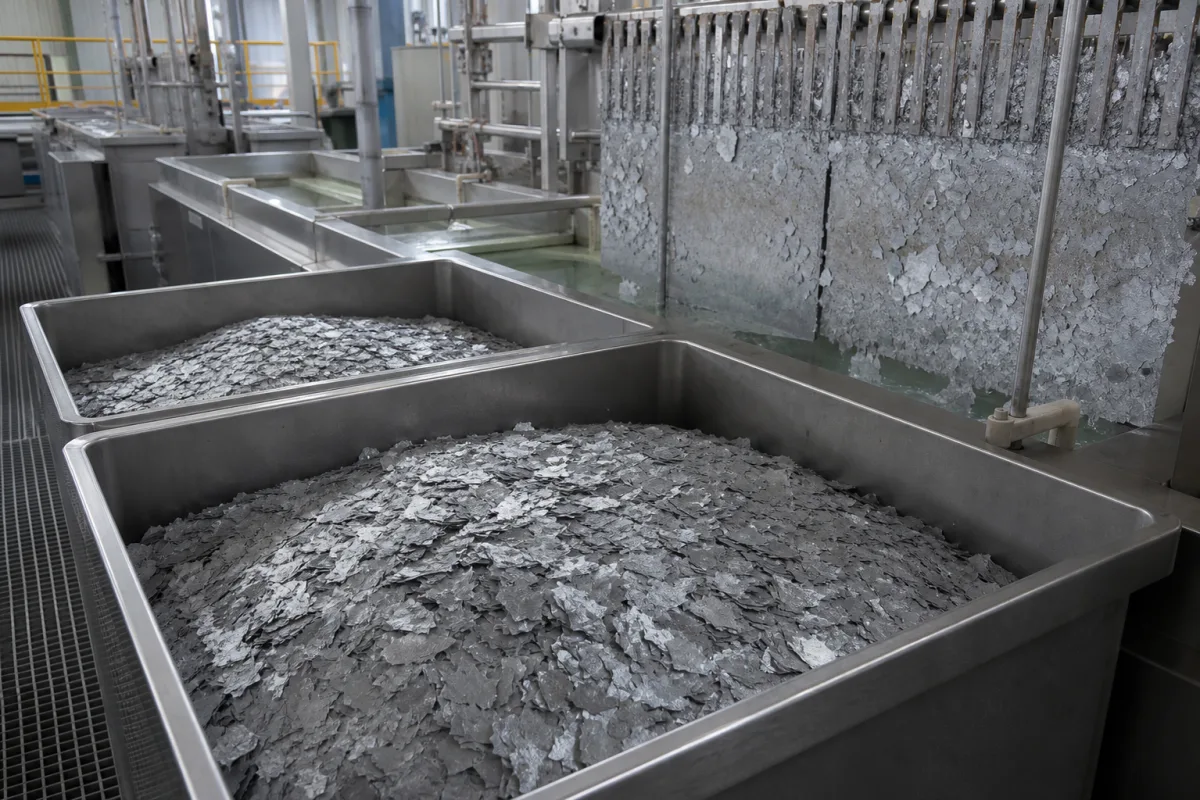
Electrolytic manganese metal (EMM) is high-purity manganese electrodeposited onto cathodes and stripped off as brittle flakes, used as an alloying addition in aluminium alloys, steels and other alloys. Ask three things first: the manganese content and impurity limits, including selenium, the producer's process, and the trade and shipping terms the flakes come under.
Electrolytic manganese metal flakes and chips. Ferromanganese, silicomanganese, manganese briquettes made from EMM powder, manganese ore and manganese chemicals are outside this page.
CNFX editorial research · Sources checked October 12, 2026 · 6 sources
Understand electrowinning and the selenium question
A 2022 study in Epistemus by Flores Santillán and co-authors explains that manganese deposits at a very negative potential (E° Mn²⁺/Mn = −1.18 V vs SHE) compared with water reduction (−0.82 V), so hydrogen forms at any pH, giving poor deposits, low current efficiency and high energy use. Selenium dioxide is the main additive used to overcome this: adsorbed selenium raises the overpotential for water reduction so that manganese can deposit. [1]
The authors call selenium highly toxic and polluting, and test alternatives (dextrin, glycerine, tellurium dioxide, sodium thiosulfate); they cite current efficiencies of 60–70% and energy use of 9,000–12,000 kWh/t reported for SeO₂, and found low concentrations of TeO₂ gave 52–60% efficiency with similar energy use, the best substitute in their tests. [1]
Editorial calculation: 9,000–12,000 kWh/t is 9–12 kWh of electricity for each kilogram of flake, so power price and supply weigh heavily on EMM cost. [1] Editorial note: because selenium may be present in the product, ask the producer for its selenium content and process, and whether a low-selenium grade is available for your alloy.
02
Know where EMM is used and how it is traded
The USGS Minerals Yearbook for 2021 has a US consumption table that lists 19,000 t of manganese metal used in 2021, with entries for steels, superalloys and other alloys. [2]
The same yearbook reports that China exported 406,000 t of manganese metal in 2021, and that a National Manganese Flake Innovation Alliance of 11 producers held about 80% of China's flake capacity; production suspensions and power restrictions helped push Chinese manganese metal prices to a 14-year high. [2]
USGS Mineral Commodity Summaries 2025 lists the US tariff line for unwrought manganese metal flake containing at least 99.5% manganese (HTS 8111.00.4700, 14% ad valorem) and shows the National Defense Stockpile planning potential acquisitions of 5 (thousand t) of electrolytic manganese metal in fiscal 2024 and 2025. [3]
03
Specify the analysis and handling
USGS gives the 99.5% tariff threshold, and one producer's grade sheets in the next section give a full analysis; the fields below should be fixed in the contract with the producer's certificate of analysis. [3][5]
Editorial note: state manganese content and maximum carbon, sulfur, phosphorus, iron, silicon and selenium, the analytical methods and sampling per lot, flake size and any passivation, packing (for example bags and pallets) and moisture protection, and whether third-party inspection applies. If the flakes go into aluminium alloys, agree impurity limits with the alloy's specification in mind.
04
Compare a producer's flake grade sheet line by line
Manganese Metal Company (MMC) in South Africa publishes grade sheets for its electrolytic manganese flake. Its Low Hydrogen (LH) flake specification (21 August 2017) sets total manganese at 99.7% minimum and metallic manganese at 99.9% minimum, with maximums of 0.04% sulfur, analysed per consignment, with 0.03% (typ.); 0.010% carbon, with 0.001% (typ.); 0.0008% hydrogen; 0.010% iron; 0.005% phosphorus; and 0.010% silicon. The sheet lists packing in 1,000 kg or 1,361 kg bulk bags, 500 kg steel drums or 25 kg paper bags. MMC's product page says the dull brown LH flake is degassed to no more than 8 ppm hydrogen, is 1 to 2 mm thick and is screened before packing; its grey Low Oxygen (LO) flake is passivated, washed and dried, holds no more than 0.1% oxygen, with hydrogen at 250 ppm (typ.), and is aimed at high-value alloys made in vacuum induction melting furnaces. The LO grade sheet states a selenium-free process with selenium at 0.0005% maximum. [5][6][4]
Editorial calculation: 99.7% total manganese leaves at most 3 kg of other elements per tonne of flake; 8 ppm hydrogen is 0.0008%, matching the grade sheet limit, while 250 ppm in LO flake is about 30 times higher. Specify LH or an equivalent degassed grade where hydrogen matters, and LO or a passivated grade where surface oxidation matters, and ask whether a selenium-free process is used, since the selenium dioxide additive described above can leave selenium in the metal. [5][4][1]
The suppliers reviewed trade ferroalloys alongside EMM; ask whether they produce the flakes or source them, the producing plant, the certificate of analysis and the selenium content.
Mn floor, impurity maxima and flake form for the contract
Selenium is the row that ties back to the process: it comes from the SeO₂ additive where a producer uses it, and MMC's selenium-free LO sheet caps it at 0.0005%. [1][6]
Field
What it means and published values
Ask the supplier for
Manganese Content (%)
US tariff line for flake: ≥99.5% Mn; e.g. ≥99.7% total, ≥99.9% metallic. [3][5]
Anyang Jinfang and Anyang Xinhai list electrolytic manganese flakes next to ferromanganese and other ferroalloys; Xinhai's listing names a 99.7% grade.
Anyang Jinfang Metallurgy Co.,Ltd.
Manufacturing site to be confirmed for the order
Lists electrolytic manganese metal flakes with ferromanganese and other alloys.
Explore company information and manufacturing capabilities, then discuss the scope of your project with a relevant supplier.
Share this page
Compiled and source-reviewed by the CNFX editorial team.
Each manufacturer above links to the page on that company's own website where the product is listed, with the date we checked it. How we source and review
· Page last updated 13 October 2026
Buyer questions
Why is selenium used to make electrolytic manganese?
Selenium dioxide raises the overpotential for hydrogen evolution so manganese can deposit; researchers are testing alternatives because selenium is toxic. [1]
What drives electrolytic manganese prices?
The USGS Minerals Yearbook for 2021 reports that production suspensions and power restrictions in China helped push Chinese manganese metal prices to a 14-year high that year. [2]
What purity defines manganese flake for US tariffs?
The tariff line covers unwrought flake containing at least 99.5% manganese. [3]
What impurity limits does a producer set for electrolytic manganese flake?
One producer's low-hydrogen flake sheet sets ≥99.7% total Mn and maximums of 0.04% S, 0.010% C, 0.0008% H, 0.010% Fe, 0.005% P and 0.010% Si. [5]
Sources and what still needs a direct check
Sources checked 2026-10-12. The USGS publications give US government market and trade data; the Epistemus article is a peer-reviewed laboratory study. Your purchase specification should come from your alloy standard.