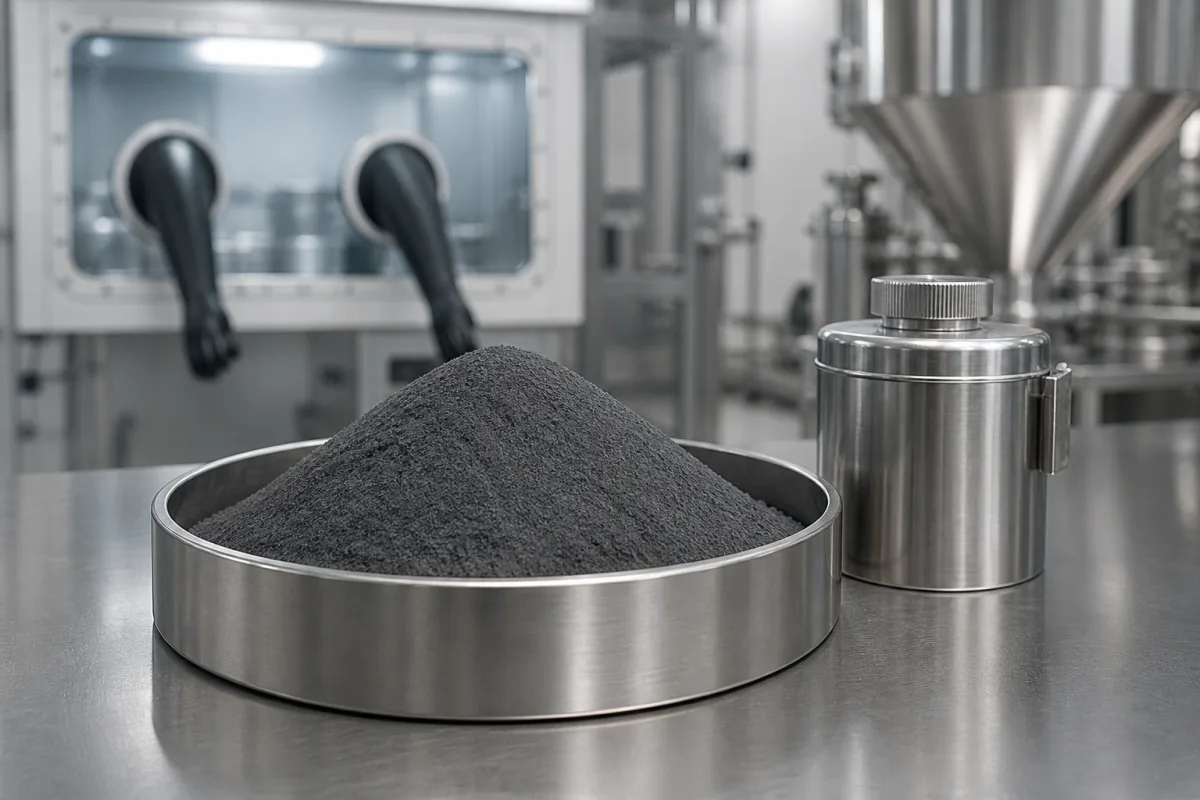
Molybdenum disilicide (MoSi2) powder · Grades set by oxygen, carbon and nitrogen limits, silicon content, laser-diffraction D10/D50/D90, BET surface area and apparent density, for heating elements, oxidation-resistant coatings and thermal spraying
Molybdenum disilicide (MoSi2) powder is a grey intermetallic powder used to make high-temperature heating elements, oxidation-resistant coatings and structural parts; at high temperature it forms a protective silica layer. Ask three things first: what the powder is for, which oxygen, carbon and nitrogen limits it must meet, and what particle size distribution, surface area and certificate the process needs.
Molybdenum disilicide powders for pressing and sintering, thermal spraying and coating, specified by chemistry and particle size. Finished MoSi2 heating elements, sputtering targets and other silicide powders are outside this page.
CNFX editorial research · Sources checked October 11, 2026 · 4 sources
MoSi2 has a molecular weight of 152.12 g/mol. [4] Höganäs' data sheet PD-5146 (issue 3, 2007) describes MoSi2 as a greyish powder in three grades: Grade A allows at most 0.5% oxygen, Grade B 1.5% and Grade C 2.0%. Silicon is 36.3–36.9% for Grade A, 36.1–36.9% for B and 35.9–36.9% for C; carbon is at most 0.2% for A and B and 0.3% for C; nitrogen at most 0.1% for A and B and 0.2% for C. [1]
SAM's thermal-spray MoSi2 grades list purity above 99.0% for 0.5–1.0 µm and above 99.9% for coarser sizes, oxygen from at most 1.0% for the finest grade to at most 0.3% for −325 mesh, nitrogen at most 0.05–0.10%, carbon at most 0.1% and silicon 33.2–36.9%; SAM notes these figures are based on theoretical data. [2]
Höganäs supplies an inspection document in accordance with EN 10204 with every shipment. [1] Ask for the oxygen, carbon, nitrogen, silicon and particle size results on that certificate.
Give the supplier the end use (heating elements, sintered parts, thermal spray, coating), the oxygen, carbon, nitrogen and silicon limits, particle size distribution or mesh, surface area, apparent density or flow needs, lot size, packaging and the certificate type required.
02
Set the particle size, surface area and form
Höganäs measures particle size by laser diffraction (Microtrac) per ASTM C 1070. Its D50 is 5.5–7.5 µm for Grade A, 3.5–5.0 µm for Grade B and 2.0–3.0 µm for Grade C, with D90 of 10.5–13.5 µm, 7.0–10.5 µm and 3.5–5.0 µm. BET surface area per DIN ISO 9277 is at most 1.0 m²/g for Grade A and at least 0.9 m²/g and 1.5 m²/g for B and C. Apparent density by Scott volumeter per ASTM B 329 is 18.0–28.0 g/inch³ for A and 15.0–25.0 g/inch³ for B; Grade C is not free-flowing. [1]
SAM offers spherical MoSi2 for thermal spraying in average particle sizes of 0.5–1.0 µm, 1.0–3.0 µm, 10.0–60.0 µm and −325 mesh, and says it forms a silica passivation layer at high temperature that prevents further oxidation; it lists uses in heating elements, oxidation-resistant coatings and high-temperature structural parts. [2] Kanthal's Super MoSi2 heating elements are rated up to 1,850 °C (3,360 °F) in oxidizing, inert, carburizing, nitriding and reducing atmospheres. [3]
Höganäs packs Grades A and B as 50 kg in 30 l steel drums and Grade C as 50 kg in 60 l drums, each with a polyethylene inlet, nine drums (450 kg) to a 1,140 × 1,140 mm pallet. [1]
Editorial calculation: with 1 in³ = 16.387 cm³, 18.0–28.0 g/inch³ is about 1.10–1.71 g/cm³ and 15.0–25.0 g/inch³ is about 0.92–1.53 g/cm³; 0.5%, 1.5% and 2.0% oxygen are 5,000, 15,000 and 20,000 ppm. [1]
03
What to ask a MoSi2 powder supplier to show on the lot certificate
Ask any supplier for a data sheet and a lot certificate showing oxygen, carbon, nitrogen and silicon, D10/D50/D90 and the method used, BET surface area, apparent density or flow, particle shape, packaging, lead time and minimum order.
04
Oxygen, silicon, carbon and nitrogen, size distribution, BET and apparent density
Höganäs' grades A, B and C carry at most 0.5%, 1.5% and 2.0% oxygen alongside their particle sizes, so fix oxygen and size together for the end use. [1]
D50, purity, oxygen, BET, apparent density and flow for a MoSi2 powder order
Höganäs states apparent density in g/inch³ by Scott volumeter, which converts to about 0.92–1.71 g/cm³ across its grades (editorial calculation); six rows here, including melting point and resistivity, have no published value. [1]
1 company lists this product among what they make. Company figures are quoted from each
company's own website; every card states where the relationship came from.
Yantai Torch Special High Temperature Ceramics Co., Ltd.
Manufacturing site to be confirmed for the order
Lists MoSi2 powder with a composition table (MoSi2 ≥99%, O <0.20%, Fe <0.10%) for heat-resistant coatings and ceramic additives.
Explore company information and manufacturing capabilities, then discuss the scope of your project with a relevant supplier.
Share this page
Compiled and source-reviewed by the CNFX editorial team.
Each manufacturer above links to the page on that company's own website where the product is listed, with the date we checked it. How we source and review
· Page last updated 13 October 2026
Buyer questions
How are MoSi2 powder grades separated?
Höganäs lists Grade A at no more than 0.5% oxygen with D50 5.5–7.5 µm, Grade B at 1.5% with 3.5–5.0 µm, and Grade C at 2.0% with 2.0–3.0 µm. [1]
What sizes are used for thermal spraying?
SAM lists 0.5–1.0 µm, 1.0–3.0 µm, 10.0–60.0 µm and −325 mesh spherical grades. [2]
How hot can MoSi2 heating elements run?
Kanthal rates its Super MoSi2 elements up to 1,850 °C. [3]
Sources and what still needs a direct check
Sources checked 2026-10-11. Höganäs and Stanford Advanced Materials sell MoSi2 powder; Kanthal makes MoSi2 heating elements; PubChem lists the compound.