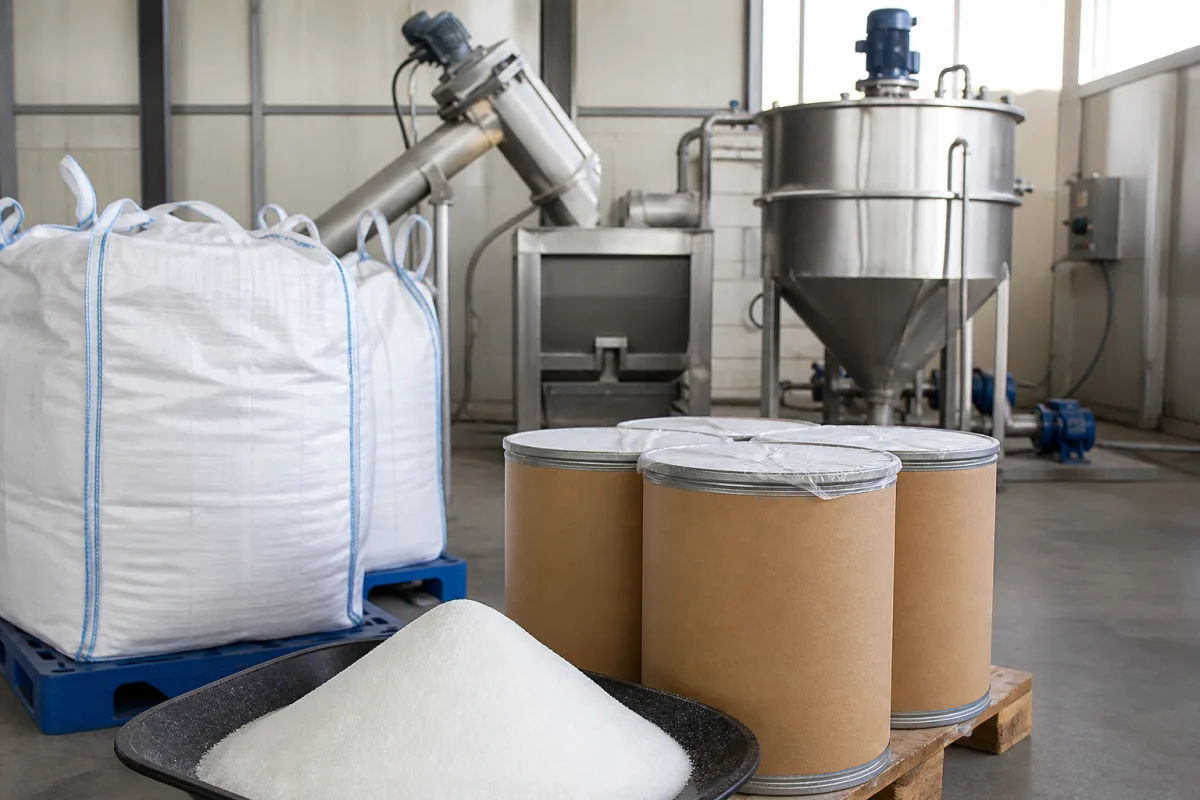
Water and sludge treatment polymer · Charge and molecular weight, make-down concentration and maturation, in-line dilution, stirring and degradation
Polyacrylamide (PAM) flocculants are very high molecular weight water-soluble polymers, supplied as powder or emulsion, anionic or cationic, that bridge fine particles into larger flocs in water clarification, sludge thickening and dewatering and mineral processing. Ask three things first: which charge type and molecular weight suits your solids, and how that will be confirmed by tests, how the powder will be dispersed and matured without lumps or shear damage, and at what concentration it will be dosed.
Powdered polyacrylamide flocculants (anionic, cationic, non-ionic) for water, wastewater, sludge and mineral slurries. Emulsion polymers are compared; inorganic coagulants, polymer make-down equipment as machinery and dewatering machines are outside this page.
CNFX editorial research · Sources checked October 12, 2026 · 4 sources
The Suez (Degrémont) Water Handbook describes polyacrylamides as very high molecular weight flocculants that are "mainly available as a powder or an emulsion" and can be anionic or cationic. For powder it warns that solutions, even diluted, can be extremely viscous, that brisk agitation mechanically degrades the flocculant, and that powder forms lumps if not properly dispersed. It gives a preparation concentration of 2–5 g/L, depending on viscosity and pumping limits, and 30–60 minutes for the polymer to mature. [1]
The handbook's preparation units disperse powder from a screw feeder into a controlled water stream in a first tank and let it swell and dissolve in a second, agitated maturation tank; emulsions are made up at 2.5–10 g/L in 15–20 minutes. Because the polymer must be spread evenly, it is then diluted in line at the dosing pump outlet to about 0.5–1 g/L for sludge treatment and 0.02–0.1 g/L for clarification, preferably with low-salinity water (below 200 mg/L). [1]
Editorial calculation: a 2,000 L make-down batch at 3 g/L takes 6 kg of powder; diluting that solution in line to 0.5 g/L for sludge needs about six volumes of total flow per volume of solution (3/0.5 = 6), and to 0.05 g/L for clarification about 60. [1]
Give the supplier the application (clarification, thickening, dewatering, mineral slurry), solids type and concentration, pH and conductivity, equipment (clarifier, belt press, centrifuge, screw press), current product and dose, make-down equipment and water quality, and ask for jar or bench tests with the candidate grades.
02
Choose charge and molecular weight, and dissolve without damage
The Suez handbook notes that polyacrylamides can be anionic or cationic. [1] In a 2023 study in Minerals, Li and co-authors dissolved anionic PAM (APAM) of 3–25 million molecular weight by mechanical stirring and found optimal stirring speeds of 800 r/min for 3–6 million, 600 r/min for 8–16 million and 800 r/min for 18–25 million molecular weight, with powder solubility best under those conditions. [2]
The same study found the settling floc of coal slime was largest at 600 r/min for the finest (−0.5 mm) slime and at 200–400 r/min for narrower size fractions, and that floc size grew with slime particle size. [2] Editorial note: these laboratory stirring speeds apply to the authors' vessel and impeller; use them as evidence that molecular weight changes the dissolution conditions, and confirm make-down settings with your equipment supplier.
For drinking water in the United States, 40 CFR 141.111 sets a treatment technique rather than a concentration limit for acrylamide monomer: each public water system must certify annually to the State, using a manufacturer's or third-party certification, that the product of polymer dose and residual monomer does not exceed 0.05% acrylamide dosed at 1 ppm, or the equivalent. [3]
Editorial calculation: 0.05% monomer at 1 mg/L of polymer is 0.0005 mg/L of acrylamide added to the water. A polymer with 0.025% residual monomer could be dosed at up to 2 mg/L on the same product basis (0.0005 ÷ 0.00025); a 0.1% grade only at 0.5 mg/L. [3]
03
Meet the WHO drinking-water value for acrylamide
The World Health Organization's background document for its Guidelines for Drinking-water Quality (WHO/SDE/WSH/03.04/71/Rev/1, 2011) retains a guideline value of 0.5 µg/L for acrylamide, with the proviso that exposure be kept as low as technically achievable. It names polyacrylamide flocculants containing residual monomer as "the most important source" of acrylamide in drinking water, and takes a maximum authorised polymer dose of 1 mg/L, which at 0.05% monomer gives a maximum theoretical concentration of 0.5 µg/L; in practice concentrations may be 2–3 times lower, and this applies to anionic and non-ionic grades, while residual levels from cationic grades may be higher. WHO describes control by limiting the monomer content of the flocculant, the dose, or both, and notes that analysis can now measure the water directly: a GC-MS method detects down to 0.008 µg/L, against an older HPLC-UV method with a 0.2–100 µg/L range. [4]
Editorial calculation: the WHO arithmetic matches the US rule above (1 mg/L × 0.05% = 0.5 µg/L); a grade with 0.025% residual monomer could be dosed at up to 2 mg/L for the same theoretical acrylamide. For drinking-water service, ask the supplier for residual monomer by lot, the charge type (cationic grades may carry more monomer), and the analytical method behind the figure. [4][3]
Aquasust's PAM listing and what to ask before a jar test
The supplier reviewed sells PAM flocculant with wastewater treatment equipment; ask for the charge type and degree, molecular weight range, residual monomer, dissolution time and a jar test on your sample.
05
Feeder, preparation and maturation tanks, dosing pump and in-line dilution
The concentrations and times in this chain are Suez's: 2–5 g/L in the preparation tank, 30–60 minutes of maturation, then dilution to 0.5–1 g/L for sludge or 0.02–0.1 g/L for clarification. [1]
Charge, molecular weight, dissolution time and residual monomer for a PAM grade
Residual monomer is the row with a regulatory number behind it for drinking water; charge and molecular weight are settled by jar test, and Li and co-authors' 3–25 million APAM range shows that molecular weight also changes the stirring speed needed to dissolve the powder. [3][2]
1 company lists this product among what they make. Company figures are quoted from each
company's own website; every card states where the relationship came from.
Aquasust
Manufacturing site to be confirmed for the order
Lists PAM flocculant with sludge dewatering machines and other wastewater treatment equipment.
Explore company information and manufacturing capabilities, then discuss the scope of your project with a relevant supplier.
Share this page
Compiled and source-reviewed by the CNFX editorial team.
Each manufacturer above links to the page on that company's own website where the product is listed, with the date we checked it. How we source and review
· Page last updated 13 October 2026
Buyer questions
At what concentration is PAM powder made down?
The Suez Water Handbook gives 2–5 g/L, depending on viscosity and pumping limits, with 30–60 minutes of maturation. [1]
How much is PAM solution diluted before dosing?
In line to about 0.5–1 g/L for sludge and 0.02–0.1 g/L for clarification. [1]
Can PAM solution be mixed hard to speed dissolution?
No; the handbook warns that brisk agitation mechanically degrades the flocculant. [1]
How much residual acrylamide is allowed in PAM for US drinking water?
40 CFR 141.111 requires certification that dose times monomer level does not exceed 0.05% acrylamide dosed at 1 ppm, or equivalent. [3]
What acrylamide level does WHO set for drinking water treated with polyacrylamide?
WHO retains a guideline value of 0.5 µg/L, which equals a 1 mg/L polymer dose at 0.05% residual monomer; cationic grades may carry more monomer. [4]
Sources and what still needs a direct check
Sources checked 2026-10-12. The Suez (Degrémont) Water Handbook is an engineering reference from a water treatment company; the Minerals article is a peer-reviewed laboratory study. Grade selection should be confirmed by tests on your water or sludge.