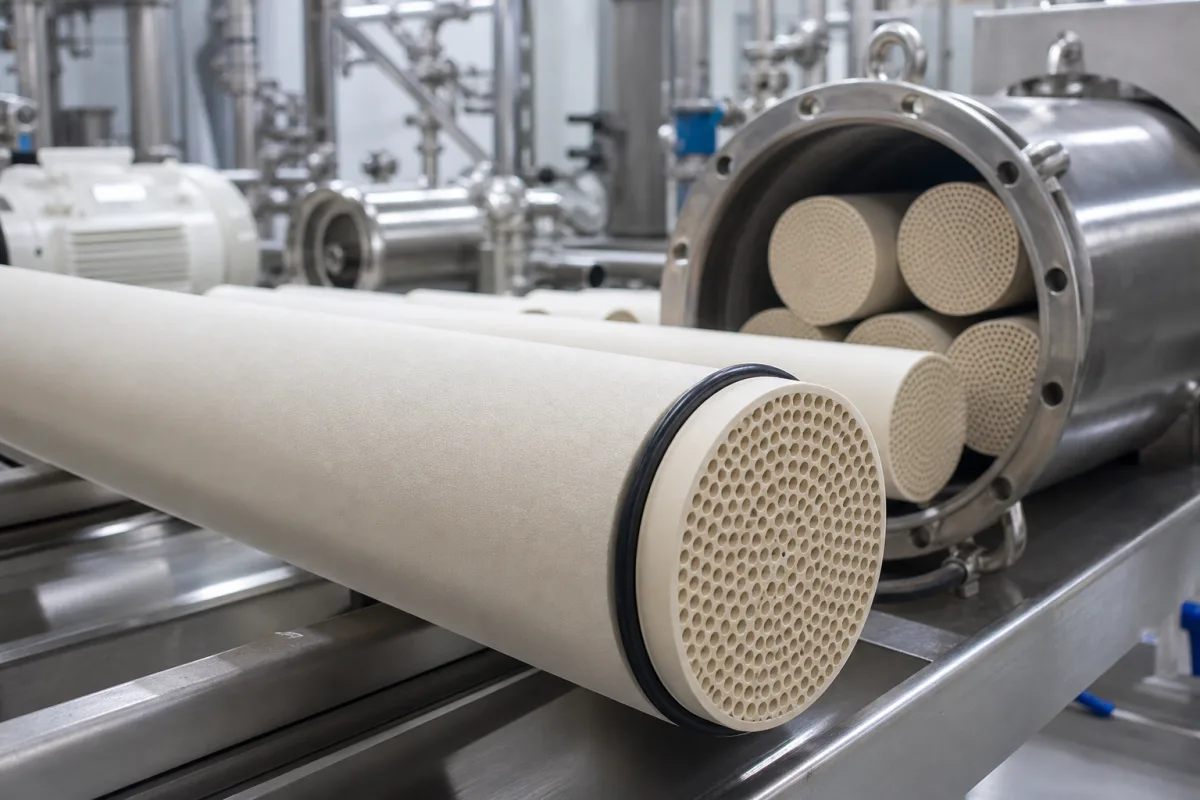
Ceramic membrane filter elements (tubular, multichannel)
Tubular multichannel ceramic membrane elements for crossflow microfiltration and ultrafiltration · pore size (µm, nm) and molecular weight cut-off, alumina support with alumina, zirconia or titania layers, channel count and diameter, element length and area, pH, temperature and pressure limits, backpulsing
A ceramic membrane element is a porous ceramic tube with one or more feed channels whose channel walls carry a thin filtering layer that sets the cut-off; liquid flows along the channels in crossflow and permeate passes out through the support. Ask three things first: the pore size or molecular weight cut-off and the layer material; the element geometry — outer diameter, channel count and diameter, length and area; and the operating limits for pH, temperature, pressure, cleaning and backpulsing in the housing you will use.
Tubular single-channel and multichannel ceramic membrane elements for crossflow microfiltration, ultrafiltration and fine ultrafiltration of liquids — alumina supports with alumina, zirconia or titania filtering layers, including the product listed here as industrial-grade ceramic membrane filter element. Complete skids, polymeric membranes, flat-sheet ceramic membranes, ceramic candle filters for gas or hot-gas filtration and dead-end cartridge filters are outside this page except where compared.
CNFX editorial research · Sources checked October 11, 2026 · 5 sources
Choose the pore size or cut-off and the layer material
TAMI Industries describes its membranes as tubular ceramics with channels whose fluid-side surface carries an active layer that sets the cut-off, across a range from 2 nm to 1.4 microns covering fine ultrafiltration, ultrafiltration and microfiltration. [4] Its INSIDE CéRAM industrial elements are offered with microfiltration ratings of 0.14, 0.20, 0.30, 0.45, 0.80 and 1.4 µm, ultrafiltration cut-offs of 15, 50, 150 and 300 kg/mol, and fine ultrafiltration cut-offs of 1, 3, 5 and 8 kg/mol. [3] Pall states that Membralox microfiltration layers are high-purity α-alumina (1.4, 0.8, 0.5, 0.2 and 0.1 µm) and ultrafiltration layers are zirconia (100, 50, 20 and 10 nm), on a support of sintered ultrapure α-alumina with a 12 µm pore size; some pore sizes are not available on all element types. [1] Pall's 2007 datasheet lists 1.42, 0.82, 0.5, 0.2 and 0.12 µm alumina and 100, 50 and 20 nm zirconia, and describes the filtering layer as alumina, zirconia or titania. [2]
In crossflow operation, TAMI explains, the feed creates a turbulent flow along the membrane surface that stops retained material forming a cake, so the flow can stay constant; in frontal (dead-end) filtration the flow is perpendicular to the surface and the cake clogs the pores in a short time. [5] Pall lists ability to withstand high-frequency backpulsing cycles and cleaning in place among Membralox features, and states that its membranes are 100% bubble point integrity tested during manufacturing. [2]
Editorial note: suppliers rate microfiltration layers in µm and ultrafiltration layers in nm or as a molecular weight cut-off in kg/mol (kDa), so ask for both the rating and the test basis when comparing quotes.
Give the supplier the feed (solids, oil, viscosity, particle or molecule size), target permeate quality, pore size or cut-off and layer material, required flux and recovery, cleaning chemicals, pH, temperature and pressure, backpulse plan, housing type and gasket material, and the element format or retrofit dimensions you need to match.
02
Size the element geometry and check operating limits
TAMI's INSIDE CéRAM industrial elements come in Ø25 mm with 7, 8, 11, 19, 23, 49 or 93 channels of 6 to 1.6 mm hydraulic diameter and 0.16 to 0.60 m² per 1,178 mm element, and in Ø41 mm with 25, 37 or 61 channels of 5.5 to 3.5 mm and 0.47 to 0.71 m² per 1,020 mm element; available lengths are 580, 850, 1,020 and 1,178 mm, and TAMI lists the elements as autoclavable and sterilisable by superheated water, steam or oxidising agents. [3] Pall's Membralox range lists hexagonal and cylindrical elements: EP3730 (3 mm channels, 37 channels, 0.35 m²), EP1940 (4 mm, 19, 0.24 m²), EP3740 (4 mm, 37, 0.47 m²), EP4840 (4 mm, 48, 0.69 m²), EP1960 (6 mm, 19, 0.36 m²), EP2760 (6 mm, 27, 0.50 m²), EC1935 (3.5 mm, 19, 0.25 m²) and EC0760 (6 mm, 7, 0.16 m²), at lengths of 1,020 and 1,178 mm. Its housings are SS 316L, and module operating limits are up to 10 barg at up to 95 °C on aqueous liquids, with pH 0–14 compatibility for the membranes. [1]
Pall's 2007 datasheet gives the same 10 bar and 95 °C liquid-filtration limits; its drawings show hexagonal element dimensions of 28/31 mm and 38/43 mm for the four element types listed. [2] For lab trials, Pall's single-tube T1-70 module uses a 7/10 mm ID/OD tube 250 mm long with 0.005 m², and Pall notes that such single-tube results cannot be used directly for scale-up. [1]
Editorial calculation: the inner channel wall area of an EP4840 is roughly π × 0.004 m × 1.02 m × 48 channels ≈ 0.62 m², close to the 0.69 m² Pall lists, which shows that channel count and diameter drive the area per element.
03
Alumina and silicon carbide membranes on supplier sites
Jiuwu Hi-Tech's website lists alumina and silicon carbide ceramic membranes; silicon carbide is not among the layer materials in the Pall and TAMI sources above.
When requesting quotations, ask each supplier for element drawings, pore size or cut-off and layer material, clean-water permeability, pH, temperature and pressure limits for the element and the housing, gasket options, integrity test method, and pilot or lab test support.
1 company lists this product among what they make. Company figures are quoted from each
company's own website; every card states where the relationship came from.
Jiangsu Jiuwu Hi-Tech Co., Ltd.
Manufacturing site to be confirmed for the order
Its website lists alumina ceramic membranes and silicon carbide ceramic membranes.
Explore company information and manufacturing capabilities, then discuss the scope of your project with a relevant supplier.
Share this page
Compiled and source-reviewed by the CNFX editorial team.
Each manufacturer above links to the page on that company's own website where the product is listed, with the date we checked it. How we source and review
· Page last updated 13 October 2026
Buyer questions
What pore sizes are ceramic membrane elements made in?
Pall lists α-alumina MF layers of 0.1–1.4 µm and zirconia UF layers of 10–100 nm on a 12 µm alumina support. [1]
What channel counts do tubular ceramic membrane elements come in?
TAMI's INSIDE CéRAM Ø25 mm elements come with 7 to 93 channels and its Ø41 mm elements with 25, 37 or 61. [3]
Why are ceramic membranes run in crossflow?
TAMI says the flow along the membrane surface stops a cake forming, keeping the flow constant, unlike dead-end filtration. [5]
Sources and what still needs a direct check
Sources checked 2026-10-11. Sources are two Pall Membralox datasheets and three TAMI Industries product and technology pages.