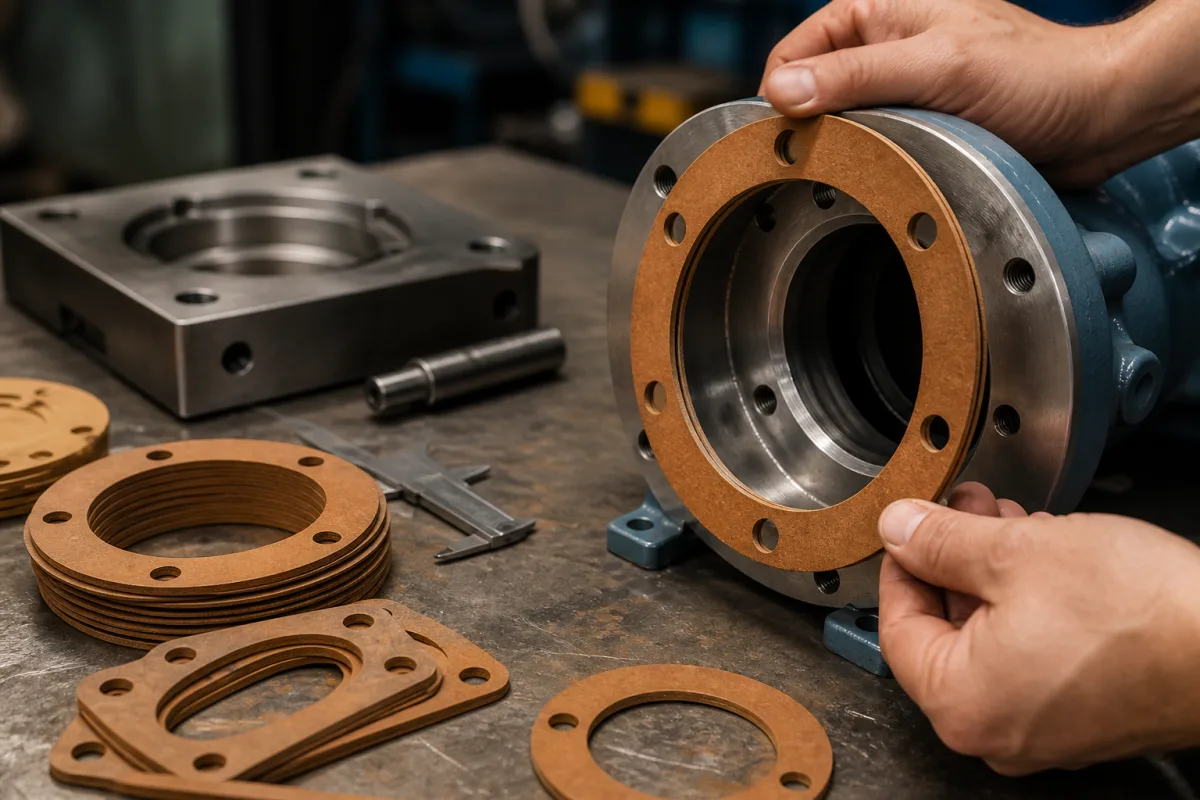
Flat leather gaskets and washers for pipe unions, pump covers and low-pressure flanges
Static face seals cut from tanned cattle hide · BSP pipe washers, pump and sump cover gaskets and bolted-flange rings for water and low-pressure oil joints
A flat leather gasket is a punched or knife-cut ring, washer or plate of tanned cattle hide clamped between two faces that do not move relative to each other: a BSP pipe union, a pump or sump cover, a bolted flange on low-pressure equipment. Leather is used here because it is tough, conforms to imperfect metal faces and, once tanned, does not rot when it is wetted again. The order is settled by three things: the pressure and temperature the sheet is rated for, the thickness and which face is skived, and how the joint will see water or oil in service.
Flat, static leather gaskets and washers die-cut or knife-cut from tanned cattle hide or leather gasket sheet: BSP and other pipe-union washers, pump and sump cover gaskets and bolt-hole flange rings for water and low-pressure oil joints, with their thickness, skiving, tannage and oiling. Leather cup, U-, flange and vee packings for pistons, plungers and rams, and leather washers used as gaskets or back-up rings in hydraulic and pneumatic cylinders, are covered on the Leather hydraulic piston seals page. Rubber, fibre, cork and compressed non-asbestos gaskets are outside this page except where compared.
CNFX editorial research · Sources checked October 12, 2026 · 5 sources
Pressure and temperature ratings of vegetable-tanned gasket sheet, and the fluids it is listed for
McMaster-Carr lists a vegetable-tanned leather gasket sheet at a maximum pressure of 500 psi and a temperature range of 0 to 150 °F, and describes it as resisting salts, grease and detergents in addition to water and oil. The sheet comes 5/64, 1/8 and 3/16 inch thick in 12 × 12, 24 × 24 and approximately 36 × 84 inch sizes, and is cut with scissors. [1] Editorial calculation: 500 psi is about 34.5 bar and 150 °F is about 66 °C; the three thicknesses are about 2.0, 3.2 and 4.8 mm.
The listing gives one pressure and one temperature range, with no statement of whether they apply together, at what bolt load, or by which test; its own filter panel shows a different band of 500 to 699 psi. [1] Treat the 500 psi figure as a catalogue rating for the sheet, ask whether it holds at the top of the temperature range, and keep hot-water and steam joints out of the selection until a supplier confirms them.
RH Nuttall, a Birmingham gasket and washer maker, names water pipe seals, sump and pump seals, metal-polishing equipment and gaskets in hydraulic systems among the uses of its leather washers and gaskets, and explains why tanned hide suits pipework: once tanned, it dries to a durable, flexible material that will not putrefy when it is wetted again. [3][2]
1, 2 and 3 inch BSP [2]; BSP washers in 3 mm and 5 mm [3]
Gasket maker
Give the supplier the fluid, maximum pressure and temperature at the joint, whether it is a pipe union, cover or bolted flange, the bolt count and size, and the drawing of the face it seals.
02
Thickness, the skived face and cutting gaskets from the hide
RH Nuttall buys pre-cut hides nominally 6 mm thick and skives them in house to 1, 2, 3, 4 or 5 mm. Skiving leaves one face clean, which the maker says gives the sealing face; the maker describes that face as brown or black, and the opposite face can be supplied black, brown, honey, aged, red or green. [2]
The same maker produces its leather washers, gaskets, seals and strip from 2 mm up to 6 mm, keeps a splitting facility to reach any thickness, and states that its leather carries a skin layer on one side. [3] Shapes run from plain rings to gaskets with holes and slots; tooling is made to the drawing, logos or names can be embossed during cutting, and samples are offered before a bulk order. [2]
Editorial note: because the thickness comes from skiving or splitting a hide rather than from a calendered sheet, ask for the thickness tolerance across the gasket, which face is the skived sealing face, and whether the part is cut from one hide region so that two gaskets in the same joint compress alike.
State the finished thickness and tolerance, the sealing face (skived or grain), the outline and hole pattern with a drawing, the quantity, and whether a sample is needed for trial on the equipment.
03
Wet joints: oiling the leather, testing water absorption, and what moisture does to compression
RH Nuttall says the natural oils in leather can be washed out by repeated exposure to water, that its leather can be oiled to preserve lifespan and suppleness, and that frequent oiling with mink oil or neatsfoot oil is advised. [3]
Where a water-absorption figure is wanted, ASTM D1815 measures the water taken up by leather immersed at 23 °C ± 2 °C under static conditions; the method may be used on all types of leather, is particularly adapted to vegetable-tanned sole leather, and does not apply to wet blue. [4] A static immersion test suits a gasket better than a flexing test, because the gasket does not flex in service.
A 1952 National Bureau of Standards study by C. E. Weir measured the compression of degreased commercial chrome upper leather from the dry state up to 38% moisture. It found compression essentially independent of moisture at low moisture contents and markedly higher at high moisture contents, with the density of chrome leather peaking below 13% moisture. The apparatus read the compression at every 1,000 atmospheres of applied pressure, far above any bolted-joint stress, so the study shows the direction of the moisture effect, not a gasket design value. [5]
Tanned leather does not putrefy when wetted back [3]
Will it dry out and harden?
Repeated water exposure washes out natural oils; oiling with mink or neatsfoot oil advised [3]
Does wet leather compress more?
Chrome leather compression rises markedly at high moisture contents (NBS, tested at very high pressure) [5]
04
Data for a leather gasket order
Paste it into your enquiry below or into an email to a maker, then replace every bracket.
Joint: [pipe union BSP size; pump or sump cover; bolted flange; drawing]
Service: [water, oil or other fluid; maximum pressure; temperature range]
Leather: [vegetable or chrome tanned; oiled or impregnated]
Thickness: [finished mm and tolerance; skived face]
Outline: [OD; ID; bolt holes or slots]
Tests: [water absorption to ASTM D1815 if required]
Quantity: [samples first; batch size; embossed marking]
Explore company information and manufacturing capabilities, then discuss the scope of your project with a relevant supplier.
Share this page
Compiled and source-reviewed by the CNFX editorial team.
Each manufacturer above links to the page on that company's own website where the product is listed, with the date we checked it. How we source and review
· Page last updated 13 October 2026
Buyer questions
What pressure and temperature are leather gaskets rated for?
McMaster-Carr lists its vegetable-tanned leather gasket sheet at 500 psi maximum and 0 to 150 °F; confirm with the supplier whether both apply together. [1]
How thick are leather gaskets?
RH Nuttall skives nominally 6 mm hides to 1–5 mm gaskets and makes BSP washers in 3 mm and 5 mm; McMaster-Carr sheet is 5/64, 1/8 or 3/16 inch. [2][3][1]
Why use leather on a wet pipe joint?
RH Nuttall notes that tanned leather will not putrefy when wetted back, and advises oiling because water washes out its natural oils. [3]
How is water absorption of leather tested?
ASTM D1815 immerses the leather at 23 °C ± 2 °C under static conditions. [4]
Sources and what still needs a direct check
Sources checked 2026-10-12. Sheet ratings come from a distributor catalogue and thickness and cutting practice from a UK gasket maker; the water absorption method is ASTM's and the moisture and compression data come from a National Bureau of Standards research paper.