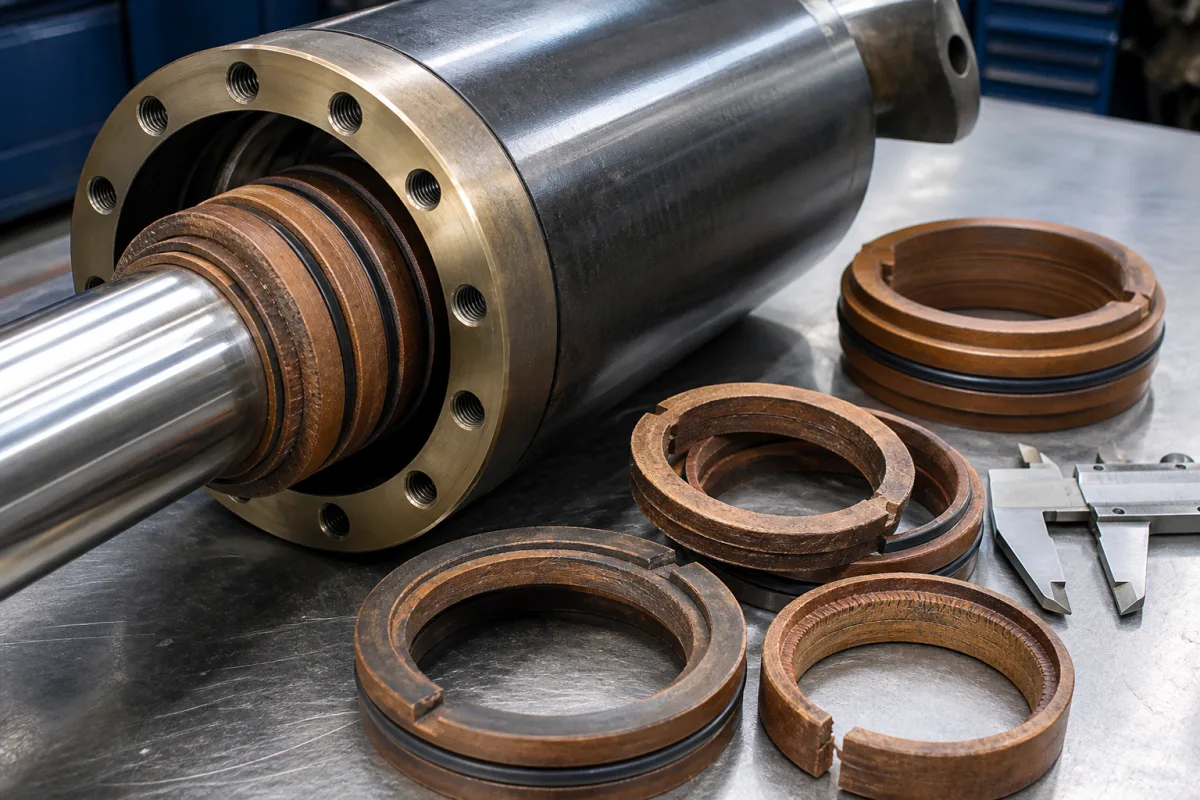
Leather piston seals and packings for hydraulic and pneumatic cylinders, presses, jacks and pumps · cups, U-packings, flanges, vee packings and washers, packing-leather grade and thickness, tensile strength, impregnation (wax, oil, resin, synthetic rubber), temperature and pressure, comparison with rubber and plastic seals
A leather piston seal is a cup, U-packing, flange or vee ring cut and moulded from tanned leather that seals a piston or ram in a hydraulic or pneumatic cylinder, press, hoist or hand pump; flat leather washers and back-up washers are cut from the same material. The leather is impregnated so that it does not pass fluid or air. Ask three things first: the seal form and dimensions your cylinder needs; the leather grade, tannage and impregnation for your fluid; and the pressure and temperature it must hold.
Leather cup, U-, flange and vee packings for pistons, plungers and rams, and leather washers used as flat gaskets or back-up rings in hydraulic and pneumatic equipment. Rubber, polyurethane and PTFE seals, O-rings, rotary shaft oil seals and leather belting are outside this page except where compared.
CNFX editorial research · Sources checked October 18, 2026 · 5 sources
Page Belting lists cups for air engines, hoists, presses and hand pumps; U-packings for plungers, rams and sealing pistons; vee packings for pistons and rods; and flange packings for rods or shafts. Its ordering information calls for a dimensioned sketch, equipment, contact gas or liquid, operating temperature and pressure. These identify the seal and its service rather than establish a pressure rating. [5]
The 2005 Power & Motion product note on CW Marsh gives 30–150 °F for the packings it describes. Use that dated product statement with its maker/application context, and obtain the limit for the actual leather, treatment and fluid being ordered. [3]
US patent 2,494,598, filed in 1947 and published in 1950, describes leather grooved rings combined with synthetic-rubber rings as giving comparatively low-pressure service and improved results up to 1,000 psi. Its preferred plastic-ring construction, with PTFE identified as preferred, targets approximately 3,000 psi and sometimes higher. Those are different material constructions in a historical patent; the higher figure is not a leather-seal rating, and neither figure certifies a present supplier’s packing. [4]
CW Marsh describes impregnating leather with greases, oils, waxes, synthetic resins or synthetic rubber for the application. Its page discusses conformity to worn or out-of-true bores and reports a paint-pump customer’s experience with synthetic-rubber-impregnated leather used alongside plastic seals. These are attributed application statements; assess bore condition, fluid and sliding duty with the seal supplier. [2]
Give the supplier a dimensioned sketch (bore or outside diameter, inside diameter or rod size, height and leather thickness), the seal form (cup, U, flange, vee, washer), the equipment (press, jack, hoist, pump, air cylinder), the fluid or gas in contact, the operating pressure and temperature, the speed and stroke, the impregnation wanted, and the quantity.
02
Specify the leather, tannage and impregnation
Bureau of Standards Circular 340 is a 1927 US government specification for vegetable-tanned hydraulic packing leather, rather than a current finished-seal qualification. It specifies oak-bark or combined vegetable tannage and full-grain leather. Grade A thickness is 10/64 up to 12/64 inch, B is 12/64 up to 14/64 inch, and C is 14/64 up to 16/64 inch. Its cracking test bends the leather 180 degrees over a ½-inch-diameter rod, grain outward. Minimum tensile strength is 3,000 psi and average tensile strength at least 3,500 psi. Stretch is limited to 15% over a 2-inch gauge length at 2,500 psi; this is stretch at a specified stress, not elongation at break. Water absorption is limited to 15% after a room-temperature 30-minute soak followed by wiping/blotting and reweighing. [1]
Impregnation must be selected with the fluid: CW Marsh lists greases, oils, waxes, synthetic resins and synthetic rubber, while the 2005 product note lists greases, oils, waxes or rubber for lubricity and sealability. Neither description supplies a universal oil-swelling percentage or a finished-seal working-pressure curve. [2][3]
For chrome-tanned or combination-tanned material, obtain that material’s own test method, results and treatment. The vegetable-tanned requirements in Circular 340 apply to its specified leather; they do not qualify another tannage or establish service life. [1]
03
Match the replacement packing to the cylinder drawing
A cup, U-packing and vee stack have different profiles and seating arrangements. Include the bore and rod sizes, packing section, installed height, support rings and orientation in the drawing sent with the equipment and fluid details. Page Belting’s listed forms and sketch requirement provide the starting point for that identification. [5]
04
Identify the leather profile, treatment and supporting rings
Greases, oils, waxes, resins or synthetic rubber. [2]
Impregnant for the fluid.
Rubber energiser ring
Synthetic-rubber ring combined with a leather grooved ring in the historical patent; its up-to-1,000-psi observation is specific to that construction. [4]
The historical patent describes improved results up to 1,000 psi for its leather/synthetic-rubber combination; this is not a general present-product rating. [4]
Rated pressure for the actual profile, support, bore clearance and fluid.
Explore company information and manufacturing capabilities, then discuss the scope of your project with a relevant supplier.
Share this page
Compiled and source-reviewed by the CNFX editorial team.
Each manufacturer above links to the page on that company's own website where the product is listed, with the date we checked it. How we source and review
· Page last updated 13 October 2026
Buyer questions
What leather is used for hydraulic packings?
Circular 340 (1927) specifies oak-bark or combined vegetable-tanned full-grain leather, with grade-dependent thickness from 10/64 up to 16/64 inch. It is a historical leather-material specification; obtain the current offered packing’s own material and duty data. [1]
What are leather seals impregnated with?
CW Marsh lists greases, oils, waxes, synthetic resins or synthetic rubber, chosen for the application. [2]
How do leather seals compare with plastic rings at high pressure?
The 1950 patent describes improved results up to 1,000 psi for its leather grooved rings combined with synthetic-rubber rings, while preferring plastic rings at higher pressure. Its approximately 3,000-psi aim concerns the preferred plastic construction; neither statement is a universal or current leather-product rating. [4]
Sources and what still needs a direct check
Sources checked 2026-10-18. Sources are a US government leather specification, a US patent, two leather packing makers' pages and a trade-press product note; values for your seal must come from the supplier's tests.